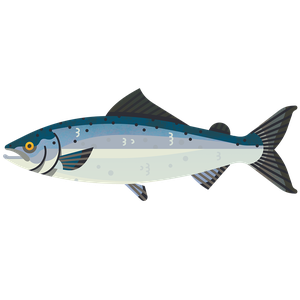
Atlantic salmon
What to check for
Europe: Ireland, All areas; UK, Scotland
Open net pen, marine
Organic
Rating summary
Atlantic salmon are farmed in open net pens in the sea. Producing fish in open systems can cause environmental impacts. Organic Certification Standards set comprehensive standards to help mitigate environmental concerns, including discharge of effluents, limited use of chemicals, escapes, disease and parasite interactions. Feed must be preferentially produced from off-cuts and by-products of human consumption fisheries which ensures that organic farmed salmon are a net producer of fish protein. All terrestrial feed ingredients must be organically certified which ensures their responsible sourcing.
This rating is based on full compliance with certification requirements. Commercial buyers should therefore ensure that full compliance has been achieved in order for this rating to be applicable.
Rating last updated January 2023.
How we worked out this Rating
References
BIM (2023). Co-ordinated Local Aquaculture Management Systems (C.L.A.M.S.). Available at: https://bim.ie/aquaculture/advisory-services/co-ordinated-local-aquaculture-management-systems-clams/#:~:text=The%20unique%20Co%2Dordinated%20Local,interests%20with%20relevant%20national%20policies [Accessed 18.01.2023]
Council Regulation (EC) No 708/2007 of June 2007 concerning the use of alien and locally absent species in aquaculture. Available at: https://eur-lex.europa.eu/legal-content/EN/TXT/?uri=celex%3A32007R0708 [Accessed 18.01.2023]
Cornwall Good Seafood Guide (2017). Ballan Wrasse. Available at: https://www.cornwallgoodseafoodguide.org.uk/fish-guide/ballan-wrasse.php [Accessed 16.01.2023]
DEFRA (2015). United Kingdom Multiannual National Plan for The Development of Sustainable Aquaculture. Available at: https://assets.publishing.service.gov.uk/government/uploads/system/uploads/attachment_data/file/480928/sustainable-aquaculture-manp-uk-2015.pdf [Accessed 18.01.2023]
Dube, K. and Chanu, T. (2012). Organic Aquaculture: Way to sustainable production. Advances in Fish Research, pp.219-229. Available at: https://www.researchgate.net/publication/262903857_Organic_Aquaculture_Way_to_sustainable_production [Accessed 16.01.2023]
EU (2018). Regulation (EU) 2018/848 of the European Parliament and of the Council of 30 May 2018 on organic production and labelling of organic products and repealing Council Regulation (EC) No 843/2007. Available at https://eur-lex.europa.eu/legal-content/EN/TXT/?uri=CELEX%3A02018R0848-20220101&qid=1673266465785 [Accessed 09.01.2023]
Esaiassen, M., Jensen, T., Edvinsen, G., Otnæs, C., Ageeva, T. and Mæhre, H. (2022). Nutritional value and storage stability in commercially produced organically and conventionally farmed Atlantic salmon (Salmo salar L.) in Norway. Applied Food Research, 2(1), 100033. Doi: https://doi.org/10.1016/j.afres.2021.100033.
Explanatory Memorandum To: The Animal Health, Alien Species in Aquaculture and Invasive Non-native Species (Amendment etc.) (EU Exit) Regulations 2019. Available at: http://www.legislation.gov.uk/uksi/2019/813/pdfs/uksiem_20190813_en.pdf [Accessed 18.01.2023]
FAO (2011). FAO Regional Training on the Principles of Cage Culture in Reservoirs. Available at: http://www.fao.org/fileadmin/templates/SEC/docs/Fishery/Fisheries_Events_2012/Principles_of_cage_culture_in_reservoirs/Mooring_Systems.pdf [Accessed 11.01.2023]
FAO (2023). Salmo salar. Cultured Aquatic Species Information Programme. Text by Jones, M. Fisheries and Aquaculture Division [online]. Rome. Updated 2004-11-25. Available at https://www.fao.org/fishery/en/culturedspecies/salmo_salar/en [Accessed 25.01.2023]
Government of Ireland (2022). National Marine Planning Framework. Available at https://www.gov.ie/en/publication/a4a9a-national-marine-planning-framework/ [Accessed 18.01.2023]
IFOAM (2010). Organic Aquaculture: EU Regulations (EC) 834/2007, (EC) 889/2008, (EC) 710/2009 Background, Assessment, Interpretation. Part VI Challenges Facing the Organic Aquaculture Sector, p.1-34. Available at: https://webgate.ec.europa.eu/maritimeforum/system/files/P4%20IFOAMorganic_aquaculture_dossier.pdf [Accessed 26.01.2023]
IOFGA (2022). Organic Food and Farming Standards in Ireland. Edition 2, Issue 1, 01.01.2022, pp.6-370. Available at: https://www.irishorganicassociation.ie/wp-content/uploads/Organic-Standard_Ed-2.0_16_12_21-2.pdf [Accessed 09.01.2023]
Marine Harvest (2022). Salmon Farming Industry Handbook 2022. Available at https://mowi.com/wp-content/uploads/2022/07/2022-Salmon-Industry-Handbook-1.pdf [Accessed 11.01.2023]
Martsikalis, P., Gkafas, G., Palaiokostas, C. and Exadactylos, A. (2019). Chapter 4: Genomics Era on Breeding Aquaculture Stocks, pp.65-77. In: Lembo, G and Mente, E. (eds) Organic Aquaculture - Impacts and Future Developments. Doi: https://doi.org/10.1007/978-3-030-05603-2_4 [Accessed 16.01.2023]
Misters, A. and Purchase, D. (2021). Use of ‘Cleaner Fish’ in UK aquaculture: Current use, concerns and Recommendations. Marine Conservation Society’s Cleaner Fish Position Paper, 33pp. Available at https://media.mcsuk.org/documents/Use_Of_Cleaner_Fish_in_UK_Aquaculture-_2021.pdf [Accessed 16.01.2023]
Monterey Bay Aquarium Seafood Watch (2021a). Atlantic Salmon (salmo salar), Norway Marine Net Pens. Available at: https://www.seafoodwatch.org/recommendation/salmon/atlantic-salmon-38266?species=302 [Accessed 11.03.2023]
Monterey Bay Aquarium Seafood Watch (2021b). Atlantic Salmon (salmo salar), Scotland Marine Net Pens. Available at: https://www.seafoodwatch.org/recommendation/salmon/atlantic-salmon-31565?species=302 [Accessed 11.01.2023]
Powell, A., Tresurer, J., Pooley, C., Keay, A., Lloyyd, R., Imsland, A. and Garcia de Leaniz, C. (2018). Use of lumpfish for sea lice control in salmon farming: challenges and opportunities. Reviews in Aquaculture, Volume 10, pp.683-702. Doi: https://doi.org/10.1111/raq.12194 [Accessed 16.01.2023]
Regulation (EU) No 1143/2014 of the European Parliament and of the Council of 22 October 2014 on the prevention and management of the introduction and spread of invasive alien species. Available at https://eur-lex.europa.eu/legal-content/EN/TXT/?uri=CELEX%3A32014R1143&qid=1674050750037 [Accessed 18.01.2023]
Scottish Government (2015). Scotland’s National Marine Plan. Available at: https://www.gov.scot/publications/scotlands-national-marine-plan/ [Accessed 18.01.2023]
Scottish Government (2021a). National Marine Plan Review 2021: Three Year Report on the effectiveness of Scotland’s National Marine Plan. Available at https://marine.gov.scot/sites/default/files/national_marine_plan_review_2021.pdf [Accessed 20.01.2023]
Scottish Government (2021b). Scottish Fish Farm Production Survey 2021. available at: https://www.gov.scot/publications/scottish-fish-farm-production-survey-2021/ [Accessed 16.01.2023]
Scottish Government LINK (2021). Protecting marine mammals around Scottish aquaculture farms. Available at https://www.scotlink.org/protecting-marine-mammals-around-scottish-aquaculture-farms-2/?utm_source=rss&utm_medium=rss&utm_campaign=protecting-marine-mammals-around-scottish-aquaculture-farms-2 [Accessed 03.03.2023]
Seafish (2020). Atlantic Salmon – salmo salar: profile last updated 16 November 2020. Available at: https://www.seafish.org/responsible-sourcing/aquaculture-farming-seafood/species-farmed-in-aquaculture/aquaculture-profiles/atlantic-salmon/ [Accessed 09.01.2023]
Seafish (2023). Seafood Trade Data. Available at https://www.seafish.org/insight-and-research/seafood-trade-data/ [Accessed 16.01.2023]
SEPA (2023). River Basin Management Planning. Available at https://www.sepa.org.uk/environment/water/river-basin-management-planning/ [Accessed 18.01.2023]
Skaala, O., Besnier, F., Borgstrom, R., Barlaup, B., Sorvik, A., Normann, E., Ostebo, B., Hansen, M. and Glover, K. (2019). An extensive common-garden study with domesticated and wild Atlantic salmon in the wild reveals impact on smolt production and shifts in fitness traits. Evolutionary Applications, Volume 12, Issue 5, pp.1001-1016. Doi: https://doi.org/10.1111/eva.12777 [Accessed 16.01.2023]
Soil Association (2021). Soil Association Standards Aquaculture. Version 18.7: updated 12th October 2021, pp.3-78. Available at: https://www.soilassociation.org/media/18614/aquaculture-standards.pdf [Accessed 09.01.2023]
Statista (2022). Import volume of salmon (inc. smoked) in the United Kingdom (UK) from 2006 to 2018 (in 1,000 tons). Available at: https://www.statista.com/statistics/316413/salmon-import-volume-in-the-united-kingdom-uk/ [Accessed 26.01.2023]
Steinnes, K., Amilien, V. and Vitterso, G. (2019). Organic Salmon in Norway. Sustainability of European Food Quality Schemes, pp.529-548. Available at: https://link.springer.com/chapter/10.1007/978-3-030-27508-2_27 [Accessed 16.01.2023]
Stokes, K., O’Neil, K. and McDonald, R. (2004) Invasive Species in Ireland. Unpublished report to Environment & Heritage Service and National Parks & Wildlife Services. Quercus, Queens University Belfast, Belfast.
The Alien and Locally Absent Species in Aquaculture (Scotland) Regulations 2015. Available at: http://www.legislation.gov.uk/ssi/2015/103/contents/made [Accessed 18.01.2023]
The Animal Health, Alien Species in Aquaculture and Invasive Non-native Species (Amendment etc.) (EU Exit) Regulations 2019. Available at: http://www.legislation.gov.uk/uksi/2019/813/contents/made [Accessed 18.01.2023]
The Aquatic Animal Health, Alien Species in Aquaculture (Amendment) (Northern Ireland) (EU Exit) Regulations 2019. Available at: http://www.legislation.gov.uk/uksi/2019/581/contents/made [Accessed 18.01.2023]