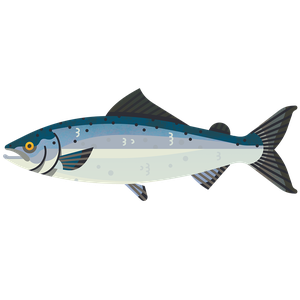
Atlantic salmon
What to check for
South America: Chile, All areas
Open net pen, marine
Rating summary
Atlantic salmon is Chile are farmed in open net pens in the sea. Producing fish in open systems can cause environmental impacts such as: impacts of chemical and sea lice treatment usage; nutrient and organic waste deposition; outbreaks of disease; impacts on wild salmonids by transmission of sea lice, and escapes from farms. In Chile, the regulation and management of the aquaculture industry is poor in relation to other salmon producing countries. There is also a lack of evidence of welfare measures in place. Salmon are carnivorous fish and rely on wild capture fisheries to produce their feed, MCS would like to see all these fish certified as sustainably managed. Due to the ongoing nature of as yet unresolved environmental impacts of salmon farming MCS is advocating a halt in industry expansion using existing practices until these can be resolved.
Rating last updated May 2023.
How we worked out this Rating
References
BioMar, 2022. Global Sustainability Report. Available at https://www.biomar.com/globalassets/.global/sustainability-report/biomar-global-sustainability-report-2022.pdf [Accessed on 28.04.2023].
BioMar, 2022. Marine Ingredients Position Statement. Available at https://www.biomar.com/globalassets/.global/pdf-files/2022-03-en_position-statement_marine-ingredients_ver.1_digital.pdf [Accessed on 01.11.2022].
Cargill, 2021. Cargill Aqua Nutrition Sustainability Report. Available at: https://www.cargill.com/doc/1432219325606/cargill-aqua-nutrition-sustainability-report-2021.pdf [Accessed on 01.11.2022].
Charles Ehler, personal communication via email, 26.08.2019.
FAO. Chile. Available at https://firms.fao.org/fi/website/FIRetrieveAction.do?dom=countrysector&xml=naso_chile.xml&lang=en [Accessed on 28.04.2023].
Intrafish. 2019. Here are the largest recorded farmed Atlantic salmon escapes in history. Available at https://www.intrafish.com/aquaculture/here-are-the-largest-recorded-farmed-atlantic-salmon-escapes-in-history/2-1-388082 [Accessed on 15.04.2020].
Monterey Bay Aquarium Seafood Watch. 2021. Atlantic and Coho Salmon. Chile. Marine Net Pens. Available at https://www.seafoodwatch.org/globalassets/sfw-data-blocks/reports/s/mba_seafoodwatch_atlantic_coho_salmon_chile.pdf [Accessed on 28.04.2023].
OECD. 2011. - Chile going green- , in Maintaining Momentum: OECD Perspectives on Policy Challenges in Chile, OECD Publishing, Paris. Available at https://www.oecd-ilibrary.org/economics/maintaining-momentum/chile-going-green_9789264095199-11-en;jsessionid=cd7x4FtNd-hdqANOV4gQCHZCBDtMAQOPpIkIBHID.ip-10-240-5-186 [Accessed on 15.05.2023].
Quinones, R. A., Fuentes, M., Montes, R. M., Soto, D. and Leon-Munoz, J. 2019. Environmental issues in Chilean salmon farming: a review. Reviews in Aquaculture, 11(375-402). Available at https://onlinelibrary.wiley.com/doi/pdf/10.1111/raq.12337 [Accessed on 15.05.2023].
Skretting. 2019. Sustainability Report. Available at https://www.skretting.com/siteassets/global-files/nuterra/sustainability-report-2019/skretting-sustainability-report-2019.pdf [Accessed on 09.09.2020].
Skretting. 2020. Sustainable soy. Available at https://www.skretting.com/en/sustainability/ingredients/sustainable-soy/ [Accessed on 12.02.2020].
Skretting. 2020. Sustainable soy. Available at https://www.skretting.com/en/sustainability/ingredients/sustainable-soy/ [Accessed on 13.04.2020].
The David & Lucile Packard Foundation. 2019. Chile Marine Strategy 2019-2021. Available at https://www.packard.org/wp-content/uploads/2019/01/Chile-Marine-Strategy-2019-2021-02.19.pdf [Accessed: 26.08.2019].
Undercurrent News. 2020. Cargill to win Chile market share with settlements over feed price-fixing. Available at https://www.undercurrentnews.com/2020/02/13/cargill-to-win-chile-market-share-with-settlements-over-feed-price-fixing/ [Accessed on 13.04.2020].