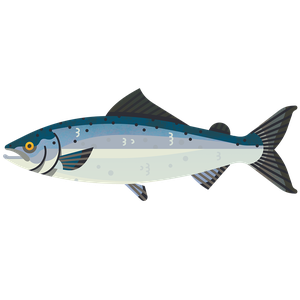
Atlantic salmon
What to check for
Europe: Faroe Islands, All areas
Open net pen, marine
Rating summary
Atlantic salmon in the Faroe Islands are farmed in open net pens in the sea. Producing fish in open systems can cause environmental impacts such as: impacts of chemical and sea lice treatment usage; nutrient and organic waste deposition; outbreaks of disease; impacts on wild salmonids by transmission of sea lice, and escapes from farms. However, in the Faroe Islands, there are low levels of pathogens and sea lice are effectively managed. Salmon are carnivorous fish and rely on wild capture fisheries to produce their feed, MCS would like to see all these fish certified as sustainably managed. Due to the lack of data in relation to some of the environmental impacts of salmon farming, MCS is advocating a halt in industry expansion using existing practices until more evidence is available.
Rating last updated May 2023.
How we worked out this Rating
References
Bakkafrost. 2022. Healthy Living Sustainability Report. Available at https://bakkafrost.cdn.fo/media/4133/healthy_living_web_22.pdf?s=4TP2oDleZvy-4-Ln4NJsfaFZPEQ [Accessed on 10.05.2023].
Coram, A., Mazilu, M. and Northridge, S. 2016. Plugging the Gaps - Improving Our Knowledge of How Predators Impact Salmon Farms. A study commissioned by the Scottish Aquaculture Research Forum (SARF). Available at http://www.sarf.org.uk/cms-assets/documents/245877-466609.sarf097.pdf [Accessed on 10.05.2023].
Eliasen, K., Danielsen, E., Johannesen, Á., Joensen, L. J. and Patursson, E. J. 2018. The cleaning efficacy of lumpfish (Cyclopterus lumpus L.) in Faroese salmon (Salmo salar L.) farming pens in relation to lumpfish size and seasonality. Aquaculture. 488:61-65. Available at https://fiskaaling.fo/media/2249/2018_kirstineliasen_et_al.pdf [Accessed on 10.05.2023].
FAROEISLANDS.FO. 2019. Faroese Salmon Renowned Around the World. Available at https://www.faroeislands.fo/economy-business/aquaculture/ [Accessed on 10.05.2023].
Global salmon initiative. Sustainability Report. Available at https://globalsalmoninitiative.org/en/sustainability-report/sustainability-indicators/ [Accessed on 10.05.2023].
Intrafish. 2020. Bakkafrost loses 1 million salmon in monster storm. Available at https://www.intrafish.com/salmon/bakkafrost-loses-1-million-salmon-in-monster-storm/2-1-769191?utm_source=Intrafish%20Europe%20Newsletter&utm_campaign=145a681a99-EMAIL_CAMPAIGN_2020_03_09_09_21&utm_medium=email&utm_term=0_6ee671474e-145a681a99-245302819 [Accessed on 07.04.2020].
Monterey Bay Aquarium Seafood Watch. 2022. Atlantic Salmon: Salmo salar. Faroe Islands. Marine Net Pens. Available at https://www.seafoodwatch.org/globalassets/sfw-data-blocks/reports/s/seafood-watch-farmed-salmon-faroes-27921.pdf [Accessed on 10.05.2023].
Niels Winther, pers comm by email on 8th June 2020.
Norði, G., Glud, R., Simonsen,K., Gaard, E. 2018. Deposition and benthic mineralization of organic carbon: A seasonal study from Faroe Islands. Journal of Marine Systems 177 (2018) 53-61. Available at https://www.sciencedirect.com/science/article/abs/pii/S0924796316302858 [Accessed on 10.05.2023].
Norði, G., Glud, R.N., Gaard, E. and Simonsen, K., 2011. Environmental impacts of coastal fish farming: carbon and nitrogen budgets for trout farming in Kaldbaksfjørður (Faroe Islands). Marine Ecology Progress Series, 431, pp.223-241. Available at https://www.int-res.com/abstracts/meps/v431/p223-241/ [Accessed on 10.05.2023].
Øssur M. Dalbúð, pers comm by email on 1st September 2023.
Salmon from the Faroe Islands. Sustainability. Fish Welfare. Available at http://salmon-from-the-faroe-islands.com/fishwelfare.html [Accessed on 10.05.2023].
Skretting. 2019. Sustainability Report. Available at https://www.skretting.com/siteassets/global-files/nuterra/sustainability-report-2019/skretting-sustainability-report-2019.pdf [Accessed on 09.09.2020].
Skretting. 2020. Sustainable soy. Available at https://www.skretting.com/en/sustainability/ingredients/sustainable-soy/ [Accessed on 12.02.2020].
Sundt-Hansen, L., Huisman, J., Skoglund, H. and Hindar, K. 2015. Farmed Atlantic salmon Salmo salar L. parr may reduce early survival of wild fish. Journal of Fish Biology, 86, pp. 1699-1712. Available at https://onlinelibrary.wiley.com/doi/abs/10.1111/jfb.12677 [Accessed on 01.05.2023].