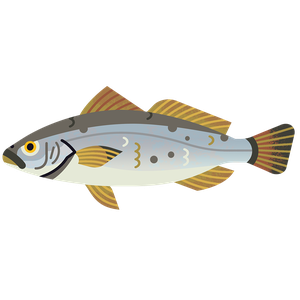
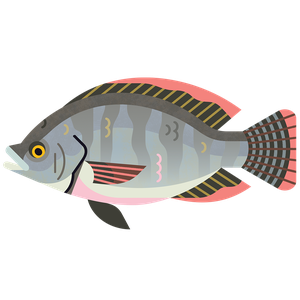
Gilthead bream
Sparus auratus
What to check for
Location
All areas
Production method
Open net pen, marine
Certification
Aquaculture Stewardship Council (ASC)
Rating summary
ASC farmed sea bream is well managed and management is thought to be fully effective. The standard mitigates many areas of environmental concern in open net pen aquaculture, including discharge of effluents, use of chemicals, escapes, disease and parasite interactions. Criteria on responsible feed sourcing requires it to be traceable, however, sourcing of marine ingredients is not verified via audit and ASC certified bream can use a high quantity of wild caught fish in their diet. Criteria on animal welfare is also lacking, with no requirements for humane slaughter.This rating is based on full compliance with certification requirements. Commercial buyers should therefore ensure that full compliance has been achieved in order for this rating to be applicable.Rating last updated: November 2022
Technical consultation summary
ASC farmed sea bream is well managed and management is thought to be fully effective. The standard mitigates many areas of environmental concern in open net pen aquaculture, including discharge of effluents, use of chemicals, escapes, disease and parasite interactions. Criteria on responsible feed sourcing requires it to be traceable, however, sourcing of marine ingredients is not verified via audit and ASC certified bream can use a high quantity of wild caught fish in their diet. Criteria on animal welfare is also lacking, with no requirements for humane slaughter.
How we worked out this Rating
Feed
What feed is given to farmed fish, where it comes from and how much is used is one of the most important aspects of fish farming. In this section we look at how sustainable the feed is and how much fish is included in the diet.
The ASC standard requires feed used in bass and bream aquaculture to be traceable and some requirements are in place for responsible ingredient sourcing. However, responsible sourcing of marine ingredients is not verified via audit and ASC-certified bass and bream can use a high quantity of wild caught fish in their diet.Seabass and bream are fed on a commercial, pelleted feed that comprises fishmeal, fish oil and vegetable proteins and oils. The ingredients are traceable however, their sustainability is not always verified via audit.The marine component of the feed (fish meal and fish oil) comes from a feed manufacturer with a public facing responsible sourcing policy in place, however, the implementation of this is not verified by third party audit. Although bass and bream are good feed convertors, they still require more wild fish protein than they produce, making them a net consumer of protein.From September 2023, 80% of soy and palm oil must come from sources certified by an ISEAL members certification, this includes Rainforest Alliance, Roundtable for Sustainable Palm Oil (RSPO) and the Roundtable for Responsible Soy Production. The use of novel and alternative feed ingredients is not required in the ASC certification.
Environment
The environmental impacts of aquaculture depend on what fish is farmed, how and where. It could be habitat damage, chemical use, pollution, freshwater use or parasites. In this section we look at the environmental impacts of greatest concern for that species and production method. Some species, such as shellfish, have very little impact, whilst others may give us cause for concern.
Seabass and bream farming in marine net pens can have negative environmental impacts. However, many of these impacts are mitigated by ASC certification.Farmed bass and bream in marine net pens does not deplete local freshwater supplies. Habitat alteration is also small scale through the use of mooring grids only. All juveniles are sourced from hatcheries.Although production systems do discharge directly into the aquatic environment, the ASC standard has indicators to ensure that all biological and non-biological waste produced by the farm is recycled, reused or disposed of properly and does not affect neighbouring communities. Chemicals are also used but are effectively regulated by the ASC standard.Parasitic transfer from farmed bass and bream to adjacent wild species is hard to prove and has rarely been documented, therefore, the environmental impact is unknown. However, the ASC standard has requirements that seek to ensure proactive health management on the farm through comprehensive health management plans and up to date record keeping systems. The same systems are in place for bacterial and disease outbreaks.In open net pen aquaculture, there is a potential risk of escapes. However, the ASC standard addresses farmed fish escapes through a rigorous farm management system. Farm management measures also prevent the use of lethal control on predators (unless worker safety is at risk).
Fish health and welfare
Fish health and welfare is a concern for many consumers. High welfare standards are an indication of good farm management, we look to see if there are industry wide welfare standards in place, and if these include humane slaughter.
The ASC seabass, sea bream and meagre standard does not cover animal welfare and humane slaughter.In the European seabass and bream sector, it is common and predominant industry practice to use immersion in an icy slurry as a method to slaughter the fish upon harvest.
Management
How aquaculture is regulated and how effective those regulations are is an important aspect of farmed fish production. We also look to see if aquaculture is included in broader environmental management plans. In this management section we also award scores for globally recognised certification standards, as certified seafood requires verification of environmental performance and traceability.
ASC farmed bass and bream are well managed and management is thought to be fully effective.Both the EU and Turkey have committed to zonal based management of aquaculture. The ASC standard has criteria in place to cover the use of land water resources, discharge including effluents and their impacts, biosecurity and disease management. Certification criteria are also thought to be fully effective in minimising environmental impacts.The ASC standards cover the main environmental and social impacts of aquaculture, including fish health, feed and fair employment conditions, by setting metric based indicators. Farms are assessed annually by external auditors and results published. ASC products are traceable throughout the supply chain. ASC is the only ISEAL compliant aquaculture certification scheme.
References
Aquaculture Stewardship Council (ASC). 2019. ASC Seabass, Seabream and Meagre Standard – version 1.1 – March 2019. Available at https://www.asc-aqua.org/wp-content/uploads/2019/03/ASC-Sea-Bass-Seabream-and-Meagre-Standard_v1.1_Final.pdf [Accessed on 25.10.2022].
Arechavala-Lopa, P. Toldeo-Guedes, K. et al. 2018. Implications of Sea Bream and Sea Bass Escapes for Sustainable Aquaculture Management: A Review of Interactions, Risks and Consequences. Reviews in Fisheries Science and Aquaculture. 28(214-234).
BioMar. 2021. Global Sustainability Report. Available at https://www.biomar.com/globalassets/.global/sustainability-report/en_biomar-global-sustainability-report-2021.pdf [Accessed on 25.10.2022].
Cardia, F. and Lovatelli, A. 2017. Aquaculture operations in floating HDPE cages. A field handbook. FAO Fisheries and Aquaculture Technical Paper 593.
Compassion in World Farming (CWF). 2018. Humane Slaughter: Gilthead sea bream and European sea bass. Available at https://www.compassioninfoodbusiness.com/media/7434843/humane-slaughter-european-sea-bass-and-gilthead-sea-bream.pdf [Accessed on 25.10.2022].
European Commission. 2021. Strategic guidelines for a more sustainable and competitive EU aquaculture for the period 2021 to 2030. Available at https://ec.europa.eu/info/law/better-regulation/have-your-say/initiatives/12261-EU-fish-farms-aquaculture-updated-guidelines_en [Accessed on 25.10.2022].
FAO. 2020. Fishery and Aquaculture Statistics. Global production by production source 1950-2018 (FishstatJ). In: FAO Fisheries and Aquaculture Department [online]. Rome. Updated 2020. Available at www.fao.org/fishery/statistics/software/fishstatj/en [Accessed on 25.10.2022].
FEFAC SOY SOURCING GUIDELINES 2021. Available at https://fefac.eu/wp-content/uploads/2021/02/FEFAC-Soy-Sourcing-Guidelines-2021-1.pdf [Accessed on 15.10.2022].
Fishsource. 2021. Aquaculture Profiles. Seabass/seabream. Turkey. Available at https://www.fishsource.org/ama_page?id=91 [Accessed on 25.10.2022].
Mladineo I, Šegvić-Bubić T, Stanić R, Desdevises Y. 2013. Morphological Plasticity and Phylogeny in a Monogenean Parasite Transferring between Wild and Reared Fish Populations. PLOS ONE 8(4): e62011.
Prevent Escape. 2013. Prevent Escape Project Compendium. Available at https://issuu.com/oceanografica/docs/prevent_escape [Accessed on 25.10.2022].
Rodrigo Orrego. 2018. Fish Farming Expert: Fish Farming School. Available at https://www.fishfarmingexpert.com/fishfarming-school/1265835 [Accessed on 25.10.2022].
Roundtable on Responsible Soy. Version 4.0 2021. Available at https://responsiblesoy.org/documentos/rtrs-standard-for-responsible-soy-production-v4-0?lang=en#:~:text=0,-Last%20approved%20Version&text=Generic%20standard%20setting%20out%20Requirements,conformity%20in%20certified%20production%20sites [Accessed on 15.10.2022].
RSPO Principles and Criteria for the Production of Sustainable Palm Oil. 2018. Available at https://rspo.org/standards [Accessed on 25.10.2022].
Seafish. Aquaculture Profiles. European Sea Bass. Feed. Available at https://www.seafish.org/responsible-sourcing/aquaculture-farming-seafood/species-farmed-in-aquaculture/aquaculture-profiles/european-sea-bass/feed/ [Accessed on 07.12.2022].
Skretting. 2021 Sustainability report. Available at https://www.skretting.com/siteassets/global/sustainability/pdfs/pdf-interactive-skretting-sustainability-report-2021.pdf?v=4a2cef [Accessed on 25.10.2022].
Skretting. Soy and oil palm ingredients sourcing policy – roadmap 2025. Available at https://www.skretting.com/globalassets/shared-documents/sustainability/201203-nutreco-soy-and-oil-palm-ingredients-sourcing-policy.pdf?v=4af3f1 [Accessed on 25.10.2022].
Tornero, V. and Hanke, G. 2016. Chemical contaminants entering the marine environment from sea-based sources: A review with a focus on European seas. Marine Pollution Bulletin. 112(1-2).
WWF. 2021. Sea bass and sea bream supply chain study: from Turkey to Europe. Fish Forward Project: Responsible seafood consumption for the benefit of people, oceans and climate. Published by WWF-UK. Available at https://www.fishforward.eu/wp-content/uploads/2021/07/WWF_supply_chain_study_2021_seabass_seabream.pdf [Accessed on 25.10.2022].
Sustainable swaps
Learn more about how we calculate our sustainability ratings.
How our ratings work
Add impact to your inbox
Join the movement: get updates on the issues you care about.
We'll email you inspiring stories about the work we're doing to save and recover our oceans, and news about our urgent campaigns for positive change.