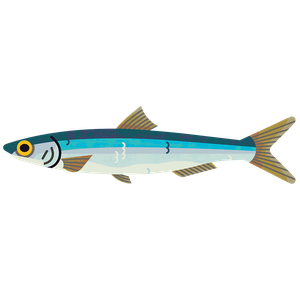
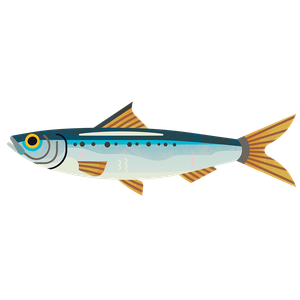
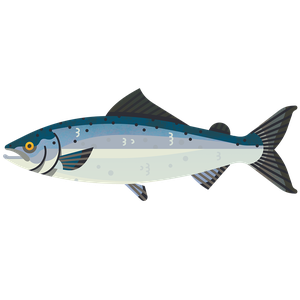
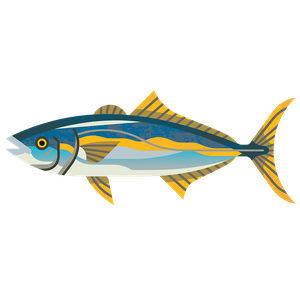
Horse mackerel
Trachurus trachurus
What to check for
Location
Skagerrak and Kattegat, North Sea (Central and South), English Channel (East). North Sea stock.: All areas
Technical location
27 - Atlantic, Northeast, 7d: English Channel (East), 4b: North Sea (Central), 4c: North Sea (South), 3a: Skagerrak and Kattegat
Caught by
Net (pelagic trawl)
Rating summary
There is limited data on the horse mackerel population (or stock) in this region. There is indication that populations are at lowest historic levels due to over-fishing. There is no management plan in place, but some management measures include total allowable catch limits. Mid-water or pelagic trawlers target horse mackerel with very little to no bycatch of other species and limited impact on the seabed.Rating last updated November 2023.
How we worked out this Rating
Stock status
The size and health of a fish population, or 'stock', that is being targeted by fishermen is a crucial indicator of whether a fishery is sustainable. If the stock is too small to withstand fishing, it is at risk of crashing. We look at how big the stock is, and how much pressure there is from fishing, to assess this. The target level that many fisheries aim for is 'Maximum Sustainable Yield' - the most fish that can be caught year after year whilst keeping the population at a healthy size.
There is limited data on the horse mackerel population (or stock) in this region and trends are used to indicate its state. There is concern for the biomass and for fishing pressure.Route 2 scoring has been applied to this rating owing to the lack of reference points for fishing pressure and biomass. Horse mackerel has a medium resilience to fishing pressure. Reference points for biomass (B) are not defined, so trends in abundance index (fish >20 cm length in the population (or stock)) are used instead. A proxy for FMSY (the maximum rate of fishing mortality, i.e. the proportion of a fish stock caught and removed by fishing, that can sustain a healthy population level), is provided within the assessment.Since 1992 the abundance of horse mackerel has shown a mostly continuous decline, and recent surveys indicate the stock remains at historically low levels. The 2023 stock assessment shows the average abundance of fish (2021-2022) to have increased from the previous three-year period. In 2022, the abundance of fish increased from the previous year (122 to 265) but remains at one of the lowest points in the time series (1992-2022). Historic catch data shows 2009 to be at one of the highest levels within the time-series, coinciding with a significant decline in abundance, thereafter, decreasing 82% from 46,919 tonnes (2009) to 8,377 tonnes (2022). In 2022, ICES assessed that fishing pressure on the stock was above the FMSY proxy (fishing at the maximum sustainable yield).ICES advises that when the MSY approach is applied, catches should be no more than 9,730 tonnes in each of the years 2024 and 2025. The catch advice has been increased mainly because of the increase in the abundance index, and the change in the advice rule.Horse mackerel in the Northeast Atlantic is separated into three stocks: North Sea, Southern, and Western.
Management
Good management is vital to be sure that fishing doesn't cause fish populations to decline. We look at whether regulations follow the best available scientific advice, how well compliance is monitored and enforced, and whether this is effective in maintaining healthy fish stocks.
There are some management measures in place for horse mackerel, which are partly effective in managing the population (or stock).There is no specific management plan for horse mackerel in this area.This fishery is currently managed by annual Total Allowable Catch (TAC) limits. TACs have been set in line with scientific advice since 2015, however, there is uncertainty in the assessment as further work is necessary to develop an index of stock biomass. In 2022 and 2023 the TAC was set marginally below advice. Compliance to the TAC is high, with total annual catches on average 85% of the TAC; 2018-2022. Historically, TACs have not limited catches and even with significant reduction in TAC and advice in recent years, it has not been low enough to limit catches.The Marine Management Organisation (MMO) has a 15 cm minimum conservation reference size (MCRS) in place for horse mackerel caught in UK waters. This provides some protection to immature fish, however, length at fist maturity is on average 24.3 cm. Fish caught below this length would likely not have had the chance to reproduce.Discarding in the target pelagic fisheries is considered minimal. The average discard rate over 2020–2022 is 2.4%.There is some overlap of the North Sea horse mackerel fishery and the Western stock, which can cause issues with allocation of catches between populations. Usually, this is a minor problem as catches in the area/s and time/s of concern are usually small, but relatively large catches do sometimes occur. Ongoing and future genetic work will shed light on this issue.In the EU, compliance with regulations has been variable, and there are ongoing challenges with implementing some of them.In the UK, it is too early to tell how effective management is, as the Fisheries Act only came into force in January 2021. The Act requires the development of Fisheries Management Plans (FMPs). FMPs are currently in development, but the scope of them remains unclear. They have the potential to be very important tools for managing UK fisheries, although data limitations may delay them for some stocks. MCS is keen to see publicly available FMPs for all commercially exploited stocks, especially where stocks are depleted, that include:Targets for fishing pressure and biomass, and additional management when those targets are not being met, based on the best available scientific evidenceTimeframes for stock recoveryImproved data collection, transparency and accountability, supported by technologies such as Remote Electronic Monitoring (REM)Consideration of wider environmental impacts of the fishery
Capture method
Environmental impacts of fishing vary hugely, depending on the method used and where it's happening. We look at whether the fishing gear being used could have an effect on seabed habitats, and if so, how severe might this be. We also review whether it catches any other species by accident (bycatch), and what effect this might have on those species - especially if they're Endangered, Threatened, or Protected.
Horse mackerel is primarily targeted by pelagic trawlers in this area. These trawlers do not make contact with the seabed and tend have very little bycatch of other species.Horse mackerel is a marine mid-water (or pelagic) species. Adults form large schools in coastal areas with sandy substrate, often found in depths between 100-200 meters. In earlier years most horse mackerel catches were used for fish meal and oil while in recent years most of the catches have been used for human consumption.In 2022, 30.9% of horse mackerel was caught by pelagic trawls. Other fishing methods (unspecified 62.1%; seine 3.7%; bottom trawl 3.3%) also contributed to catch, most of which landed horse mackerel as bycatch in non-directed fisheries.Pelagic trawls are towed in mid-water with no intentional contact with the seabed, thus negligible impact on the seabed environment. Pelagic trawls are species specific in operation, but on occasion can bycatch marine mammals, other pelagic fish and surface-dwelling birds on hauling. There are no known reports of bycatch of endangered, threatened or protected (ETP) species in this fishery. Where unwanted bycatch does occur, species may include Mediterranean horse mackerel and blue jack mackerel.UK regulations to reduce the impacts of fishing on marine habitats and wider species are under development, in the meantime most EU regulation have been adopted. Under EU legislation, bycatch species should be managed within scientifically defined or, where data isn’t available, suitability precautionary sustainable exploration limits. If stocks fall below a certain threshold, measures can be brought in such as gear limitations (e.g., mesh size or depth of use), time and/or areas closures, and Minimum Conservation Reference Sizes (MCRS).
References
Abaunza, P., Gordo, L., Karlou-Riga, C. et al., (2003). Growth and reproduction of horse mackerel, Trachurus trachurus (carangidae). Reviews in Fish Biology and Fisheries, 13, pp.27–61. Available at https://core.ac.uk/download/pdf/34725233.pdf [Accessed 06.11.2023]
Froese, R. and D. Pauly (editors) (2023). FishBase: Atlantic horse mackerel (Trachurus trachurus). Available at https://fishbase.mnhn.fr/summary/Trachurus-trachurus.html [Accessed 06.11.2023]
ICES (2021). Stock Annex: Horse mackerel (Trachurus trachurus) in divisions 3.a, 4.b-c, and 7.d (Skagerrak and Kattegat, southern and central North Sea, eastern English Channel). ICES Stock Annexes. Report. https://doi.org/10.17895/ices.pub.18622685.v1
ICES (2022). Greater North Sea ecoregion – Ecosystem Overview. ICES Advice: Ecosystem Overviews. Report. https://doi.org/10.17895/ices.advice.21731912.v1
ICES (2022). ICES Roadmap for bycatch advice on protected, endangered and threatened species (2022). ICES Technical Guidelines. Report. https://doi.org/10.17895/ices.advice.19657167.v3
Seafish (2023). Pelagic Trawl. Available at: https://www.seafish.org/responsible-sourcing/fishing-gear-database/gear/pelagic-trawl/ [Accessed 07.11.2023]
ICES. (2023a). Horse mackerel (Trachurus trachurus) in divisions 3.a, 4. b–c, and 7.d (Skagerrak and Kattegat, southern and central North Sea, eastern English Channel). In Report of the ICES Advisory Committee, 2023. ICES Advice 2023, hom.27.3a4bc7d, https://doi.org/10.17895/ices.advice.21856536
ICES. (2023b). Working Group on Widely Distributed Stocks (WGWIDE). ICES Scientific Reports. 5:82. https://doi.org/10.17895/ices.pub.24025482
MCS (2023). MPA Reality Check. Available at https://mpa-reality-check.org/ [Accessed 07.11.2023]
MMO (2018). Statutory guidance: Minimum Conservation Reference Size (MCRS) in UK waters. Available at https://www.gov.uk/government/publications/minimum-conservation-reference-sizes-mcrs/minimum-conservation-reference-sizes-mcrs-in-uk-waters [Accessed 06.11.2023]
Seafish (2023). Pelagic Trawl. Available at: https://www.seafish.org/responsible-sourcing/fishing-gear-database/gear/pelagic-trawl/ [Accessed 06.11.2023]
Sustainable swaps
Learn more about how we calculate our sustainability ratings.
How our ratings work
Add impact to your inbox
Join the movement: get updates on the issues you care about.
We'll email you inspiring stories about the work we're doing to save and recover our oceans, and news about our urgent campaigns for positive change.