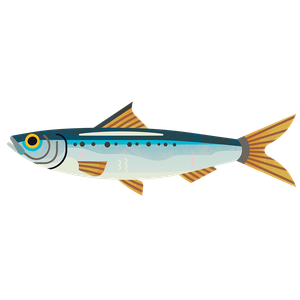
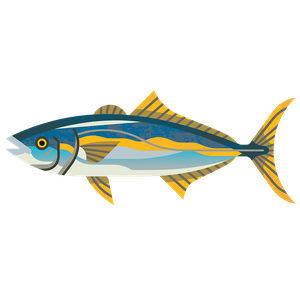
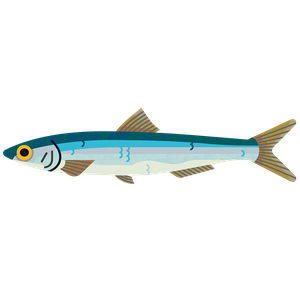
Peruvian anchovy
Engraulis ringens
What to check for
Location
Peruvian North-Central Stock: All areas
Technical location
87 - Pacific, Southeast, All areas
Caught by
Net (purse seine or ring)
Rating summary
The stock of Peruvian anchovy is underfished and is not subject to overfishing. There are some strong management measures in place, though these can be undermined by a lack of transparency in stock assessments, and policies based on a lack of scientific evidence. Peruvian anchovy is caught by purse seiners in northern central Peru. There is little to no impact on ecosystems and bycatch does not appear to be significant..Rating last updated November 2024.
How we worked out this Rating
Stock status
The size and health of a fish population, or 'stock', that is being targeted by fishermen is a crucial indicator of whether a fishery is sustainable. If the stock is too small to withstand fishing, it is at risk of crashing. We look at how big the stock is, and how much pressure there is from fishing, to assess this. The target level that many fisheries aim for is 'Maximum Sustainable Yield' - the most fish that can be caught year after year whilst keeping the population at a healthy size.
Peruvian anchovy in the Peruvian North-Central Stock is not subject to overfishing and is not overfished.Stock assessments are carried out by the Marine Research Institute of Peru (IMARPE). The most recent stock assessment was published in 2023 using data up to the same year. The stock assessment defines reference points for fishing pressure (F) and biomass (B). For fishing pressure, there is a target to keep F at or below Maximum Sustainable Yield (FMSY). For biomass, there is a target to keep B at or above BMSY.Total biomass (SSB) of Peruvian anchovy or anchoveta in this northern-central stock was estimated at 6.45 million tonnes between February and April 2023, which is lower than estimates in 2021 and 2022 (averaging 9.85 million tonnes). Spawning stock biomass has remained above Bmsy (5.09 million tonnes). Therefore, there is no concern for biomass.Fishing mortality (F) in 2023 has also been reported as below the reference point target fishing mortality (FMSY) of 1.14. As fishing mortality is reported below FMSY there is no concern for fishing pressure.Recruitment for the stock is influenced by environmental and oceanic conditions such as El Niño and La Niña, which may, alongside fishing pressure, affect the SSB of the species, particularly under a changing climate. Surveys for the area indicate that high proportions of juveniles in recent years indicating that the stock is renewing.
Management
Good management is vital to be sure that fishing doesn't cause fish populations to decline. We look at whether regulations follow the best available scientific advice, how well compliance is monitored and enforced, and whether this is effective in maintaining healthy fish stocks.
Management is partially effective, some but not all relevant management measures are in place.Catches remain below TACs, and several strong management measures are in place. However, key issues include the lack of clear scientific advice, a harvest control rule, and a comprehensive plan covering all fleets.Peruvian fisheries are managed by the Ministry of Production (PRODUCE) and the Vice-Ministry of Fisheries, with scientific advice provided by IMARPE. Anchoveta management uses an adaptive system to address high ecosystem variability and biomass fluctuations. In 2022, catches totalled 4.24 million tonnes, 16% below the TAC, but there is no evidence that TACs are informed by scientific recommendations.Effective management measures include a minimum landing size (12cm), minimum mesh size (13mm), spatial closures within 5nm of the coast for industrial vessels, temporary closures to protect juveniles, effort controls (e.g., one trip per day, satellite monitoring), and discard bans for artisanal fisheries. Additional precautions include early season closures, reduced TACs, and cancellations of fishing seasons, such as the suspension of the first season in 2023 due to high juvenile presence.Despite these measures, the lack of evidence-based TACs, absence of a harvest control rule, and inadequate fleet-wide management remain significant concerns. IUU fishing is also a challenge but is estimated to account for only 2-4% of landings, aided by observer programs and port inspections.
Capture method
Environmental impacts of fishing vary hugely, depending on the method used and where it's happening. We look at whether the fishing gear being used could have an effect on seabed habitats, and if so, how severe might this be. We also review whether it catches any other species by accident (bycatch), and what effect this might have on those species - especially if they're Endangered, Threatened, or Protected.
Peruvian anchovy is caught by purse seiners in northern central Peru. There is little to no impact on ecosystems and bycatch does not appear to be significant.Purse seines usually to not have any direct contact with the seafloor, unless they are used in waters that are shallower than the height of the nets, this may occasionally occur in this fishery within Peru, but overall contact is considered minimal.Bycatch of Endangered, Threatened, or Protected (ETP) species is low, with no reports of marine mammal interactions. However, the capture of longnose anchovy alongside Peruvian anchovy is unregulated, and the stock status of the former is unknown. Up to 5% of landings may include bycatch species, but there is little analysis or public data on species composition. A list of prohibited species includes Peruvian Diving Petrel, Humboldt penguin, Guanay cormorant, Peruvian pelican, Peruvian booby, green sea turtle, South American sea lion and Southern fur seal, with national regulations banning the capture, processing, and marketing of small cetaceans and sea turtles.Several measures aim to reduce environmental impacts, including spatial closures to protect coastal habitats, electronic logbooks to improve bycatch data, ongoing bycatch studies, and two marine protected areas for seabirds and mammals, which are respected by the fishery. All industrial vessels are satellite-tracked.Improved reporting on bycatch and evidence of gear interactions with the seabed are needed, along with assessments of the effectiveness of existing environmental protections.
References
Acuña, E. D., P. Marin, and E. Q. Salazar. 2021. Alternative stock assessment of the northern-central Peruvian anchoveta (Engraulis ringens) using a stochastic surplus production model in continuous time. OFICIO N° 683-2021-IMARPE/PCD. 35 pp. Institute of the Sea of Peru. Available at: https://fisheryprogress.org/sites/default/files/documents_actions/IMARPE_Of.%20N%20683-2021-IMARPE-PCD_Evaluaci%C3%B3n%20alternativa%20de%20anchoveta%20usando%20un%20modelo%20estoc%C3%A1stico.pdf#overlay-context=node/3546/actions-progress [Accessed on 27.11.2024].
Bucarey, D., M. Zúñiga Basualto, F. Espíndola Rebolledo, and J. C. Quiroz, 2022. Status and sustainable exploitation possibilities of Anchoveta and European sardine, from the Atacama Region to the Coquimbo Region, 2022. SECOND REPORT Performance Agreement 2021. SUBSECRETARY OF ECONOMY AND EMT / May 2022. 125 pp. IFOP. Available at: https://www.ifop.cl/wp-content/contenidos/uploads/RepositorioIfop/InformeFinal/2022/P-483259_anchoveta_sardina_esp_Atacama_Coquimbo.pdf [Accessed on 27.11.2024].
Canales, T., and E. Leal, 2009. Life history parameters of anchoveta Engraulis ringens Jenyns, 1842, in central north Chile. Revista de Biología Marina y Oceanografía, 44(1), pp.173-179. Available at: http://www.scielo.cl/pdf/revbiolmar/v44n1/art17.pdf [Accessed on 27.11.2024].
Canales, C. M., N. A. Adasme, L. A. Cubillos, M. J. Cuevas, and N. Sánchez, 2018. Long-time spatio-temporal variations in anchovy (Engraulis ringens) biological traits off northern Chile: an adaptive response to long-term environmental change? ICES Journal of Marine Science, 75(6):1908-1923. Available at: https://academic.oup.com/icesjms/article/75/6/1908/5052273 [Accessed on 27.11.2024].
CCT-PP, 2022a. Minutes of the third session of the Technical Scientific Committee on Small Pelagic Fisheries, 2022. 9 pp. Available at: https://www.subpesca.cl/portal/616/articles-114925_documento.pdf [Accessed on 27.11.2024].
CCT-PP, 2022b. Minutes of the second session of the Technical Scientific Committee on Small Pelagic Fisheries, 2022. 12 pp. Subpesca. Available at: https://www.subpesca.cl/portal/616/articles-114064_documento.pdf [Accessed on 27.11.2024].
Fishery Progress, 2022. Peru anchovy - industrial purse-seine. Available at: https://fisheryprogress.org/fip-profile/peruvian-anchovy-industrial-purse-seine [Accessed on 27.11.2024].
FishSource, 2024. Anchoveta Peruvian Northern-Central – Profile updated on 20 September 2023. Available at: https://www.fishsource.org/fishery_page/3318 [Accessed on 19.11.2024]
Global Fishing Watch, 2020. Chile Shows Global Leadership On Fisheries Transparency. Available at: https://globalfishingwatch.org/transparency/chile-leadership/ [Accessed on 27.11.2024].
Gonzalez-Pestana, A., Alfaro-Shigueto, J., Mangel, J.C., 2022. A review of high trophic predator-prey relationships in the pelagic Northern Humboldt system, with a focus on anchovetas. Fisheries Research, Volume 253. Available at: https://doi.org/10.1016/j.fishres.2022.106386 [Accessed on 27.11.2024].
Gozzer-Wuest, R., E. Alonso-Población, and G. A. Tingley, 2021. Identifying priority areas for improvement in Peruvian Fisheries. Marine Policy, 129:104545. Available at: https://www.sciencedirect.com/science/article/pii/S0308597X21001561 [Accessed on 27.11.2024].
IMARPE, 2022. Available at: INSTITUTO DEL MAR DEL PERU - IMARPE http://www.imarpe.gob.pe/imarpe/index2.php?id_seccion=reportes [Accessed on 27.11.2024].
MEFT, 2019. Law 21132. Modernizes and strengthens the public function of the National Fisheries Service. Ministry of Economy, Development, and Tourism. Available at: https://www.bcn.cl/leychile/navegar?idNorma=1128370 [Accessed on 27.11.2024].
MRAG, 2020b. Peru anchovy - industrial purse-seine - Independent 3 year audit. 48 pp. Available at: https://fisheryprogress.org/system/files/independent_audit/Peruvian_Anchovy_IHC_FIP_Review_2019_GB2338.pdf [Accessed on 27.11.2024].
Petit, I. J., A. N. Campoy, M.-J. Hevia, C. F. Gaymer, and F. A. Squeo, 2018. Protected areas in Chile: are we managing them? Revista Chilena de Historia Natural, 91(1):1. Available at: https://doi.org/10.1186/s40693-018-0071-z [Accessed on 27.11.2024].
Silva, C., I. Andrade, E. Yáñez, S. Hormazabal, M. Á. Barbieri, A. Aranis, and G. Böhm, 2016. Predicting habitat suitability and geographic distribution of anchovy (Engraulis ringens) due to climate change in the coastal areas off Chile. Progress in Oceanography, 146:159-174. Available at: https://doi.org/10.1016/j.pocean.2016.07.003 [Accessed on 27.11.2024].
SUBPESCA. 2017. R. Ex. 3893/2017. Approves the management plan for anchoveta and European sardine fisheries in regions III-IV. Available at: https://www.subpesca.cl/portal/615/w3-article-98874.html [Accessed on 27.11.2024].
Vega, R., L. Ossa, B. Suárez, M. Jiménez, S. Henríquez, A. González, R. Ojeda, et al., 2020. Observer program: Research and monitoring program of discard and incidental catch in pelagic fisheries, 2019-2020. FINAL REPORT. Performance Agreement 2019. 442 pp. Available at: https://www.ifop.cl/wp-content/contenidos/uploads/RepositorioIfop/InformeFinal/2020/P-581156.pdf [Accessed on 27.11.2024].
Sustainable swaps
Learn more about how we calculate our sustainability ratings.
How our ratings work
Add impact to your inbox
Join the movement: get updates on the issues you care about.
We'll email you inspiring stories about the work we're doing to save and recover our oceans, and news about our urgent campaigns for positive change.