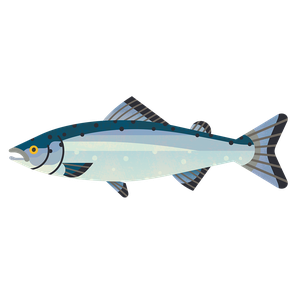
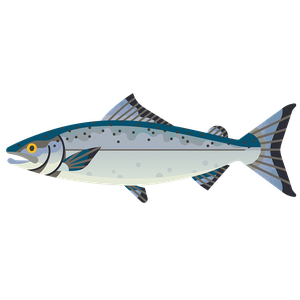
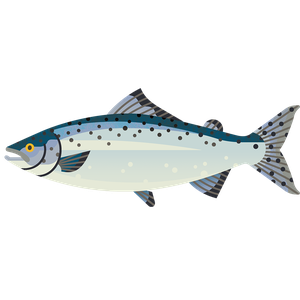
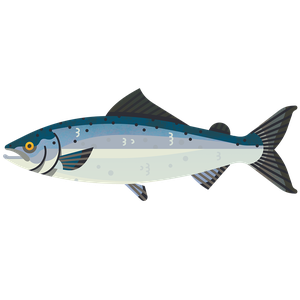
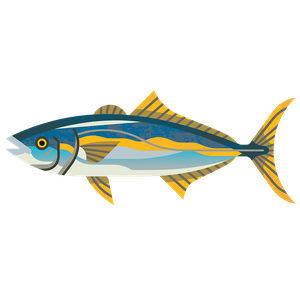
Rainbow trout
Oncorhynchus mykiss
What to check for
Location
All areas
Production method
Open net pen, marine
Rating summary
Rainbow trout feed is traceable and requirements are in place for responsible ingredient sourcing, however, it is a net consumer of protein. Farming in marine net pens can have a negative environmental impact such as sea lice, disease outbreaks and escapes. However, there is no use of freshwater supplies and habitat alteration is small. Chemical usage is regulated and there are practices in place for welfare and humane slaughter. Management and regulations are in place.Rating last updated June 2022.
How we worked out this Rating
Environment
The environmental impacts of aquaculture depend on what fish is farmed, how and where. It could be habitat damage, chemical use, pollution, freshwater use or parasites. In this section we look at the environmental impacts of greatest concern for that species and production method. Some species, such as shellfish, have very little impact, whilst others may give us cause for concern.
Rainbow trout farming in marine net pens can have a negative environmental impact.Farmed rainbow trout in marine net pens does not deplete local freshwater supplies. Habitat alteration is also small scale through the use of mooring grids only. All juveniles are sourced from hatcheries.While there is a lack of information on the environmental impacts of chemical usage in freshwater ponds, this is thought to be effectively regulated and is covered by both the Quality Trout UK Standard and the Code of Good Practice, as well as being regulated by CEFAS (England and Wales) and SEPA (Scotland). Trout farms also can discharge directly into the environment but there is no evidence of a country or region level negative impact resulting from this discharge, and it is effectively mitigated by regulation and standards.Rainbow trout farmed in seawater are susceptible to sea lice infestation and there is concern about how well sea lice control is regulated, as well as a lack of data around rainbow trout and sea lice. Disease outbreaks can also happen but there is no evidence to suggest that these outbreaks threaten the viability of the region.Large escape events have happened in the last decade in marine net pens. In Scotland in 2020, there was one escape incident involving the loss of 1601 fish from a rainbow trout site. In 2019, there were three incidents involving the loss of 37,372 fish from rainbow trout sites. Escaped rainbow trout can alter the natural environment by indirectly affecting aspects of the wild population behavior, predators and disease interaction.
Fish health and welfare
Fish health and welfare is a concern for many consumers. High welfare standards are an indication of good farm management, we look to see if there are industry wide welfare standards in place, and if these include humane slaughter.
Quality Trout UK standard covers both fish welfare and humane slaughter. A Veterinary Health Plan is required which covers transport and staff are required to be trained in welfare practices.
Management
How aquaculture is regulated and how effective those regulations are is an important aspect of farmed fish production. We also look to see if aquaculture is included in broader environmental management plans. In this management section we also award scores for globally recognised certification standards, as certified seafood requires verification of environmental performance and traceability.
This assessment scores well for management measures but would benefit from 3rd party certification.Aquaculture policy in the UK is a devolved matter, with the separate administrations of Wales, England, Northern Ireland and Scotland responsible for its collective oversight. Aquaculture is not yet included in the River Basin Management Plans (RBMPs) and MCS would like to see this included in the next RBMPs (produced every 7 years).In the UK, there is regulatory framework in place to address the environmental impacts of aquaculture. This includes the Habitats Directive 92/43/EEC and the Birds Directive 2009/147/EC, which form the cornerstones of the EU’s nature conservation policy and protect valuable habitats and species. There is also regulation in place to cover the use of land and water resources, discharges including effluents and their impacts, biosecurity and disease management. These regulations are thought to be mostly effective, however there is a lack of standard criteria on habitat protections.
References
Biomar. 2018. Sustainability Report. Available at https://www.biomar.com/globalassets/.global/pdf-files/biomar-group-sustainability-report-2018.pdf [Accessed on 12.02.2022].
European Commission. 2012. Guidance on Aquaculture and Natura 2000. Available at https://ec.europa.eu/fisheries/sites/fisheries/files/docs/body/guidance-aquaculture-natura2000.pdf [Accessed on 04.04.2022].
FAO. 2019. National Aquaculture Legislation Overview: United Kingdom. Available at http://www.fao.org/fishery/legalframework/nalo_uk/en [Accessed on 04.04.2022]
FAO. Oncorhynchus mykiss (Walbaum 1792). Available at https://www.fao.org/fishery/en/culturedspecies/oncorhynchus_mykiss/en [Accessed on 28.03.2022].
Naylor, R. L., Hardy, R. W., Buschmann, A. H., Bush, S. R., Cao, L., Klinger, D. H., Little, D. C., Jubchenco, J., Shumway, S. E and Troell, M. 2021. A 20-year retrospective review of global aquaculture. Nature. 591 (551-563). Available at https://www.nature.com/articles/s41586-021-03308-6#Tab1 [Accessed on 04.04.2022].
O’Donohoe, P. Kane, F.McDermott, T. Jackson,D. 2016. Sea reared rainbow trout, Oncorhynchus mykiss need fewer sea lice treatments that Atlantic salmon, Salmo salar. Bulletin European Association of Fish Pathology 36(5).201
Quality Trout UK. Combined Farm & Hatchery Certification Standards. Issue 5.9 (9th November 2021). Available at http://qualitytrout.co.uk/wp-content/uploads/2021/12/Quality-Trout-UK-Standard-Issue-5.9-9-11-2021-for-release.pdf [Accessed on 4.04.2022].
Quality Trout UK. The Code of Good Practice for Scottish Finfish Aquaculture. Available at http://qualitytrout.co.uk/code-of-good-practice/ [Accessed on 28.03.2022].
Scotland’s Aquaculture. 2022. Data search. Available online at: http://aquaculture.scotland.gov.uk/data/sealice_in_feed_treatment_residues.aspx. [Accessed on 04/04/2022].
Scottish Government. Aquaculture. Available at https://www.gov.scot/policies/aquaculture/fish-farm-consents/#page-top [Accessed on 04/04/2022].
Scottish Government. 2017. Environmental Impacts. Available at https://www2.gov.scot/Topics/marine/Fish-Shellfish/18716/environmentalimpact [Accessed on 04.04.2022].
Scottish Government. 2020. Seal Licensing. Available at https://www2.gov.scot/Topics/marine/Licensing/SealLicensing [Accessed on 03.03.2022].
Scottish Government. 2021. Scottish fish farm production surveys. Available at https://www.gov.scot/collections/scottish-fish-farm-production-surveys/ [Accessed on 04.04.2022].
Seafish. Rainbow Trout. Available at https://www.seafish.org/responsible-sourcing/aquaculture-farming-seafood/species-farmed-in-aquaculture/aquaculture-profiles/rainbow-trout/sources-quantities-and-cultivation-methods/ [Accessed on 28.03.2022].
Sustainable swaps
Learn more about how we calculate our sustainability ratings.
How our ratings work
Add impact to your inbox
Join the movement: get updates on the issues you care about.
We'll email you inspiring stories about the work we're doing to save and recover our oceans, and news about our urgent campaigns for positive change.