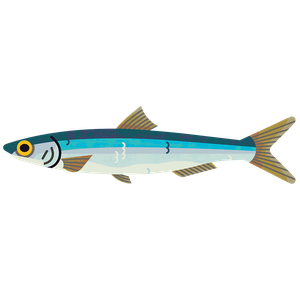
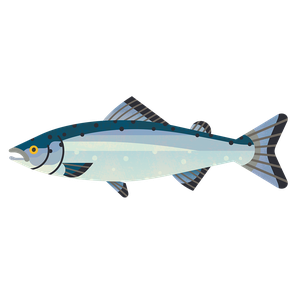
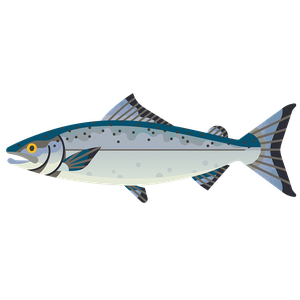
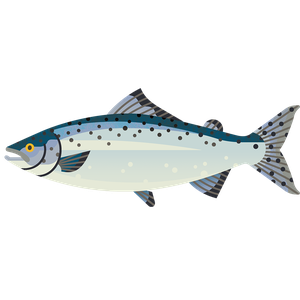
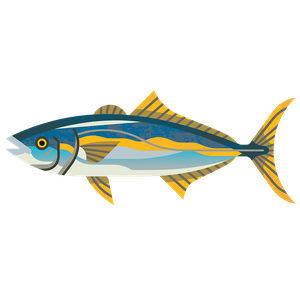
Sardine
Sardina pilchardus
What to check for
Location
Northwest Africa: Zone A and B (Central): All areas
Technical location
34 - Atlantic, Eastern Central, All areas
Caught by
Net (pelagic trawl; purse seine)
Rating summary
There is concern for the biomass of Sardine in Northwest Africa, Zone A and B, however there is no concern for fishing pressure. Few appropriate management measures are currently in place, and the stock is considered overfished, with insufficient action to support recovery. Management should include species‑specific catch limits and coordinated TAC setting between nations. Sardine in this area are caught in purse seine nets and pelagic trawls. Both gears are considered to have very low potential effects on the habitat and on protected species.Rating last updated in January 2026.
How we worked out this Rating
Stock status
The size and health of a fish population, or 'stock', that is being targeted by fishermen is a crucial indicator of whether a fishery is sustainable. If the stock is too small to withstand fishing, it is at risk of crashing. We look at how big the stock is, and how much pressure there is from fishing, to assess this. The target level that many fisheries aim for is 'Maximum Sustainable Yield' - the most fish that can be caught year after year whilst keeping the population at a healthy size.
There is concern for the biomass of Sardine in Northwest Africa, Zone A and B, however there is no concern for fishing pressure.Route 2 (data limited) scoring has been applied to this rating owing to the limited reference points for fishing pressure and biomass. Sardine is considered to have a medium resilience to fishing pressure.Stock assessments are carried out by the Fishery Committee for the Eastern Central Atlantic. The most recent assessment was published in 2025 using data up to 2024. The next assessment is expected in 2026.The stock assessment uses reference points for both fishing pressure (F) and biomass (B), where Fcur and Bcur describe current levels, and the target reference points F0.1 and B0.1 represent the fishing mortality and biomass associated with a more precautionary exploitation rate. F0.1 equates to the fishing mortality rate that achieves 90% of the yield at FMSY, and B0.1 the corresponding biomass. These targets indicate the desirable state of the stock. F0.1 and B0.1 were selected instead of the traditional FMSY and BMSY due to data inconsistencies and to ensure a more precautionary approach.In 2024, Bcur was 71% of B0.1, indicating that the stock is currently overexploited. Therefore, we consider there to be concern for biomass.Catch decreased by 55% from 354,000 t in 2023 to 196,000t in 2024, remaining below the recent five‑year (2020–2024) average of 379,000 t. Fishing pressure is also below the target levels, with Fcur at 37% of F0.1 in 2024. Therefore, there is currently no concern for fishing pressure.This stock is strongly influenced by environmental factors and exhibits fluctuations in biomass independent of fishing. For this reason, the maximum total catch to be caught must be adapted to the natural modifications of the stock. The structure and abundance of the stock should also be closely monitored by methods independent of fishing, such as coordinated acoustic surveys covering the entire range of the species. Additionally, the average size of sardine has declined in recent years, indicating the need for continued vigilance in how this stock is exploited.The Working Group maintains the recommendation to limit catches of sardines in this area to a level not exceeding 196,000 tonnes.
Management
Good management is vital to be sure that fishing doesn't cause fish populations to decline. We look at whether regulations follow the best available scientific advice, how well compliance is monitored and enforced, and whether this is effective in maintaining healthy fish stocks.
Few appropriate management measures are currently in place, and the stock is considered overfished, with insufficient action to support recovery. Management should include species‑specific catch limits and coordinated TAC setting between nations.There is limited publicly available, up‑to‑date information on management measures for Zone A+B.All recorded catches in this central area are understood to be taken by the Moroccan fishery. While a number of management measures are in place and provide some degree of control, they are insufficient for effective management of individual stocks, and several species within this mixed fishery are considered over‑exploited.A multispecies management plan, incorporating effort limits, has been in place since 2015. However, the plan does not include species‑specific catch limits or a harvest control rule, limiting its ability to respond to changes in stock status. The Moroccan National Institute for Fisheries Research (INRH) carries out stock assessments but does not provide explicit management advice, while an FAO working group has recommended annual catch limits that have not been translated into total allowable catches (TACs). Although catches have at times exceeded advised levels, they have remained below these recommendations since 2014.Management relies primarily on input controls, including licensing, vessel and gear regulations, and spatial and seasonal closures. Additional restrictions apply to purse‑seine vessels, such as per‑trip catch caps and, in some areas, annual catch limits. Morocco has strengthened measures to address illegal, unreported and unregulated (IUU) fishing, although information on the scale of IUU activity remains limited, and under‑reporting is a particular concern in the artisanal sector. Observer coverage has increased in recent years, and discard rates in the coastal purse‑seine fishery are reported to be low.
Capture method
Environmental impacts of fishing vary hugely, depending on the method used and where it's happening. We look at whether the fishing gear being used could have an effect on seabed habitats, and if so, how severe might this be. We also review whether it catches any other species by accident (bycatch), and what effect this might have on those species - especially if they're Endangered, Threatened, or Protected.
Sardine in this stock area (Zones A + B) are caught in purse seine nets and pelagic trawls. Both gears are considered to have very low potential effects on the habitat and on protected species.Data on interactions with protected species in Moroccan waters are limited, although a number of protective measures are in place. These include species‑specific protections for sharks and a defined bycatch limit for allowable non‑target species.Fishing zones are clearly defined to distinguish between artisanal and industrial activities. In Morocco, artisanal vessels and purse seiners with a gross tonnage of 2–150 tonnes are restricted to operating beyond 2 nautical miles (nm) from the coast. The pelagic fishing gears used in this fishery are not expected to interact with seabed ecosystems.Several Marine Protected Areas (MPAs) have been established along the Northwest African coast. While these MPAs do not directly contribute to sardine stock management, they may offer indirect ecosystem protection. Morocco has three MPAs within the central area, although the extent and effectiveness of fishing restrictions within these sites remain unclear.A non‑target species (bycatch) threshold of 3% of total catch is set for Moroccan small pelagic fisheries. Despite this, interactions between Moroccan small pelagic fisheries and protected species remain poorly documented, and further investigation is needed. Sharks are commonly reported as bycatch in fisheries off Northwest Africa, along with sea turtles (including green and loggerhead turtles), manta rays, sunfish and dolphins. However, interactions within the purse‑seine sector are considered likely to be low, and the now‑inactive Moroccan Fishery Improvement Project (FIP) previously concluded that the Moroccan sardine purse‑seine fishery did not pose a significant threat to endangered species.In addition, Morocco implemented a ban on the capture of certain shark species between 2012 and 2017, which was subsequently extended through to 2022. This ban covers hammerhead sharks (Sphyrna spp., excluding bonnethead S. tiburo), oceanic whitetip shark (Carcharhinus longimanus, Critically Endangered) and bigeye thresher shark (Alopias superciliosus, Vulnerable), in line with commitments and recommendations from the International Commission for the Conservation of Atlantic Tunas (ICCAT) and the General Fisheries Commission for the Mediterranean (GFCM).Sardine occupy a position at or near the base of the marine food web, and the ecosystem impacts of their large‑scale removal remain poorly understood, requiring further investigation. Small pelagic species targeted in this fishery are also highly dependent on oceanographic conditions in Northwest Africa, adding uncertainty to assessments of long‑term ecological effects.
References
Froese, R. and D. Pauly. Editors. 2025. FishBase. . Sardine, Sardina pilchardus. Available at https://www.fishbase.de/summary/Sardina-pilchardus.html [Accessed on 27.01.2026].
Daly, J., 2019. Global Standard for Responsible Supply of Marine Ingredients Fishery Assessment Methodology and Template Report V2.0: European pilchard (Sardina Pilchardus) FAO area 34. Available at https://www.marin-trust.com/sites/marintrust/files/approved-raw-materials/European%20Pilchard_FAO%2034_Thailand_Surv%202_2018_Final.pdf [Accessed on 27.01.2026].
EC, 2006. Council Regulation (EC) No 1801/2006 of 30 November 2006 on the conclusion of the Fisheries Partnership Agreement between the European Community and the Islamic Republic of Mauritania Fisheries Partnership Agreement between the European Community and the Islamic Republic of Mauritania. Available at https://eur-lex.europa.eu/legal-content/EN/TXT/?uri=uriserv:OJ.L_.2006.343.01.0001.01.ENG [Accessed on 27.01.2026].
EC, 2013. Protocol between the European Union and the Kingdom of Morocco setting out the fishing opportunities and financial contribution provided for in the Fisheries Partnership Agreement between the European Union and the Kingdom of Morocco. Available at https://eur-lex.europa.eu/legal-content/EN/TXT/?qid=1407509544410&uri=CELEX:22013A1207(01) [Accessed on 27.01.2026].
FAO, 2025. FAO Working Group on the Assessment of Small pelagic fish off Northwest Africa 2025: Summary Report. Available at: https://openknowledge.fao.org/bitstreams/48572e26-38ef-40b9-8f89-9cbf92efc545/download [Accessed on 27.01.2026].
Fishery Progress, 2025. Mauritania small pelagics - purse seine. Available at: https://fisheryprogress.org/fip-profile/mauritania-small-pelagics-purse-seine [Accessed on 27.01.2026].
Fishery Progress, 2022b. INACTIVE Morocco sardine - pelagic trawl and seine / Maroc sardine - chalut pélagique et senne. Available at: https://fisheryprogress.org/fip-profile/morocco-sardine-pelagic-trawl-and-seine-maroc-sardine-chalut-pelagique-et-senne [Accessed on 27.01.2026].
Rigby, C.L., Barreto, R., Carlson, J., Fernando, D., Fordham, S., Francis, M.P., Herman, K., Jabado, R.W., Liu, K.M., Marshall, A., Pacoureau, N., Romanov, E., Sherley, R.B. & Winker, H. 2019. Carcharhinus longimanus. The IUCN Red List of Threatened Species 2019: e.T39374A2911619. https://dx.doi.org/10.2305/IUCN.UK.2019-3.RLTS.T39374A2911619.en. [Accessed on 27.01.2026].
Seafish, 2025, Gear, Purse seine & Pelagic trawl, Available at: https://www.seafish.org/responsible-sourcing/fishing-gear-database/gear [Accessed on 27.01.2026].
Sustainable swaps
Learn more about how we calculate our sustainability ratings.
How our ratings work
Add impact to your inbox
Join the movement: get updates on the issues you care about.
We'll email you inspiring stories about the work we're doing to save and recover our oceans, and news about our urgent campaigns for positive change.