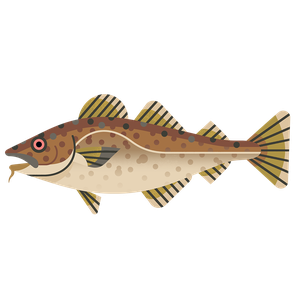
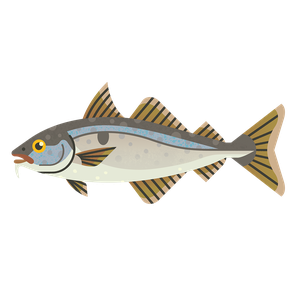
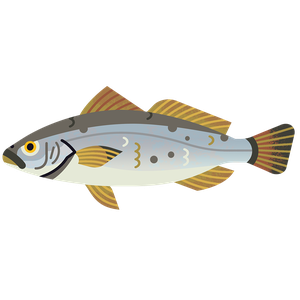
Atlantic cod
What to check for
Northern Shelf: Viking substock: All areas
Bottom trawl (otter)
Rating summary
Scientific advice recommends zero-catch for the all Northern Shelf cod, but this advice is not being followed, resulting in a default red rating. Management has not historically been appropriate for protecting and recovering cod stocks in this area. Most cod catches are by otter trawls, which are likely to cause some damage to the seabed and bycatch other species.
Rating last updated December 2025.
How we worked out this Rating
References
Eigaard, O. R., Bastardie, F., Breen, M., Dinesen, G. E., Hintzen, N. T., Laffargue, P., Mortensen, L. O., Nielsen, J. R., Nilsson, H. C., O- Neill, F. G., Polet, H., Reid, D. G., Sala, A., Skold, M., Smith, C., Sorensen, T. K., Tully, O., Zengin, M. and Rijnsdorp, A. D., 2016. Estimating seabed pressure from demersal trawls, seines, and dredges based on gear design and dimensions. ICES Journal of Marine Science, 73:1, pp. i27- i43. Available at: https://doi.org/10.1093/icesjms/fsv099 [Accessed on 09.12.2025].
European Commission, 2025. Agreed record of fisheries consultations between the united kingdom, the European union and Norway for 2026. Published 5 December 2025. Available at: https://oceans-and-fisheries.ec.europa.eu/news/eu-norway-and-uk-agree-fishing-opportunities-north-sea-2026-2025-12-05_en#:~:text=On%205%20December%2C%20the%20EU,fleet%2C%20worth%20609%20million%20euros.[Accessed on 09.12.2025].
EU, 2023. Council Regulation (EU) 2022/109 of 27 January 2022 fixing for 2022 the fishing opportunities for certain fish stocks and groups of fish stocks applicable in Union waters and for Union fishing vessels in certain non-Union waters. Available at https://eur-lex.europa.eu/legal-content/EN/TXT/?uri=celex%3A32023R1324. [Accessed on 09.12.2025].
Hiddink, J., Jennings, S., Sciberras, M., Szostek, C.L., Hughes, K.M., Ellis, N., Rijnsdorp, A.D., McConnaughey, R.A., Mazor, T., Hilborn, R., Collie, J.S., Pitcher, C.R., Amoroso, R.O., Parma, A.M., Suuronen, P. and Kaiser, M.J. 2017. Global analysis of depletion and recovery of seabed biota after bottom trawling disturbance. PNAS. 114:31, pp. 8301-8306. Available at: https://doi.org/10.1073/pnas.1618858114 [Accessed on 09.12.2025].
ICES, 2022. Workshop on Stock Identification of West of Scotland Sea Cod (WK6aCodID; outputs from 2021 meeting). ICES Scientific Reports. 4:5. 24 pp. Available at: http://doi.org/10.17895/ices.pub.10031. [Accessed on 16.07.2024].
ICES, 2023. Stock Annex: Cod (Gadus morhua) in Subarea 4, divisions 6.a and 7.d, and Subdivision 20 (North Sea, West of Scotland, eastern English Channel, Skagerrak). ICES Stock Annexes. 35 pp. Available at: https://doi.org/10.17895/ices.pub.22633843. [Accessed on 09.12.2025].
ICES. 2024. Greater North Sea ecoregion – Ecosystem overview. In Report of the ICES Advisory Committee, 2024. ICES Advice 2024, Section 7.1, Available at: https://doi.org/10.17895/ices.advice.25714239 [Accessed on 09.12.2025].
ICES, 2025. Working Group on the Assessment of Demersal Stocks in the North Sea and Skagerrak (WGNSSK). ICES Scientific Reports. 07:57. 1524 pp. Available at: https://doi.org/10.17895/ices.pub.29085995 [Accessed on 09.12.2025].
ICES, 2025. Cod in Subarea 4, divisions 6.a and 7.d, and Subdivision 20 (North Sea, West of Scotland, eastern English Channel and Skagerrak). In Report of the ICES Advisory Committee, 2025. ICES Advice 2025, cod.27.46a7d20. Available at: https://doi.org/10.17895/ices.advice.27202566 [Accessed on 09.12.2025]
Kennelly, S. J. & Broadhurst, M. K., 2021. A review of bycatch reduction in demersal fish trawls. Rev Fish Biol Fisheries 31, 289–318. Available at: https://doi.org/10.1007/s11160-021-09644-0 [Accessed on 16.07.2024].
Koul, V., Sguotti, C., Årthun, M., Brune, S., Dusterhus, A., Bogstad, B, Ottersen, G., Baehr, J. and Schrum, C., 2021. Skilful prediction of cod stocks in the North and Barents Sea a decade in advance. Commun Earth Environ 2, 140. https://doi.org/10.1038/s43247-021-00207-6.
Kynoch, R., Fryer, R. & Neat, F., 2015. A simple technical measure to reduce bycatch and discard of skates and sharks in mixed-species bottom-trawl fisheries. ICES J Mar Sci,72(6):1861
Marshall, C.T. Macdonald, P. Torgerson, E. Asare, J.L. Turner, R., 2021. Design, development and deployment of a software platform for real-time reporting in the west of Scotland demersal fleet. A study commissioned by Fisheries Innovation Scotland (FIS). Available at http://www.fiscot.org/
Marty, L., Rochet, M., & Ernande, B., 2014. Temporal trends in age and size at maturation of four North Sea gadid species: cod, haddock, whiting and Norway pout. Marine Ecology Progress Series, 497, 179-197. https://doi.org/10.3354/meps10580.
MMO, 2025. UK National North Sea Cod Avoidance Plan. Document No: V4. Update: Jan 2025. Available at: https://assets.publishing.service.gov.uk/media/69650464e8b93f59c3aecce7/UK_National_Cod_Avoidance_Plan_-_Updated_Jan_2026.pdf [Accessed on 09.12.2025].
OSPAR, 2021. List of Threatened and/or Declining Species and Habitats: Cod. Available at: https://www.ospar.org/work-areas/bdc/species-habitats/list-of-threatened-declining-species-habitats/fish/cod [Accessed on 09.12.2025].
Scottish Government, 2022. Publication - Minutes. Offshore MPA Fisheries Measures: West Shetland Shelf - 27 January 2022. Available at: https://www.gov.scot/publications/offshore-mpa-fisheries-measures-west-shetland-shelf-27-january-2022/ [Accessed on 16.07.2024].
Scottish Government, 2023. Publication - Consultation paper: Clyde cod spawning closure Spring 2024/25: consultation. Published: 30 June 2023. Available at: https://www.gov.scot/publications/consultation-clyde-cod-spawning-closure-spring-2024-25/ [Accessed on 16.07.2024].
Sguotti, C., Otto, S.A., Frelat, R., Langbehn, T.J., Plambech Ryberg, M., Lindegren, M., Durant, J.M., Stenseth, N.C. and Möllmann, C., 2019. Catastrophic dynamics limit Atlantic cod recovery. Proc. R. Soc. B.: 286. https://doi.org/10.1098/rspb.2018.2877.
Silva, F., Ellis, J. & Catchpole, T., 2012. Species composition of skates (Rajidae) in commercial fisheries around the British Isles and their discarding patterns. J Fish Biol., 80:1678–1703
van Denderen, P. Bolam, S., Hiddink, J.G., Jennings, S., Kenny, A., Rijnsdorp, A., and van Kooten, T., 2015. Similar effects of bottom trawling and natural disturbance on composition and function of benthic communities across habitats. Mar Ecol Prog Ser. 2015;541:31–43