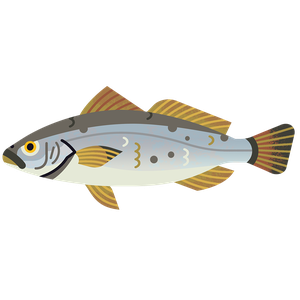
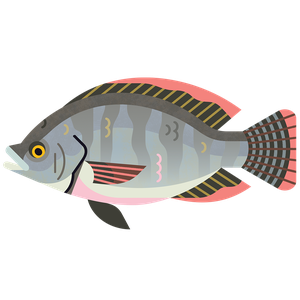
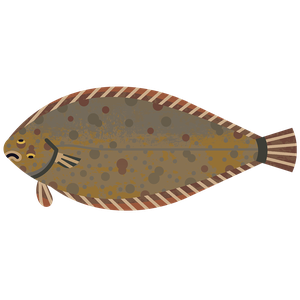
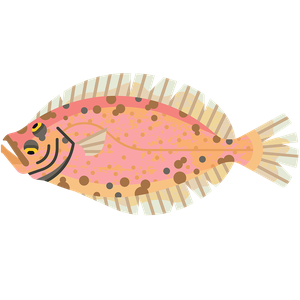
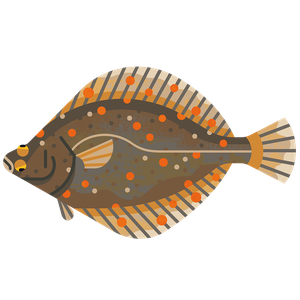
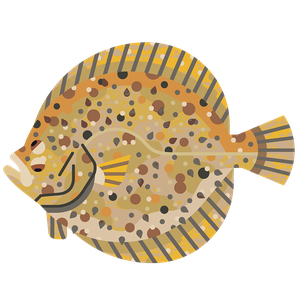
Black bream
Spondyliosoma cantharus
What to check for
Location
English Channel: Sussex IFCA District (0-6nm)
Technical location
27 - Atlantic, Northeast, 7d: English Channel (East), 7e: English Channel (West)
Caught by
Hook & line (pole & line)
Rating summary
Black bream is a data limited species in the English Channel. There is concern for the biomass, but no concern for fishing pressure. There are some appropriate management measures in place for black bream landed within the Sussex IFCA district. Recreational pole and line fishing has negligible impacts on the seabed and minimal bycatch. However, there is some concern surrounding pressure on bait species stocks, and uncertainty in recreational fishing data.Rating last updated May 2025.
How we worked out this Rating
Stock status
The size and health of a fish population, or 'stock', that is being targeted by fishermen is a crucial indicator of whether a fishery is sustainable. If the stock is too small to withstand fishing, it is at risk of crashing. We look at how big the stock is, and how much pressure there is from fishing, to assess this. The target level that many fisheries aim for is 'Maximum Sustainable Yield' - the most fish that can be caught year after year whilst keeping the population at a healthy size.
Black bream is a data limited species in the English Channel. There is concern for the biomass, but no concern for fishing pressure.Route 2 (data limited) scoring has been applied to this rating due to the absence of a stock assessment and biomass reference points. Black bream in the English Channel is considered to have medium resilience to fishing pressure, but their stock status remains unknown. Although black bream abundance along the south UK coast and in the southern North Sea has increased over the past century, this is more likely a result of climate-driven range shifts with rising sea temperatures rather than genuine stock growth.Black bream is vulnerable due to its life history. During the spawning season, from April to July, adults form inshore aggregations and seek out specific habitats – level bedrock with a thin layer of gravel or sand – to form nests. These nests are sensitive to disturbance, and habitat degradation can negatively impact recruitment. There is also evidence of nest site fidelity in black bream, meaning adults return to the same spawning areas annually. This behaviour leads to spatial structuring and a basis for genetic differentiation within the English Channel population. As a result, there is an increased risk of local depletion and potential loss of niche adaptations, especially as fishing effort is greatest during the spawning season.Black bream are also protogynous hermaphrodites, meaning all individuals are born female and transition to male at a certain size and age. Fishing pressure is skewed towards larger males, yet these mature males are crucial in black bream reproduction as they guard nests of fertilised eggs. Their removal can reduce recruitment by leaving eggs vulnerable to predators and smothering. Given these vulnerabilities and the lack of biomass indicators, there is concern for black bream biomass in the English Channel.Black bream are caught by both commercial and recreational fisheries. In 2023, approximately 491 tonnes were captured cross the UK, with 36% landed by commercial vessels, 23% kept by recreational fishers, and 41% returned by recreational fishers. Recreational removals in 2023 were estimated at 114 tonnes, slightly above the 2016-2023 average of 102 tonnes, but below the 2021 peak of 133 tonnes. Over this period, an average of 63.6% of recreationally-caught fish were released, and the remainder removed. Commercial landings have varied between 2019 and 2023, with a recent peak of 179 tonnes in 2023, well above the five-year average of 123 tonnes. However, since 2018, most landings of ‘black sea bream’ have been grouped into the category of ‘sea breams’, which includes other species and may be responsible for the apparent increase in landings. Although black bream is not a major commercial species, high market prices for sea breams (£22-45/kg) create an economic incentive to target this non-TAC (Total Allowable Catch) species. Despite these pressures, there is currently no evidence to suggest that black bream is overfished, and given their medium resilience to fishing, fishing pressure is not currently considered a concern.
Management
Good management is vital to be sure that fishing doesn't cause fish populations to decline. We look at whether regulations follow the best available scientific advice, how well compliance is monitored and enforced, and whether this is effective in maintaining healthy fish stocks.
There are some appropriate management measures in place for black bream landed within the Sussex IFCA district. These include a minimum landing size, protection as a ‘designated feature’ of a Marine Conservation Zone, and indirect protection through a trawling byelaw.There is little management of black bream within the English Channel. It is not subject to a Total Allowable Catch (TAC) and there is no national minimum landing size (MLS).In the Sussex IFCA district, black bream is subject to management measures implemented by both the Marine Management Organisation (MMO) and Sussex IFCA. Gear-specific regulations include:Pelagic Trawl: minimum mesh size of 16mm in ICES areas 7e and 7d.Drift and Fixed Nets: minimum mesh size of 100mm in area 7e, and 90mm in 7d.Demersal Seine: minimum mesh size of 100mm in both ICES areas 7e and 7d.These mesh size rules are designed to protect juvenile black bream, among other species, by allowing smaller individuals to escape. Although black bream is a minor commercial species, it is highly prized by recreational anglers, and effective management must address both sectors. Across the Sussex IFCA district, a Minimum Landing Size (MLS) of 230mm is enforced to protect black bream stocks through ensuring individuals have the opportunity to reproduce at least once.Additional management is included through the Kingmere Marine Conservation Zone (MCZ), designated to protect important species and habitats, known as ‘designated features’, including black bream. The Kingmere MCZ is thought to be one of the most important breeding grounds for black bream in UK coastal waters. To protect this vulnerable life stage, specific management measures apply to both commercial and recreational activities.During the spawning season (1st April to 30th June):Angling is prohibited in Zone 1, with a bag limit of four bream per person in Zones 2, 3 and 4.Potting, lining, and dive gathering are prohibited in Zones 1 and 2, but allowed in Zones 3 and 4 with no retention of bream.Towed gears and netting are prohibited across all Zones.Outside of the spawning season (1st July to 31st March):Angling allowed in all Zones with a bag limit of four bream per person.Potting, lining, dive gathering and netting allowed in all Zones, with no bag limits.Towed gears are prohibited in Zones 1, 2, and 4, but allowed in Zone 3 with no bag limit.These measures are designed to minimise disturbance during critical spawning and nesting periods, especially in Zone 1, where the majority of nests are located.In addition to protections within the Kingmere MCZ, black bream also benefits from the Nearshore Trawling Byelaw, introduced in 2019. This byelaw prohibits the use of trawling gear, including demersal seines, year-round within nearshore waters. This helps to protect key habitats used by black bream and reduces fishing mortality from demersal seining within these areas.There is also a voluntary Code of Conduct for recreational angling within the Kingmere MCZ. This encourages responsible fishing practices, such as handling fish with care, adhering to seasonal guidance, and adopting a maximum landing size of 400mm. A maximum landing size helps to protect larger, more fecund individuals. This is especially crucial for large male black bream, as they are essential in nest guarding and are often disproportionately removed by fishing.Management compliance in the EU and UK has been inconsistent, with ongoing challenges in enforcing some regulations.The Marine Conservation Society views Remote Electronic Monitoring (REM) with cameras is one of the most cost-effective tools for providing reliable fisheries data and aiding informed management decisions. Fully monitored fisheries enhance collaboration, data accuracy, stock recovery, and reduce impacts on marine wildlife and habitats. However, the full potential of REM may only be achieved when it tracks fishing location and documents catch and bycatch, particularly where vulnerable species and habitats are at risk. As of January 2024, the EU is introducing a Remote Electronic Monitoring (REM) mandate for EU vessels, including CCTV cameras on vessels 18m or more that pose a potential risk of non-compliance, within the next 4 years. Across the UK, different approaches to REM are being taken and legislation is expected to be in place across all 4 countries within the next few years.The Fisheries Act (2020) requires the development of Fisheries Management Plans (FMPs) (replacing EU Multi-Annual Plans) in the UK. 43 FMPs have been proposed and are at various stages of development and implementation, these should all be published by the end of 2028. FMPs have the potential to be very important tools for managing UK fisheries, although data limitations may delay them for some stocks. It is also essential the UK governments define and adopt a standardised approach or model across the four nations to a universally defined FMP design, to ensure the consistence, quality and coherence of all the proposal FMPs.The Marine Conservation Society is keen to see publicly available Fishery Management Plans for all commercially exploited stocks, especially where stocks are depleted, that include:An overview of the fishery including current stock status, spatial coverage, current fishing methods and impactsTargets for fishing pressure and biomass, and additional management when those targets are not being met, based on the best scientific evidenceTimeframes for stock recoveryImproved data collection, transparency, and accountability, supported by technologies such as Remote Electronic Monitoring (REM)Consideration of wider environmental impacts of the fishery, including habitat impacts and minimising bycatchStakeholder engagementBlack bream is included in the Seabream FMP, coordinated by Defra. At the time of writing, it is too soon to know whether proposed management measures will be effective in managing the stock. For more information about this FMP and expected progress and timelines, see [https://www.gov.uk/guidance/black-seabream-fisheries-management-plan-fmp].
Capture method
Environmental impacts of fishing vary hugely, depending on the method used and where it's happening. We look at whether the fishing gear being used could have an effect on seabed habitats, and if so, how severe might this be. We also review whether it catches any other species by accident (bycatch), and what effect this might have on those species - especially if they're Endangered, Threatened, or Protected.
Recreational pole and line fishing has negligible impacts on the seabed and minimal bycatch. However, there is some concern surrounding pressure on bait species stocks, and uncertainty in recreational fishing data.In 2023, recreational pole and line accounted for the largest share of black bream landings (41.9%), followed by commercial pelagic trawls (32.6%), demersal seines (13.1%), and drift nets (12.5%). Retained black bream by recreational pole and line fishing totalled 114.2 tonnes in 2023.Hook-and-line fishing methods, including handlining, trolling, lures, and rod-and-reel, are among some of the most sustainable and species-selective fishing methods available, with minimal bycatch and no impact on the seabed. Black bream may be recreationally caught using this method from the shoreline or from inshore vessels (including charter boats). Non-target species accidentally caught are typically released alive, with lower post-capture mortality rates than other fishing methods.Black bream is a highly prized sport fish, with seabreams as a group ranking as the second most valuable species for charter boats in the South Inshore Marine Planning Area. This popularity drives demand for bait, placing additional pressure on bait species used in both recreational and commercial fisheries. Pole and line fishers often rely on polychaete worms, which may be farmed or collected from the wild, but wild harvesting is largely unregulated and stock status remains uncertain. While voluntary codes of conduct (e.g. the Angling Trust) and some IFCA guidance exists, management of bait resources is inconsistent. Other commonly used bait species raise similar concerns, including squid, which is data‑limited and often poorly rated for sustainability, and mackerel, whose stocks have shown continued signs of decline. Given the growing popularity of black bream, it is important to recognise the resultant demand on bait species.Recreational catches are also difficult to monitor accurately, with assessments often based on estimates rather than complete, up‑to‑date data. This uncertainty limits understanding of the recreational sector’s full impact and makes effective management challenging. With black bream now the UK's ninth most popular recreational species by weight and sixth by number in 2024, participation continues to rise, highlighting the need for improved monitoring and more sustainable approaches to both target and bait species.
References
Angling Trust, 2012. Angling Trust Recommended Voluntary Code of Conduct For Bait Digging. Available at: Angling-Trust-Bait-Digging-Code-Of-Conduct-2012.pdf [Accessed on 25.03.2026].
ASCOBANS, 2018. Update on the implementation of the EU nature, marine and fisheries policies relevant for ASCOBANS activities. Available at: https://www.ascobans.org/sites/default/files/document/AC24_Inf._8.a_Background%20document%20on%20relevant%20EU%20policy%20matters_0.pdf
Black Seabream Fisheries Management Plan Working Group. 2024. Black Seabream FMP - Working Group: Meeting 1. Available at: https://assets.publishing.service.gov.uk/media/6735cad154652d03d5161106/Presentation_slides_for_the_WC_FMP___BSB_FMP_WG_meeting_1_on_22_October.pdf [Accessed on 12.05.2025].
Davies, P., Stamp, T., Hall, A., Atterborne, A., Lewis, J., Balchin, G.P., Tebb, A., Ward, S., Binney, F., Blampied, S. and Plaster, A., 2024. Interannual homing to reproductive sites and transboundary migration in black seabream Spondyliosoma cantharus, with implications for management. ICES Journal of Marine Science, 81(9), pp.1774-1784. Available at: https://academic.oup.com/icesjms/article/81/9/1774/7748988?login=false#494654660 [Accessed on 12.05.2025].
Defra. 2019. Purbeck Coast Marine Conservation Zone. Available at: https://assets.publishing.service.gov.uk/media/5f56652ce90e0709942be6f2/mcz-purbeck-coast-2019.pdf [Accessed on: 19.05.2025].
Defra. 2019. Southbourne Rough Marine Conservation Zone. Available at: https://assets.publishing.service.gov.uk/media/5f55eda2d3bf7f4d75de6fe1/mcz-southbourne-rough-2019.pdf [Accessed on: 19.05.2025].
Defra. 2019. Poole Rocks Marine Conservation Zone. Available at: https://assets.publishing.service.gov.uk/media/5f36598cd3bf7f1b11192583/mcz-poole-rocks-2019.pdf [Accessed on: 19.05.2025].
Eigaard, O.R., Bastardie, F., Breen, M., Dinesen, G.E., Hintzen, N.T., Laffargue, P., Mortensen, L.O., Nielsen, J.R., Nilsson, H.C., O'Neill, F.G., Polet, H., Reid, D.G., Sala, A., SkOld, M., Smith, C., Sorensen, T.K., Tully, O., Zengin, M., Rijnsdorp, A.D., 2016. Estimating seabed pressure from demersal trawls, seines, and dredges based on gear design and dimensions. ICES Journal of Marine Science, Volume 73, Issue suppl 1. Pages i27-i43. Available at https://academic.oup.com/icesjms/article/73/suppl_1/i27/2573989 [Accessed on: 27.05.2025].
Froese, R. and Pauly, D. Editors. 2025. FishBase. Black seabream, Spondyliosoma cantharus. Available at https://www.fishbase.se/summary/Spondyliosoma_cantharus.html [Accessed on 12.05.2025].
ICES. 2024. Celtic Seas ecoregion – Ecossytem Overview. Available at: https://ices-library.figshare.com/articles/report/Celtic_Seas_ecoregion_Ecosystem_Overview/25713033?file=46294378 [Accessed on: 27.05.2025].
ICES. 2024. Greater North Sea ecoregion – Ecosystem overview. Available at: https://ices-library.figshare.com/articles/report/Greater_North_Sea_ecoregion_-_Ecosystem_Overview/27888621?file=50810502 [Accessed on: 27.05.2025].
ICES. 2022. Working Group on Bycatch of Protected Species (WGBYC). ICES Scientific Reports. 3:107. 168 pp. https://doi.org/10.17895/ices.pub.9256
MMO. 2025. Fishing gear requirements and Landing Obligation exemptions: Applicable to Pelagic gears in UK waters of the North Sea and North Western Waters. Available at: https://assets.publishing.service.gov.uk/media/679a00121c041dcc469dae9b/14_-_2025_NS_and_NWW_-_Pelagic_gears_v1.pdf [Accessed on: 15.05.2025].
MMO. 2025. Fishing gear requirements and Landing Obligation exemptions: Applicable to Gill, Trammel and Drift net fishing in UK waters of North Western Waters. Available at: https://assets.publishing.service.gov.uk/media/679a0012aa3a187e2c9dae97/12_-_2025_NWW_-_Fixed_nets_v1.pdf [Accessed on: 15.05.2025].
MMO. 2025. Fishing gear requirements and Landing Obligation exemptions: Applicable to Demersal towed gears fishing in UK waters of the English Channel. Available at: https://assets.publishing.service.gov.uk/media/67bc33d4d157fd4b79addd13/2025_English_Channel_-_Demersal_towed_gears_v2__1_.pdf [Accessed on: 15.05.2025].
MMO. 2023. UK fleet landings by rectangle stock port and EEZ 2019-2023. Available at: https://www.gov.uk/government/statistics/uk-sea-fisheries-annual-statistics-report-2023 [Accessed on: 01.05.2025].
MMO, 2020. Mapping recreational sea anglers in English waters. A report produced for the Marine Management Organisation, MMO Project No: 1163. Available at: https://assets.publishing.service.gov.uk/media/5f5777d9e90e0709942be702/003-MMO1163_mappingreport_20200902_Updated_Report.pdf [Accessed on: 15.05.2025].
Morris-Webb, L., Parry, R. and Jenkins, S., 2025. An Evaluation of the Current Use of Farmed vs Wild-Caught Ragworm Bait in Wales: NRW Evidence Report No: 883.
Natural England. 2021. Kingmere MCZ 2018 Survey Report. Available at: https://publications.naturalengland.org.uk/publication/5936372117667840 [Accessed on: 13.05.2025].
Pinder, A. C., Velterop, R., Cooke, S. J. and Britton, J. R. 2017. Consequences of catch-and-release angling for black bream Spondyliosoma cantharus, during the parental care period: implications for management, ICES Journal of Marine Science, 74(1), pp. 254-262. Available at https://academic.oup.com/icesjms/article/74/1/254/2669567 [Accessed on 12.05.2025].
Seafish. 2025. Fishing Gear Database. Available at: https://www.seafish.org/responsible-sourcing/fishing-gear-database/ [Accessed on: 27.05.2025].
Small, J. 2021. Southern IFCA: Black sea bream (Spondyliosoma cantharus). Available at: https://secure.toolkitfiles.co.uk/clients/25364/sitedata/Redesign/Key_Species/Black-Sea-Bream-Species-Profile-1.4.pdf [Accessed on 12.05.2025].
Southern IFCA. 2016. Bottom Towed Fishing Gear Byelaw. Available at: https://secure.toolkitfiles.co.uk/clients/25364/sitedata/Redesign/Byelaws/Bottom-Towed-Fishing-Gear.pdf [Accessed on: 19.05.2025].
Southern IFCA. 2009. Minimum conservation Reference Size Byelaw. Available at: https://secure.toolkitfiles.co.uk/clients/25364/sitedata/Redesign/Byelaws/SIFCA-MCRS-Byelaw.pdf [Accessed on: 19.05.2025].
Sussex IFCA. 2021. Minimum Size (Fish, Crustacea and Mollusc) Byelaw 2021. Available at: https://secure.toolkitfiles.co.uk/clients/34087/sitedata/files/Byelaws/Minimum-Size-Byelaw-2021.pdf [Accessed on: 14.05.2025].
Sussex IFCA. 2019. Nearshore Trawling Byelaw 2019. Available at: https://secure.toolkitfiles.co.uk/clients/34087/sitedata/files/Byelaws/Nearshore-Trawling-Byelaw.pd [Accessed on: 14.05.2025].
Sussex IFCA. 2015. Marine Protected Areas Byelaw 2015. Available at: https://secure.toolkitfiles.co.uk/clients/34087/sitedata/files/Byelaws/Kingmere-Schedule-Guidance.pdf [Accessed on 14.05.2025].
Sussex IFCA. Unknown. Kingmere Marine Conservation Zone: Angling Code of Conduct. Available at: https://secure.toolkitfiles.co.uk/clients/34087/sitedata/files/Regulations/Kingmere-MCZ-Angling-CoC-Reviewed-Jan-2025.pdf [Accessed on: 14.05.2025].
UK Sea Angling Information Library (UK SAIL). 2025. Catch: Black sea bream. Available at: https://rconnect.cefas.co.uk/sea_angling_library/ [Accessed on 12.05.2025].
Watson, G.J., Murray, J.M., Schaefer, M. and Bonner, A., 2017. Bait worms: a valuable and important fishery with implications for fisheries and conservation management. Fish and fisheries, 18(2), pp.374-388.
Sustainable swaps
Learn more about how we calculate our sustainability ratings.
How our ratings work
Add impact to your inbox
Join the movement: get updates on the issues you care about.
We'll email you inspiring stories about the work we're doing to save and recover our oceans, and news about our urgent campaigns for positive change.