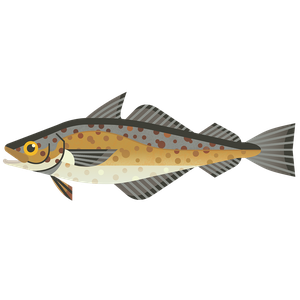
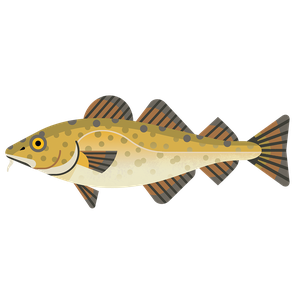
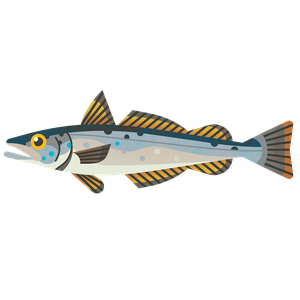
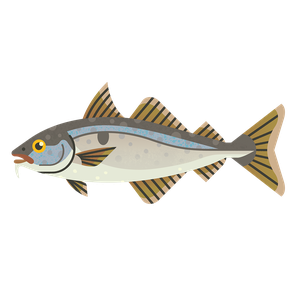
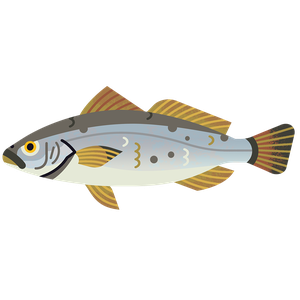
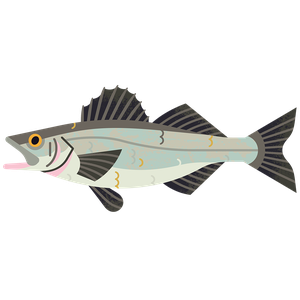
Coley
What to check for
Iceland: All areas
Bottom trawl (otter)
Marine Stewardship Council (MSC)
Rating summary
Icelandic coley, or saithe, is not in an overfished state. However, fishing pressure is slightly too high. There is a management plan in place, which has successfully reduced fishing pressure. Catch limits are set in line with scientific advice and are expected to keep the stock at target levels. All Icelandic saithe landed by the Icelandic fleet is MSC certified. Most catches are by otter trawling, which is likely to cause some damage to the seabed. Bycatch is moderate. There are a number of measures in place to mitigate impacts on species and habitats, but more needs to be done to ensure they are effective.
Rating last updated July 2022.
How we worked out this Rating
References
Gaudian, G., Gascoigne, J., Medley, P., O´Boyle, R. and Cappell, R., 2019. ISF Iceland Multi-Species Demersal Fishery: Public Certification Report. Carried out by Vottunarstofan Tún ehf. on behalf of Iceland Sustainable Fisheries ehf. (ISF). Published on 10 September 2019. Available at https://fisheries.msc.org/en/fisheries/isf-iceland-multi-species-demersal-fishery/@@assessments [Accessed on 15.07.2022].
Government of Iceland, 2018. Management Strategy and Harvest Control Rules Available at https://www.government.is/news/article/2018/05/15/Haddock/ [Accessed on 14.07.2022].
Government of Iceland, 2022. Ministry of Food٫ Agriculture and Fisheries: Fisheries Management. Available at https://www.government.is/topics/business-and-industry/fisheries-in-iceland/fisheries-management/ [Accessed on 14.07.2022].
ICES. 2021. Icelandic Waters ecoregion –Ecosystem overview. In Report of the ICES Advisory Committee, 2021. ICES Advice 2021, Section 11.1, https://doi.org/10.17895/ices.advice.9440 [Accessed on 14.07.2022].
ICES, 2021. Icelandic Waters ecosystem – Fisheries overview. In Report of the ICES Advisory Committee, 2021. ICES Advice 2021, section 11.2. https://doi.org/10.17895/ices.advice.9167 [Accessed on 14.07.2022].
ICES. 2022. Northwestern Working Group (NWWG). ICES Scientific Reports. 4:42. 734 pp. http://doi.org/10.17895/ices.pub.19771381 [Accessed on 14.07.2022].
ICES. 2022. Saithe (Pollachius virens) in Division 5.a (Iceland grounds). In Report of the ICES Advisory Committee, 2022. ICES Advice 2022, pok.27.5a, https://doi.org/10.17895/ices.advice.19453652 [Accessed on 15.07.2022].
MFRI, 2020. State of Marine Stocks and Advice 2020: Fisheries Overview. Marine and Freshwater Research Institute. Published 16 June 2020. Available at https://www.hafogvatn.is/static/files/2020-sidur/00d-fishoverview.pdf [Accessed on 06.07.2021].
MFRI, 2022. MFRI Assessment Reports 2022: Saithe, Pollachius virens. Marine and Freshwater Research Institute, published 15 June 2022. Available at https://www.hafogvatn.is/static/extras/images/03-saithe_tr1325969.pdf [Accessed on 15.07.2022].
MFRI, 2022. State of Marine Stocks and Advice 2022: Saithe, Pollachius virens. Marine and Freshwater Research Institute, published 15 June 2022. Available at https://www.hafogvatn.is/static/extras/images/03-saithe1325968.pdf [Accessed on 15.07.2022].
Poliono, V. and Scarcella, G., 2021. ISF Iceland multi-species demersal fishery: 1st Surveillance Report. Carried out by Global Trust Certification on behalf of Iceland Sustainable Fisheries (ISF). Published on 14 September 2021. Available at https://fisheries.msc.org/en/fisheries/isf-iceland-multi-species-demersal-fishery/@@assessments [Accessed on 15.07.2022].
Reeves, S. A., Bell, J. B., Cambie, G., Davie, S. L., Dolder, P., Hyder, K., Pontalier, H., Radford Z. and Vaughan, D., 2018. An international review of fisheries management regimes. Cefas. Issued 2 August 2018. Available at http://randd.defra.gov.uk/Document.aspx?Document=14357_A_Review_of_International_Fisheries_Management_Regimes.pdf [Accessed on 06.07.2021].