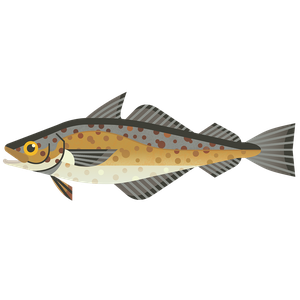
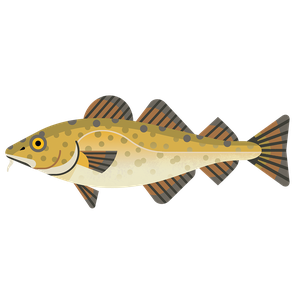
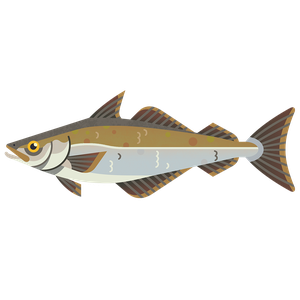
European hake
Merluccius merluccius
What to check for
Location
Northern stock (North Sea, Celtic Seas, Bay of Biscay (north)): Certified fleets only (Cornwall)
Technical location
27 - Atlantic, Northeast, 8b: Bay of Biscay (Central), 8a: Bay of Biscay (North), 8d: Bay of Biscay (Offshore), 7: Irish Sea, Porcupine Bank, English Channel, Bristol Channel, Celtic Seas, West and Southwest of Ireland, 4: North Sea, 6: Rockall, West of Scotland, 3a: Skagerrak and Kattegat
Caught by
Net (gill or fixed)
Certification
Marine Stewardship Council (MSC)
Rating summary
For more information about this rating please visit: http://www.cornwallgoodseafoodguide.org.uk/fish-guide/hake.php
How we worked out this Rating
Stock status
The size and health of a fish population, or 'stock', that is being targeted by fishermen is a crucial indicator of whether a fishery is sustainable. If the stock is too small to withstand fishing, it is at risk of crashing. We look at how big the stock is, and how much pressure there is from fishing, to assess this. The target level that many fisheries aim for is 'Maximum Sustainable Yield' - the most fish that can be caught year after year whilst keeping the population at a healthy size.
Northern hake is not overfished and not subject to overfishing.The most recent stock assessment was published by the International Council for the Exploration of the Sea (ICES) in 2022, using data up to 2022. It defines reference points for fishing pressure (F) and biomass (B). For fishing pressure, there is a target to keep F at or below Maximum Sustainable Yield (MSY). For biomass, there is no target. However, there is a trigger point (MSY BTrigger). Below this level, F should be reduced to allow the stock to increase. Because BMSY is not defined, the Good Fish Guide applies its own definition of 1.4 x MSY BTrigger. The stock assessment was benchmarked in 2022, and the new estimates of stock size are 71% larger over time. Estimates of spawning stock biomass (SSB) now only include females, whereas previously they included males as well.The spawning-stock biomass (SSB) has increased substantially from being outside biologically safe levels in 2006 (around 45,000 tonnes) to peak at almost 300,000t in 2015. It has since declined to 186,358t in 2022. This is well above MSY Btrigger (78,405t). The stock is therefore not in an overfished state.Fishing mortality (F) decreased significantly between 2005 and 2012, and has been fluctuating below levels associated with Maximum Sustainable Yield (FMSY, 0.24) since then. In 2021 it was 0.184 - below FMSY. The stock is therefore not subject to overfishing.ICES advises that when the MSY approach is applied, catches in 2023 should be no more than 83,130 tonnes. This is an 11% increase on the previous year's advice, because of revised new stock assessment.There is some uncertainty in this stock assessment. The biomass surveys don't cover the entire stock distribution area, and changes in distribution are known to increase uncertainty in the assessment. Analyses show that the new assessment tends to revise historical SSB downwards and F upwards when a new year’s data is added. If this pattern continues, this may result in an inflated advised catch.

Management
Good management is vital to be sure that fishing doesn't cause fish populations to decline. We look at whether regulations follow the best available scientific advice, how well compliance is monitored and enforced, and whether this is effective in maintaining healthy fish stocks.
For more information about this rating please visit: http://www.cornwallgoodseafoodguide.org.uk/fish-guide/hake.php
Capture method
Environmental impacts of fishing vary hugely, depending on the method used and where it's happening. We look at whether the fishing gear being used could have an effect on seabed habitats, and if so, how severe might this be. We also review whether it catches any other species by accident (bycatch), and what effect this might have on those species - especially if they're Endangered, Threatened, or Protected.
For more information about this rating please visit: http://www.cornwallgoodseafoodguide.org.uk/fish-guide/hake.php
References
For more information about this rating please visit: http://www.cornwallgoodseafoodguide.org.uk/fish-guide/hake.php
Sustainable swaps
Learn more about how we calculate our sustainability ratings.
How our ratings work
Add impact to your inbox
Join the movement: get updates on the issues you care about.
We'll email you inspiring stories about the work we're doing to save and recover our oceans, and news about our urgent campaigns for positive change.