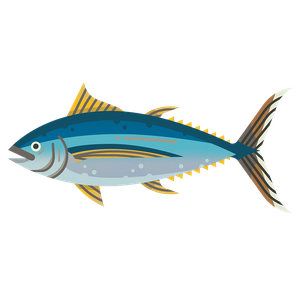
Atlantic bluefin tuna
Thunnus thynnus
What to check for
Location
All areas
Production method
Marine net pen, capture-based
Rating summary
Farming or ranching of Bluefin tuna relies on capture of juvenile wild tunas for on-growing and fattening in open net cages until harvest. Therefore this process is completely reliant on wild fish stocks. There is still concern for the biomass of the stock as the stock is still recovering from very low levels and there is a lack of reference points. Farming in this way will not lessen the pressure on the species. In the case of Mediterranean sea ranching operations, the capture of tuna for ongrowing is an increasing part of the catch. The ranching of tuna requires large amounts of fresh fish for feeding, with an average of 20 kg of wild fish required to produce 1 kg of Bluefin. There are currently no known procedures in place to ensure animal welfare and humane slaughter. Tuna resulting in a significant net loss of fish protein. Management and regulation of ranched tuna in the Mediterranean is only partially effective in mitigating the negative environmental impacts from aquaculture. However, it does seem that farming is incorporated in marine spatial planning.Rating last updated January 2025.
Technical consultation summary
Farming or ranching of Bluefin tuna relies on capture of juvenile wild tunas for on-growing and fattening in open net cages until harvest. Therefore this process is completely reliant on wild fish stocks. There is still concern for the biomass of the stock as the stock is still recovering from very low levels and there is a lack of reference points. Farming in this way will not lessen the pressure on the species. In the case of Mediterranean sea ranching operations, the capture of tuna for ongrowing is an increasing part of the catch. The ranching of tuna requires large amounts of fresh fish for feeding, with an average of 20 kg of wild fish required to produce 1 kg of Bluefin. There are currently no known procedures in place to ensure animal welfare and humane slaughter. Tuna resulting in a significant net loss of fish protein. Management and regulation of ranched tuna in the Mediterranean is only partially effective in mitigating the negative environmental impacts from aquaculture. However, it does seem that farming is incorporated in marine spatial planning.
How we worked out this Rating
Feed
What feed is given to farmed fish, where it comes from and how much is used is one of the most important aspects of fish farming. In this section we look at how sustainable the feed is and how much fish is included in the diet.
Ranched Atlantic Bluefin tuna are fed a diet of whole fish that are untraceable and are a net consumer of protein.Ranched Bluefin tuna are classified as a fed species. However, unlike other farmed fish, they do not receive commercial pelleted feed but are instead fed whole fish. This is primarily composed of a variety of small, pelagic species such as round sardinella, herring, chub mackerel horse mackerel, bogue, and squid. Japan is the primary market for Bluefin tuna, where it is believed that feeding them whole fish enhances both the taste and oil content of the flesh.While the types of fish used for feeding in tuna ranching are generally known, the specific composition of feed fish is not known in most cases because of the commercial nature of the tuna farming industry. It is challenging to determine the exact species and their proportions in the diet, as this information is proprietary to individual companies, hindering transparency and traceability. Some farms are experimenting with alternative feeds, with some incorporating soy, to reduce reliance on baitfish, but the extent of this adoption is unclear.Bluefin tuna have a high protein requirement due to their diet of whole fish, leading to a significant dependence on feed fisheries. Their fast metabolism, combined with a higher blood temperature than most fish, supports their muscle function, aiding in speed and agility. They require far more protein than they produce with an average The feed fish dependency ratio of 20:1, making them a net consumer of protein.
Environment
The environmental impacts of aquaculture depend on what fish is farmed, how and where. It could be habitat damage, chemical use, pollution, freshwater use or parasites. In this section we look at the environmental impacts of greatest concern for that species and production method. Some species, such as shellfish, have very little impact, whilst others may give us cause for concern.
Bluefin Tuna ranching in marine open net pens has a negative impact on the environment.There is limited data on chemical use in tuna ranches, but it is generally believed that the use of chemicals is minimal, and the risk of chemical impacts is considered low. However, there is a lack of regulation and monitoring regarding the discharge of organic waste, which could be significant due to the high demand for feed. While tuna fattening pens are typically located in areas with high water movement and flushing rates, this cannot be confirmed due to insufficient monitoring.Bluefin tuna aquaculture relies on the wild capture of juvenile fish for fattening, meaning it is not a true farming operation that raises fish from hatcheries. This practice does not reduce pressure on wild tuna populations but instead depends on them to supply the farms. Although there have been improvements, concerns remain about biomass levels, as there is no clear indication of the stock's status. The population is recovering from long-term depletion, but uncertainty persists about the extent of this recovery. Overall, the stock is still considered at risk, and further depletion to support tuna ranching is not sustainable.The incidence of parasite transfer to nearby species and regional disease outbreaks is low, but there is a lack of regulation, data, and monitoring on these issues. Similarly, the rate of escapes from tuna farms is low, and since the fish are wild caught, any escapes are unlikely to have a harmful impact on local species.Data on predator control is lacking, and while bycatch occurs during the capture of juvenile tuna, the extent of this bycatch remains unknown.
Fish health and welfare
Fish health and welfare is a concern for many consumers. High welfare standards are an indication of good farm management, we look to see if there are industry wide welfare standards in place, and if these include humane slaughter.
There are currently no known procedures in place to ensure animal welfare and humane slaughter.There are currently no known operating procedures in place for Atlantic Bluefin tuna ranching which are specifically tailored to promote animal welfare and adhere to definitions of humane slaughter. The lack of established reporting procedures means that this area of farming remains data deficient.
Management
How aquaculture is regulated and how effective those regulations are is an important aspect of farmed fish production. We also look to see if aquaculture is included in broader environmental management plans. In this management section we also award scores for globally recognised certification standards, as certified seafood requires verification of environmental performance and traceability.
Management and regulation of ranched tuna in the Mediterranean is only partially effective in mitigating the negative environmental impacts from aquaculture. However, it does seem that farming is incorporated in marine spatial planning.A Multi-Annual Management Plan for Bluefin Tuna in the Eastern Atlantic and the Mediterranean entered into force in 2022 and was updated in 2023. This plan has incorporated several regulations for the tuna aquaculture sector including caging rules, farming capacity and establishing farming management plans.Despite this the overall regulation of the Bluefin tuna production sector appears to be lacking, despite their being a requirement for an Environmental Impact Assessment, all other regulations expected to be in force, in relation to chemical use, discharges, biosecurity and disease management are either not in place or no data is publicly available in relation to them.This assessment is for the uncertified production of Bluefin tuna.
References
Aguado-Giménez, F. and García-García, B., 2005. Growth, food intake and feed conversion rates in captive Atlantic bluefin tuna (Thunnus thynnus Linnaeus, 1758) under fattening conditions. Aquaculture Research, 36(6), pp.610–614.
Aksu, M., Kaymakçı-Başaran, A. and Egemen, Ö., 2010. Long-term monitoring of the impact of a capture-based bluefin tuna aquaculture on water column nutrient levels in the Eastern Aegean Sea, Turkey. Environmental Monitoring and Assessment, 171, pp.681–688.
Collette, B.B., Boustany, A., Fox, W., Graves, J., Juan Jorda, M. and Restrepo, V., 2021. Thunnus thynnus. The IUCN Red List of Threatened Species 2021: e.T21860A46913402. Available at: https://dx.doi.org/10.2305/IUCN.UK.2021-2.RLTS.T21860A46913402.en [Accessed on 09.12.2024].
European Parliament, 2023. Provisional agreement resulting from interinstitutional negotiations. Available at: https://www.europarl.europa.eu/resources/library/media/20230912RES04957/20230912RES04957.pdf [Accessed on 24.10.2024].
GFCM, 2005. Report of the Third Meeting of the Ad Hoc GFCM/ICCAT Working Group on Sustainable Bluefin Tuna Farming/Fattening Practices in the Mediterranean, Rome, 16–18 March 2005. General Fisheries Commission for the Mediterranean and International Commission for the Conservation of Atlantic Tunas (ICCAT). FAO Fisheries Report No. 779.
Grigorakis, K. and Rigos, G., 2011. Aquaculture effects on environmental and public welfare – The case of Mediterranean mariculture. Chemosphere, 85, pp.899–919.
Guillen, J., Asche, F., Carvalho, N., Jean-Noël Druon, Llorente, I., Sciberras, A., Višnić Novaković, S. and Vukov, I., 2024. How sustainable is tuna aquaculture? A methodology to assess the sustainability of seafood production systems. Frontiers in Aquaculture, [online] 3. doi: https://doi.org/10.3389/faquc.2024.1422372 [Accessed on 09.12.2024].
Jelić Mrčelić, G., Nerlović, V., Slišković, M. and Zubak Čižmek, I., 2023. An Overview of Atlantic Bluefin Tuna Farming Sustainability in the Mediterranean with Special Regards to the Republic of Croatia. Sustainability, [online] 15(4), p.2976. doi: https://doi.org/10.3390/su15042976 [Accessed on 09.12.2024].
Lines, J. and Spence, J., 2014. Humane harvesting and slaughter of farmed fish. Revue Scientifique et Technique (International Office of Epizootics), 33, pp.255–264.
MSC, 2024. MSC UK Tuna Shopper Report 2023. Available at: https://www.msc.org/docs/default-source/uk-files/msc-uk-tuna-shopper-report-2023.pdf?Status=Master&sfvrsn=5309aa2f_3%2F+MSC-UK-Tuna-Shopper-Report-2023+.pdf [Accessed on 09.12.2024].
Mylonas, C., De La Gándara, F., Corriero, A. and Ríos, A., 2010. Atlantic Bluefin Tuna (Thunnus thynnus) farming and fattening in the Mediterranean Sea. Reviews in Fisheries Science, 8(3), pp.266–280.
Ottolenghi, F., 2008. Capture-based aquaculture of bluefin tuna. In: A. Lovatelli and P.F. Holthus, eds., Capture-based aquaculture: Global overview. FAO Fisheries Technical Paper No. 508. Rome: FAO, pp.169–182.
Report of the 2024 ICCAT Intersessional Meeting of Bluefin Tuna Species Group (BFTSG), 2024. Available at: https://www.iccat.int/Documents/Meetings/Docs/2024/Reports/2024_BFT_ENG.pdf [Accessed on 09.12.2024].
REPORT OF THE STANDING COMMITTEE ON RESEARCH AND STATISTICS (SCRS), 2024. Available at: https://www.iccat.int/Documents/Meetings/Docs/2024/Reports/2024_SCRS_REV_ENG.pdf [Accessed on 09.12.2024].
Seafood Watch, 2016. Farmed Mediterranean Bluefin Tuna Report. Available at: https://www.seafoodwatch.org/-/m/sfw/pdf/reports/t/mba_seafoodwatch_bluefintuna_mediterraneanfarmedreport.pdf [Accessed on 09.12.2024].
Seafood Watch, 2021. Farmed Mediterranean Bluefin Tuna Report. Available at: https://www.seafoodwatch.org/globalassets/sfw-data-blocks/reports/t/mba_seafoodwatch_farmed_bluefin_tuna_mediterranean.pdf [Accessed on 09.12.2024].
Spatial Analysis of Fish Farming in the Gulluk Bay (Eastern Aegean), 2013. Available at: http://www.trjfas.org/uploads/pdf_188.pdf [Accessed on 09.12.2024].
UK Government, 2024. Atlantic Bluefin Tuna fishing plan 2024. Available at: https://www.gov.uk/government/news/atlantic-bluefin-tuna-fishing-plan-2024 [Accessed on 09.12.2024].
UNEP-MAP, n.d. Mediterranean Action Plan. Available at: https://web.unep.org/unepmap/who-we-are/mediterranean-action-plan [Accessed on 09.12.2024].
Vita, R. and Marín, A., 2007. Environmental impact of capture-based bluefin tuna aquaculture on benthic communities in the western Mediterranean. Aquaculture Research, 38, pp.331–339.
Vizzini, S. and Mazzola, A., 2012. Tracking multiple pathways of waste from a northern bluefin tuna farm in a marine-coastal area. Marine Environmental Research, 77, pp.103–111.
Sustainable swaps
Learn more about how we calculate our sustainability ratings.
How our ratings work
Add impact to your inbox
Join the movement: get updates on the issues you care about.
We'll email you inspiring stories about the work we're doing to save and recover our oceans, and news about our urgent campaigns for positive change.