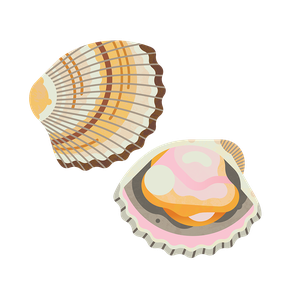
King scallop
Pecten maximus
What to check for
Location
England
Production method
Culture, suspension
Rating summary
Scallops farmed in the UK in suspended rope culture and bottom culture have little environmental impact and do not require any commercial feed sources as they get all of their nutrient requirements from the surrounding water. Scallop aquaculture is entirely sea-based and habitat concerns are minimal. Scallop culture generally does not involve the use of chemicals and there is no concern about the impact of effluents. Spat used for farming are either collected from the wild or settle naturally and research into development of a hatchery is ongoing. Disease risk and parasite interactions are thought to be minimal and do not threaten regional level populations. Currently, no independently certified scallops are available.Rating last updated March 2024.
Technical consultation summary
Scallops farmed in the UK in suspended rope culture and bottom culture have little environmental impact and do not require any commercial feed sources as they get all of their nutrient requirements from the surrounding water. Scallop aquaculture is entirely sea-based and habitat concerns are minimal. Scallop culture generally does not involve the use of chemicals and there is no concern about the impact of effluents. Spat used for farming are either collected from the wild or settle naturally and research into development of a hatchery is ongoing. Disease risk and parasite interactions are thought to be minimal and do not threaten regional level populations. Currently, no independently certified scallops are available.
How we worked out this Rating
Feed
What feed is given to farmed fish, where it comes from and how much is used is one of the most important aspects of fish farming. In this section we look at how sustainable the feed is and how much fish is included in the diet.
Farmed scallops are filter feeders and do not require any commercial feed sources, as they get all their nutrient requirements from the surrounding water.
Environment
The environmental impacts of aquaculture depend on what fish is farmed, how and where. It could be habitat damage, chemical use, pollution, freshwater use or parasites. In this section we look at the environmental impacts of greatest concern for that species and production method. Some species, such as shellfish, have very little impact, whilst others may give us cause for concern.
Suspended scallop cultures and bottom scallop cultures have minimal impacts on the environment.Overall, scallop aquaculture in England performs well on environmental impacts. Scallops used in aquaculture can be found naturally in the marine environment. They live on sand or gravel sea beds, therefore culture is entirely sea-based. Habitat concerns resulting from the physical infrastructure associated with suspended scallop culture and hand harvesting are minimal. For bottom culture methods, dredging has the potential to have significant habitat impacts. However, tows for farmed scallops are generally much shorter than for wild-caught and farming takes place in shallow coastal areas which can recover from major disturbances within a few weeks or months. A variety of shellfish predators exist among scallop farms, including echinoderms, gastropods, crustaceans, fishes, and seabirds. Methods used to cultivate and harvest scallops in suspended rope generally do not result in direct impacts to predators. Scallop harvesting by dredge can result in an immediate decline in abundance and biomass of all species, but the decline is often followed by rapid benthic recovery. Passive and benign barrier yields are used to prohibit predators and are removed manually without lethal control.Scallop culture generally does not involve the application of chemicals (e.g. antibiotics, pesticides, herbicides, fertilizers) to control fouling and predators or to prevent disease. The amount of chemicals used in scallop culture is thought to be nominal, if at all. In addition, the water in which chemicals would be used is generally not released into the marine environment and therefore, there is no threat of chemical contamination to adjacent waters or organisms. As farmed scallops are not provided external feed and there is no nutrient fertilisation, there is no concern about the impact of effluents. However, there can be a concern over changes in the sedimentary environment due to bio deposition and sediment trapping. These changes are limited to the farm site and are not considered to extend beyond the immediate vicinity if the farm. Furthermore, scallop farming has been shown to increase water quality at the farm site through removal of excess nutrients and phytoplankton.Aquaculture systems that are open to the environment tend to pose a risk for disease and parasite interaction with wild populations. However, relatively few diseases have been reported in scallops and good management practices ensure that the risk is low. Disease outbreaks have not affected regional level populations.
Fish health and welfare
Fish health and welfare is a concern for many consumers. High welfare standards are an indication of good farm management, we look to see if there are industry wide welfare standards in place, and if these include humane slaughter.
Animal welfare is not applicable for shellfish as it is not covered by the assimilated EU[BS1] regulations on welfare. Humane slaughter has been carried out by RSPCA definitions.
Management
How aquaculture is regulated and how effective those regulations are is an important aspect of farmed fish production. We also look to see if aquaculture is included in broader environmental management plans. In this management section we also award scores for globally recognised certification standards, as certified seafood requires verification of environmental performance and traceability.
This assessment scores well for management measures but would benefit from third party certification.This assessment covers uncertified scallops produced in England.Aquaculture policy in the UK is a devolved matter, with the separate administrations of Wales, England, Northern Ireland and Scotland responsible for its collective oversight. There is a total of 73 shellfish aquaculture sites in England and Wales, 55 in Northern Ireland and 328 in Scotland. In England, the Marine Management Organisation has prepared marine plans for 11 predefined areas in England, covering 6 individual marine plans. The East Marine Plans were adopted in April 2014, the South Marine Plans in July 2018, and the Northeast, North West, South East and South West Marine Plans in June 2021. England now has a complete and integrated marine planning framework to guide the usage, development, protection, and enhancement our marine environment.In the UK, the regulations regarding the environmental impacts of aquaculture are either not applicable or are in place and are fully effective. These include the Conservation of Habitats and Species (Amendment) (EU Exit) Regulations 2019, which was transposed from the Habitats Directive 92/43/EEC and Birds Directive 2009/147/EC. This is the cornerstone of nature conservation policy and the protection of valuable habitats and species. There are also regulations in place to cover the use of land and water resources, discharges including effluents and their impacts, biosecurity and disease management.
References
CEFAS. 2014. CEFAS Report: Background information for sustainable aquaculture development, addressing environmental protection in particular. Available at: https://ec.europa.eu/environment/enveco/water/pdf/SUSAQ%20Final%20Report%20Part%201.pdf [Accessed 21.02.2024]
DAERA. 2022. Marine Plan for Northern Ireland. Available at: https://www.daera-ni.gov.uk/articles/marine-plan-northern-ireland [Accessed: 12.03.2024]
DEFRA. 2021. Policy paper: Changes to the Habitat Regulations 2017. Available at: https://www.gov.uk/government/publications/changes-to-the-habitats-regulations-2017/changes-to-the-habitats-regulations-2017. [Accessed 11.03.2024].
DEFRA. 2015. United Kingdom multiannual national plan for the development of sustainable aquaculture. Available at: https://assets.publishing.service.gov.uk/government/uploads/system/uploads/attachment_data/file/480928/sustainable-aquaculture-manp-uk-2015.pdf [Accessed: 12.03.2024]
FAO. 2024. Species Fact Sheets: Pecten Maximus,1758. Fisheries and Aquaculture Division [online]. Rome. Available at https://www.fao.org/fishery/en/aqspecies/3516/en. [Accessed on 21.02.2024].
Holland, J., 2015. What’s next for the U.K. shellfish industry. Available at: https://www.seafoodsource.com/features/what-next-for-the-u-k-shellfish-industry [Accessed 21.02.2024]
ICES. 2020. Scallop Assessment Working Group (WGSCALLOP). ICES Scientific Reports. 2:111. 57 pp. Available at: http://doi.org/10.17895/ices.pub.7626 [Accessed 21.02.2024].
MMO. 2023. Identification of strategic areas of sustainable aquaculture production in English waters: Final Report (MMO1184) Available at: https://assets.publishing.service.gov.uk/media/652d25a0697260000dccf864/MMO1184_FinalReport_Method_16102023.pdf__1_.pdf [Accessed on 12.03.2024].
Monetary Bay Aquarium Seafood Watch. 2021. Farmed Scallops: Worldwide – Bottom and off-bottom culture. Available at : https://www.seafoodwatch.org/globalassets/sfw-data-blocks/reports/s/mba_seafoodwatch_scallops_global_report.pdf [Accessed on 21.02.2024].
Seafish. 2024. Scallops. Available at: https://www.seafish.org/responsible-sourcing/aquaculture-farming-seafood/species-farmed-in-aquaculture/aquaculture-profiles/scallops/ [Accessed: 19.03.2024]
Torbay Council. 2019. Torbay Port Masterplan. Addendum 2019-2024. Available online at: https://www.tor-bay-harbour.co.uk/media/1376/port-masterplan-addendum.pdf [Accessed 12.03.2024]
UK Legislation. 2019. The Aquatic Animal Health and Alien Species in Aquaculture (Amendment etc.) (EU Exit) Regulations 2019, No. 451. Available at: https://www.legislation.gov.uk/uksi/2019/451/contents. [Accessed 11.03.2024].
Sustainable swaps
Learn more about how we calculate our sustainability ratings.
How our ratings work
Add impact to your inbox
Join the movement: get updates on the issues you care about.
We'll email you inspiring stories about the work we're doing to save and recover our oceans, and news about our urgent campaigns for positive change.