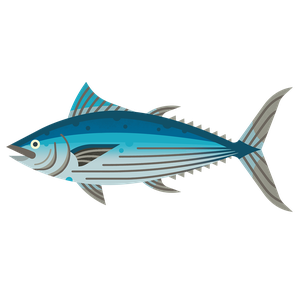
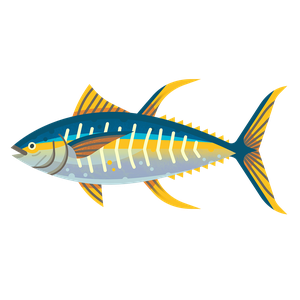
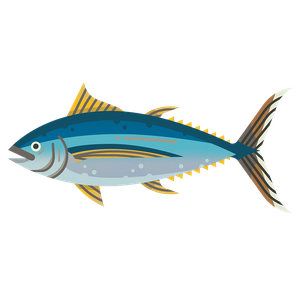
Pacific bluefin tuna
Thunnus orientalis
What to check for
Location
Pacific Ocean: All areas
Technical location
77 - Pacific, Eastern Central, 67 - Pacific, Northeast, 61 - Pacific, Northwest, 87 - Pacific, Southeast, 81 - Pacific, Southwest, 71 - Pacific, Western Central, All areas, All areas, All areas, All areas, All areas, All areas
Caught by
Net (purse seine on aggregating devices or free-schooling fish)
Rating summary
Pacific bluefin tuna remains in a overfished state, with fishing pressure still too high, although the stock is showing signs of gradual recovery from historically low levels. Current management measures appear to be supporting rebuilding; however, the rebuilding plan is not precautionary, as it allows catch levels to increase while the stock remains severely depleted. Approximately half of Pacific bluefin tuna catches are taken by purse‑seine fisheries, a fishing method associated with bycatch of vulnerable species, including sharks, sea turtles and marine mammals.Rating last updated January 2026.
How we worked out this Rating
Stock status
The size and health of a fish population, or 'stock', that is being targeted by fishermen is a crucial indicator of whether a fishery is sustainable. If the stock is too small to withstand fishing, it is at risk of crashing. We look at how big the stock is, and how much pressure there is from fishing, to assess this. The target level that many fisheries aim for is 'Maximum Sustainable Yield' - the most fish that can be caught year after year whilst keeping the population at a healthy size.
There is concern for the biomass and fishing pressure of Pacific bluefin tuna. The stock has been gradually recovering and rebuilding targets continue to be met ahead of schedule, but the stock assessment still lacks formal reference points.Route 2 (data limited) scoring has been applied to this rating owing to the lack of reference points for biomass and fishing pressure. Pacific bluefin tuna is considered to have medium resilience to fishing.Pacific bluefin tuna is assessed by the International Scientific Committee for Tuna and Tuna-like species in the North Pacific (ISC). It has a single Pacific-wide stock managed by both the Western and Central Pacific Fisheries Commission (WCPFC) and the Inter-American Tropical Tuna Commission (IATTC). The last stock assessment was carried out in 2024 using data up to 2022. The next assessment is expected in 2026.This species has been fished since the early 1800s. Historical catch records are poor, but catches appear to have peaked before the 1940s at about 50,000t. After this, they fluctuated widely, and are now around 18,000t.Biomass, expressed as spawning stock biomass (SSB), declined steadily from approximately 150,000 t in the early 1960s to 12,600 t by the mid‑1980s. Following a brief period of improvement, SSB fell again to a historic low of 10,800 t in 2010, representing just 1.7% of estimated unfished levels. SSB has shown gradual recovery since then, increasing to 5.6% in 2018 and 10.2% in 2020.Although there is no formal reference point for determining stock status, the initial rebuilding target was to reach 6.3% of unfished biomass by 2024. This milestone was achieved in 2019, five years ahead of schedule. The subsequent management target, 20% of unfished levels by 2029, was also met early, with SSB estimated at 23.2% in 2022.The Marine Conservation Society considers 20% of unfished biomass to be equivalent to Blim. Below this level, and in line with common reference points used for tuna stocks, the stock would be considered outside safe biological limits. As SSB has now risen above this threshold, the stock is no longer assessed as being outside safe biological limits. However, it is still classified as overfished and therefore there is concern for biomass levels.Fishing mortality (F) is measured as spawning potential ratio (SPR) - the reproductive potential of fish at the current fishing pressure compared to an absence of any fishing. F was at 1% SPR from 2004-2009 and has since improved to 23.6% SPR for 2020 - 2022. To achieve a biomass of 20% of unfished levels, the corresponding F would also be 20% SPR. Therefore, fishing mortality is at a level that should allow the stock to increase above Blim. However, this is not the level of fishing pressure that would be associated with a long-term sustainable Maximum Sustainable Yield - that target has not been defined. It is often set at 30% or 40% for other tuna stocks. It is therefore not possible to know whether the stock is subject to overfishing, therefore there is concern for fishing pressure.There is not yet a formally adopted target for the long term but maintaining the stock at levels capable of producing maximum sustainable yield is considered as a potential target.
Management
Good management is vital to be sure that fishing doesn't cause fish populations to decline. We look at whether regulations follow the best available scientific advice, how well compliance is monitored and enforced, and whether this is effective in maintaining healthy fish stocks.
Management appears to be recovering Pacific bluefin tuna from historically low levels. However, the rebuilding plan is not precautionary as it is allowing catches to increase while the stock remains severely depleted.Tuna, marlin, and swordfish are highly migratory species, found on the high seas and in numerous countries' waters. This makes harmonised and effective management challenging. Regional Fisheries Management Organisations (RFMOs) are responsible for monitoring and managing these stocks on behalf of the countries that access them. However, the degree to which management is implemented, monitored and enforced by each country varies significantly.Pacific bluefin tuna (PBF) is a single Pacific-wide stock managed by the Western and Central Pacific Fisheries Commission (WCPFC) in the west, and the Inter-American Tropical Tuna Commission (IATTC) in the east. The impact of fisheries in the WCPFC convention area on PBF (83%) is far greater than that of fisheries in the IATTC area (17%), and so management measures by WCPFC are considered to be of greater importance. However, management must be comparable and properly implemented across the entire range of the stock in order for it to be effective. The IATTC and WCPFC endeavour to work together to promote compatibility between their respective conservation and management measures across the Pacific, but this is not always achieved.PBF has been badly managed in the past, with a lack of regulation and enforcement across its range. Contributing to this has been its extremely high market value, adding incentive for Illegal, Unreported and Unregulated (IUU) fisheries. In 2010 the stock had dropped to just 1.7% of its unfished levels. A Northern Committee working group comprising IATTC, WCPFC and others was established in 2016 to support joint working on Pacific bluefin tuna. The main management measures are a rebuilding plan and harvest strategy.The rebuilding plan, started in 2015, has an initial goal of rebuilding the spawning biomass (SB) to the historical median, 40,994t, by 2024 with at least 60% probability. This would take the SB to 6.4% of unfished levels. This was reached in 2019, ahead of schedule. A second rebuilding target was adopted in 2018: to reach 20% of unfished levels within 10 years of reaching the initial target (i.e. by 2029) with at least 60% probability. Current management measures are on track to achieve and potentially exceed this target. Management therefore appears to be effectively rebuilding the stock.There is also a harvest strategy in place for the stock. If the probability of achieving the rebuilding target drops to less than 60%, catches of small fish (below 30kg) should be reduced. If the probability is above 75%, overall catches are allowed to increase (with some restrictions). This potential for increasing catches, even when the stock is in a highly depleted state, is concerning. In the 2020 stock assessment, recruitment for 2017 and 2018 was estimated to be the lowest since early 1990s. Scientific advice is that future recruitments may remain low until there is sufficient recovery in spawning biomass. Therefore, scientists have urged the commissions to take a precautionary approach to the management of Pacific Bluefin tuna. Management does not appear to be taking a precautionary approach.There are catch limits, set differently by the two RFMOs.In the northern WCPFC area (north of 20 degrees N), fishing effort is frozen to each fleet's 2002-2004 average. Countries appear to be staying within those limits. Catch for the whole area is frozen to 2002-2004 levels for large bluefin (over 30kg). The catch limits up to 2021 equated to around 14,000t. For 2022, the limit was increased by 15% for large bluefin (catches can now be 115% of the 2002-2004 average).In the IATTC area, total catch limits are set for 2-year periods. The 2021-2022 limit was 7,295t, increasing to 7,990t for 23-24. IATTC report 40% catch reductions in their area since 2012 through resolutions and voluntary measures. IATTC's scientific committee has recommended that WCPFC do more to limit catches of adult bluefin.According to the International Scientific Committee for Tuna and Tuna-like species in the North Pacific (ISC), total PBF catches in 2021 were 14,766t. This is above the 2017-2021 average (13,000t). As noted above, increasing catch limits at this early stage of recovery is not precautionary.Both RFMOs require reductions in catches of 'small' PBF (below 30kg). In the WCPFC area the limit is 50% of 2002-2004 average levels. In the IATTC area the limit is 50% of the total catch. Juvenile Pacific bluefin tuna can weigh up to 85kg, so this does not protect juveniles.Monitoring of the fisheries is not high enough for some fleets. Both RFMOs have 100% observer coverage on large purse seiners but only 5% on large longliners. A minimum of 20% is recommended for accurate data. In addition, data recorded by longliners in the IATTC area is considered inadequate for scientific purposes and minimum data standards must be identified and introduced.To help address illegal, unregulated and unreported fishing, WCPFC and IATTC maintain an IUU Vessel List; a register of authorised large longliners; and prohibit transhipments at sea for large purse seiners, and most other transhipments must be documented and observed as part of the regional observer programme. Countries are required to report annually on monitoring, control and compliance of management measures. There is also a joint WCPFC-IATTC catch documentation scheme (CDS) for PBF.
Capture method
Environmental impacts of fishing vary hugely, depending on the method used and where it's happening. We look at whether the fishing gear being used could have an effect on seabed habitats, and if so, how severe might this be. We also review whether it catches any other species by accident (bycatch), and what effect this might have on those species - especially if they're Endangered, Threatened, or Protected.
Half the catch of Pacific bluefin tuna is by purse seine. This method is associated with bycatch of species such as sharks, turtles and marine mammals.Around 50% of Pacific bluefin catches are by purse seining, 31% by gillnet and trolling and 19% by longlining. In the Eastern Pacific, most of the catches are transported to holding pens, where the fish are held for fattening and later sale to sashimi markets. These fisheries catch a very high proportion of juvenile fish (although recent juvenile fishing mortality has been lower than in previous years).Purse seining is associated with bycatch of species such as sharks, turtles and marine mammals, although less so than longlining. Bycatch is higher when FADs are used. FADs are floating objects that tuna and other species tend to aggregate around. It is estimated that 1.1% of the total catch (by weight) in FAD fisheries in the western Pacific is non-target species, as opposed to 0.3% in free-schooling fisheries. Analyses in 2018 and 2019 found that the giant manta ray, bigeye and pelagic thresher sharks, smooth and scalloped hammerhead sharks, and silky shark are highly vulnerable to purse seining in the eastern Pacific Ocean. It is currently not possible to assess the state of most sharks and mobulid ray species to understand what impact this has on populations. In 2020, an estimated 1.7 million sharks were caught as bycatch or had an interaction with western Pacific fisheries. Bycatch species include bigeye thresher, shortfin mako, and silky. Of greatest concern is oceanic whitetip shark, which is in a severely overfished state and critically endangered.A number of Endangered and Critically Endangered species are caught as bycatch in Pacific longline fisheries. Data on impacts is poor, partly because there are not enough scientific observers on vessels. Observer coverage is only required to be 5%, and recommendations are for at least 20%. Some mitigation measures are in place, but they often don't follow scientific recommendations for best practice, and their effectiveness has not been evaluated. Modelling has estimated that between 13,000 and 19,000 seabirds were killed in western Pacific longline and purse seine fisheries from 2015 to 2018. There were over 3,000 seabird deaths from eastern Pacific longlining in 2019, which is a minimum estimate given the significant data gaps. The required mitigation measures do not follow recommended best practice by ACAP (the Agreement on the Conservation of Albatrosses and Petrels). IATTC and WCPFC require one or more measures (depending on location) from a set list of options, including weighted branch lines, bird scaring lines and night setting. ACAP recommends the simultaneous use of all three, or hook-shielding or underwater bait setting devices.Gillnets used for catching tuna and tuna-like species can be 7km long and are known for extremely high bycatch including turtles, whales, dolphins, whale sharks, mobulids, requiem sharks and sunfish. WCPFC bans the use of gillnets over 2.5km long, but monitoring is poor. There is no available data on bycatch by gillnet fisheries in the WCPO. Globally, an estimated 400,000 birds are killed each year in gillnets. Some of the highest bycatch rates are in the northwest Pacific.
References
ACAP, 2024. ACAP Review of mitigation measures and Best Practice Advice for Reducing the Impact of Pelagic Longline Fisheries on Seabirds. Reviewed at the Fourteenth Meeting of the Advisory Committee, Lima, Peru 12- 16 August 2024. Available at https://www.acap.aq/resources/bycatch-mitigation/mitigation-advice/4840-acap-2024-pelagic-longlines-mitigation-review-bpa/file [Accessed on 21.01.2026].
IATTC, 2026. Inter-American Tropical Tuna Commission: IATTC Resolutions. Available at https://www.iattc.org/en-US/Resolution/Type/IATTC [Accessed on 21.01.2026].
IATTC, 2025. Report on the tuna fishery, stocks, and ecosystem in the Eastern Pacific Ocean in 2024. No-23-2025 . Available at https://www.iattc.org/GetAttachment/02c5d8e6-6d9b-42b3-a943-a6873f75deac/No-23-2025_The-tuna-fishery-in-the-Eastern-Pacific-Ocean-in-2024_EN.pdf [Accessed on 21.01.2026].
ISC, 2024. Stock Assessment of Pacific Bluefin Tuna in the Pacific Ocean in 2022. ISC/22/ANNEX/13. 24nd Meeting of the International Scientific Committee for Tuna and Tuna-Like Species in the North Pacific Ocean. Victoria, Canada, 19-24 June 2024. Available at https://isc.fra.go.jp/pdf/ISC24/ISC24_ANNEX13-Pacific_Bluefin_Tuna_Stock_Assessment_in_2024-FINAL.pdf [Accessed on 21.01.2026].
Murua, H., Dagorn, L., Justel-Rubio, A., Moreno, G. and Restrepo, V. 2021. Questions and Answers about FADs and Bycatch (Version 3). ISSF Technical Report 2021-11. International Seafood Sustainability Foundation, Washington, D.C., USA. Available at: https://www.iss-foundation.org/downloads/22377/.
Peatman, T., Abraham, E., Ochi, D., Webber, D. and Smith, N., 2019. Project 68: Estimation of seabird mortality across the WCPFC Convention Area. WCPFC-SC15-2019/EB-WP-03. 15th Regular Session of the Scientific Committee, Pohnpei, Federated States of Micronesia, 12-20 August 2019. Available at https://meetings.wcpfc.int/file/7140/download [Accessed on 21.01.2026].
WCPFC, 2024. Joint IATTC and WCPFC‑NC Working Group Meeting on the Management of Pacific Bluefin Tuna – Ninth Session (JWG‑09) WCPFC-NC20-2024/WP-02. Kushiro, Hokkaido, Japan, 10-13 July 2024. Available at https://meetings.wcpfc.int/file/15041/download [Accessed on 21.01.2026].
WCPFC, 2025. Conservation and Management Measures of the Western and Central Pacific Fisheries Commission. Available at https://www.wcpfc.int/conservation-and-management-measures [Accessed on 21.01.2026]
WCPFC, 2024. Public domain Bycatch data (Bycatch Data Exchange Protocol – BDEP), Regional Observer Programme (ROP) Database. Last updated 6 November 2024. Available at https://www.wcpfc.int/sustainability/bycatch-mitigation/public-domain-bycatch-data [Accessed on 21.01.2026].
WCPFC, 2025. Ecosystem and Climate Indicators. WCPFC22-2025-16. Twenty-Second Regular Session of the Scientific Committee. Manila, Philippines (Hybrid). Available at https://meetings.wcpfc.int/file/19449/download [Accessed on 21.01.2026].
Zydelis, R., Small, C. and French, G., 2013. The incidental catch of seabirds in gillnet fisheries: A global review. Biol Cons 162. pp. 76-88. http://dx.doi.org/10.1016/j.biocon.2013.04.002.
Sustainable swaps
Learn more about how we calculate our sustainability ratings.
How our ratings work
Add impact to your inbox
Join the movement: get updates on the issues you care about.
We'll email you inspiring stories about the work we're doing to save and recover our oceans, and news about our urgent campaigns for positive change.