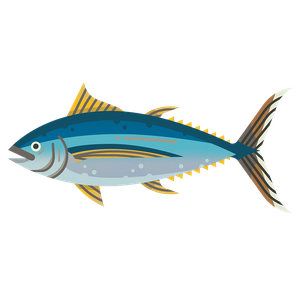
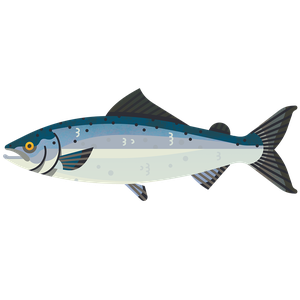
Yellowfin tuna
Thunnus albacares
What to check for
Location
Atlantic: All areas
Technical location
34 - Atlantic, Eastern Central, 27 - Atlantic, Northeast, 21 - Atlantic, Northwest, 47 - Atlantic, Southeast, 41 - Atlantic, Southwest, 31 - Atlantic, Western Central, All areas, All areas, All areas, All areas, All areas, All areas
Caught by
Hook & line (handline), Hook & line (pole & line), Hook & line (troll)
Rating summary
Atlantic yellowfin tuna is not overfished and is not subject to overfishing. However, there is some uncertainty in this assessment, and recent catches have been above recommended levels, which could cause the stock to decline. Few appropriate management measures are in place. Management is not effective at controlling fishing pressure on this stock as catch limits have been exceeded in every year since 2015. Some yellowfin tuna in the Atlantic are caught by surface fisheries such as troll, handline, and pole & line. These are generally low-impact methods.Rating last updated January 2026.
How we worked out this Rating
Stock status
The size and health of a fish population, or 'stock', that is being targeted by fishermen is a crucial indicator of whether a fishery is sustainable. If the stock is too small to withstand fishing, it is at risk of crashing. We look at how big the stock is, and how much pressure there is from fishing, to assess this. The target level that many fisheries aim for is 'Maximum Sustainable Yield' - the most fish that can be caught year after year whilst keeping the population at a healthy size.
Atlantic yellowfin tuna is not overfished and is not subject to overfishing. However, there is some uncertainty in this assessment, and recent catches have been above recommended levels, which could cause the stock to decline.Yellowfin tuna in the Atlantic is assessed by the International Commission for the Conservation of Atlantic Tunas (ICCAT). The last stock assessment was carried out in 2024, using data up to 2022.Catches of yellowfin declined from their peak of 190,000 tonnes in 1990 to 100,000t in 2007, and subsequently rose to an average of 141,000 tonnes from 2020-2024. Biomass has continuously declined throughout the lifetime of the fishery, while fishing mortality has been increasing since the mid-2000s.In 2022, biomass (B) was 37% above biomass levels associated with Maximum Sustainable Yield (SSB MSY). Therefore, the stock is not in an overfished state.Fishing mortality (F) in 2022 was 89% of the fishing pressure levels associated with FMSY. Therefore, the stock is not subject to overfishing.The catch in 2024 was 140,300 tonnes. This is of concern to the scientific committee because it exceeds the adopted catch limit (110,000t) and has exceeded MSY (122,000t) every year since 2015. Projections indicate that catches above 120,000t would cause biomass to decline. At 140,000 tonnes, there is a 48% probability that the stock will be above BMSY and below FMSY by 2030.Some catches are on Fish Aggregating Devices (FADs), which tend to catch smaller tunas, including juveniles. The scientific committee has highlighted that increased catches of small yellowfin (and small bigeye, as they are caught together on FADs) will have negative effects on stock size and future harvest rates.
Management
Good management is vital to be sure that fishing doesn't cause fish populations to decline. We look at whether regulations follow the best available scientific advice, how well compliance is monitored and enforced, and whether this is effective in maintaining healthy fish stocks.
Few appropriate management measures are in place. Management is not effective at controlling fishing pressure on this stock. Catch limits have been exceeded in every year since 2015, at levels that are expected to cause the stock to decline.Tuna, marlin and swordfish are highly migratory species that occur both on the high seas and within the waters of multiple coastal states, making harmonised and effective management challenging. Regional Fisheries Management Organisations (RFMOs) are therefore responsible for the assessment, management and monitoring of these stocks on behalf of their member countries. However, the extent to which agreed measures are implemented, monitored and enforced varies considerably between countries.Atlantic yellowfin tuna is managed and assessed by the International Commission for the Conservation of Atlantic Tunas (ICCAT). Core management measures include an overall Total Allowable Catch (TAC), restrictions on fishing capacity and gear, and controls on fishing practices, particularly the use of Fish Aggregating Devices (FADs).An overall TAC of 110,000 tonnes, unallocated by country, has been in place since 2012. Scientific advice indicates that maintaining catches at 120,000 tonnes or less would be expected to sustain the stock in a healthy condition through to 2033, suggesting that the TAC itself is broadly aligned with scientific advice. However, total catches have exceeded the TAC every year since 2015. Average reported catches between 2020 and 2024 were approximately 141,000 tonnes, a level expected to lead to stock decline. ICCAT’s scientific committee has consequently concluded that existing conservation and management measures are insufficient and require strengthening.Most yellowfin tuna catches are taken by purse seine fisheries, many of which deploy FADs. FADs aggregate tuna and other pelagic species, increasing fishing efficiency but also resulting in high catches of juvenile fish, which can negatively affect population growth. In European purse‑seine fleets, which account for the majority of landings, the average size of yellowfin has declined to around half of the average weight observed in 1990, at least partly due to increased fishing on FADs and the capture of smaller individuals.To address these impacts, ICCAT has implemented a multi‑annual management plan for tropical tunas, covering yellowfin and bigeye tuna since 2012, and eastern skipjack since 2015, with a strong focus on FAD management. Early measures included a two‑month FAD fishing ban in areas of high juvenile abundance and a limit of 500 FADs per vessel. As these measures did not sufficiently reduce juvenile mortality, additional restrictions were introduced. The number of operational FADs per vessel was reduced to 300 in 2021–2022, and a full‑area FAD closure lasting 72 days was implemented in 2022. For 2025, ICCAT has agreed a 45‑day closure (17 March–30 April) during which purse‑seine and baitboat vessels are prohibited from fishing on floating objects in both the high seas and EEZs, alongside a 15‑day pre‑closure ban on deploying drifting FADs.Further measures include limits on the number of FADs with operational buoys, set at 300 per vessel in 2025 and reducing to 288 in 2026 and 2027, with CPCs encouraged not to exceed their 2018 FAD fishing effort levels. CPCs with purse‑seine or baitboat fisheries are also required to submit annual FAD management plans. To reduce bycatch and environmental impacts, ICCAT requires that from 1 January 2025, all FADs deployed or redeployed must be non‑entangling, and has agreed a stepwise transition to biodegradable FADs between January 2025 and January 2028, excluding tracking buoys.Additional conservation measures include a ban on discarding skipjack, yellowfin and bigeye tuna, meaning all catches must be landed, and a tagging programme aimed at improving stock assessments and evaluating management effectiveness. This programme contributed to improvements in the 2019 yellowfin assessment.There is also a ban on drift nets (introduced by the EU in 2002 and by ICCAT in the Mediterranean in 2003), restrictions on at‑sea transhipment unless pre‑authorised and observer‑covered, and the maintenance of IUU vessel lists.Observer coverage requirements are 100% for purse‑seine vessels targeting tropical tunas and 10% for large longline vessels, although compliance remains uneven and falls short of the 20% coverage recommended by scientists for robust data collection. Vessel Monitoring Systems (VMS) are mandatory for all vessels over 24 metres, and work is ongoing to expand electronic monitoring systems.Despite this range of measures, persistent TAC overruns, continued high juvenile mortality, and uneven implementation and enforcement indicate that current management remains inadequate to ensure the long‑term sustainability of Atlantic yellowfin tuna.

Capture method
Environmental impacts of fishing vary hugely, depending on the method used and where it's happening. We look at whether the fishing gear being used could have an effect on seabed habitats, and if so, how severe might this be. We also review whether it catches any other species by accident (bycatch), and what effect this might have on those species - especially if they're Endangered, Threatened, or Protected.
Some yellowfin tuna in the Atlantic are caught by surface fisheries such as troll, handline, and pole & line. These are generally low-impact methods.Traditional surface fisheries, including trolling, handlining, and pole‑and‑line fishing, account for approximately 5% of total Atlantic yellowfin tuna catches. These fisheries target tuna near the surface and rarely come into contact with the seabed, resulting in a very low risk of habitat impacts. They are generally labour‑intensive and highly selective, which leads to low levels of bycatch of vulnerable species.Pole‑and‑line fisheries use rods and live bait to attract tuna to the vessel. Baitfish typically small pelagic species such as sardines or anchovy are caught in advance and kept alive either near fishing grounds or onboard vessels. Estimates of bait usage vary depending on the characteristics of individual fisheries but generally range from 2-8%, meaning that 2-8 kg of baitfish are required to catch 100 kg of tuna. Assuming a mid‑range estimate of 5%, bait use would equate to approximately 353 tonnes, which is unlikely to have a significant impact on baitfish populations. Nevertheless, improved monitoring and reporting of baitfish use are needed to ensure that these impacts remain low and are managed effectively.A proportion of handline fisheries use vessels to aggregate fish, and the deployment of aggregating devices raises ecological concerns due to their potential impacts on marine ecosystems. These concerns are compounded by the rapid expansion of a Brazilian vessel‑associated handline fishery, where combined catches of yellowfin and bigeye tuna increased markedly from approximately 5,200 tonnes in 2013 to nearly 17,000 tonnes in 2017.Surface fisheries also tend to catch smaller and younger yellowfin tuna compared with fisheries operating at greater depths. This is of concern, as scientific advice highlights that increased fishing mortality of small yellowfin tuna can negatively affect stock size and future harvest potential. As such, the introduction of effective measures to reduce fishing pressure on juvenile yellowfin tuna is recommended.
References
ICCAT, 2024. 2024 Yellowfin Tuna Stock Assessment Meeting: Report of the 2024 ICCAT Yellowfin Tuna Stock Assessment Meeting. Hybrid/ Madrid, Spain, 8-12 July 2024. Available at:
https://www.iccat.int/Documents/SCRS/DetRep/YFT_SA_ENG.pdf [Accessed on 21.01.2026].
ICCAT, 2025. 2025 Report of the SCRS to the ICCCAT Panel 1:Tropical Tunas. Presented to the 29th Regular Meeting of the Commission. 17 -24 November 2025, Seville, Spain. Available at https://www.iccat.int/Documents/SCRS/Presentation/2025/Panel1-2025.pdf [Accessed on 21.01.2026].
ICCAT, 2025. Report of the Standing Committee on Research and Statistics (SCRS), 29 September - 3 October 2025, Hybrid /Madrid (Spain). Available at https://www.iccat.int/Documents/BienRep/REP_EN_24-25-II-2.pdf [Accessed on 21.01.2026].
ICCAT, 2026. Resolutions, Recommendations and other Decisions. Available at https://www.iccat.int/en/RecRes.asp [Accessed on 21.01.2026].
IPNLF, 2012. Ensuring sustainability of livebait fish, International Pole and Line Foundation, London, 57 pp. Available at https://ipnlf.org/wp-content/uploads/2021/02/ensuring-sustainability-of-livebait-fish-reportipnlfrocliffe-printable-04-12-12-.pdf.
ISSF, IPNLF, 2019. Skippers' Guidebook to Pole-and-Line Fishing Best Practices. First Edition, 2019. A Joint Publication by the International Seafood Sustainability Foundation and International Pole & Line Foundation. Available at https://www.iss-foundation.org/issf-downloads/download-info/issf-ipnlf-skippers-guidebook-to-pole-and-line-fishing-best-practices/ [Accessed on 21.01.2026].
Sustainable swaps
Learn more about how we calculate our sustainability ratings.
How our ratings work
Add impact to your inbox
Join the movement: get updates on the issues you care about.
We'll email you inspiring stories about the work we're doing to save and recover our oceans, and news about our urgent campaigns for positive change.