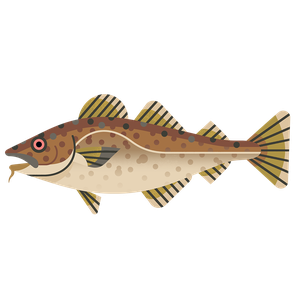
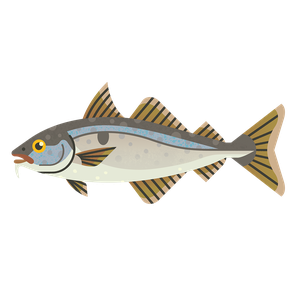
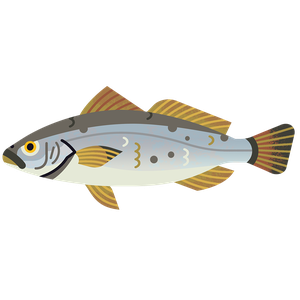
Atlantic cod
What to check for
Rockall: All areas
Bottom trawl (otter)
Rating summary
Data surrounding Rockall cod is limited. There is concern for both biomass and fishing pressure. The Rockall cod stock is at a very low level, although recent data indicate that it may be starting to increase. Landings have been above the advice since 2016, and fishing pressure is currently unknown related to reference points, therefore there is concern for fishing pressure. Landings of cod from this area in the 1980s-90s were relatively high, often between 1,500-2,000 tonnes. However since 2004 the landings have been consistently below 100 tonnes. This dramatic decline in landings is likely indicative of a depleted stock. Total Allowable Catches and landings are above recommended limits, although effort in the fishery has decreased since 2010. The main management measures relate to catch limits, which have been set significantly higher than scientific advice in recent years. Management is therefore not following scientific advice. Most Rockall cod are caught by otter trawls as bycatch, which is likely to cause some damage to the seabed. Bycatch is moderate and may include vulnerable species such as blue and flapper skate.
Rating last updated August 2024.
How we worked out this Rating
References
DEFRA, 2022. List of fisheries management plans (FMPs). 6 December 2022. Available at: https://www.gov.uk/government/publications/joint-fisheries-statement-jfs/list-of-fisheries-management-plans [Accessed on 03.07.2024].
Eigaard, O. R., Bastardie, F., Breen, M., Dinesen, G. E., Hintzen, N. T., Laffargue, P., Mortensen, L. O., Nielsen, J. R., Nilsson, H. C., O- Neill, F. G., Polet, H., Reid, D. G., Sala, A., Skold, M., Smith, C., Sorensen, T. K., Tully, O., Zengin, M. and Rijnsdorp, A. D., 2016. Estimating seabed pressure from demersal trawls, seines, and dredges based on gear design and dimensions. ICES Journal of Marine Science, 73:1, pp. i27- i43. https://doi.org/10.1093/icesjms/fsv099.
EU, 2019. Regulation (EU) 2019/472 of the European Parliament and of the Council of 19 March 2019 establishing a multiannual plan for stocks fished in the Western Waters and adjacent waters, and for fisheries exploiting those stocks, amending Regulations (EU) 2016/1139 and (EU) 2018/973, and repealing Council Regulations (EC) No 811/2004, (EC) No 2166/2005, (EC) No 388/2006, (EC) No 509/2007 and (EC) No 1300/2008. Official Journal of the European Union, L 83: 1– 17. Available at: http://data.europa.eu/eli/reg/2019/472/oj [Accessed 04.07.2024].
ICES, 2024. Working group for the Celtic Seas ecoregion (WGCSE). ICES Scientific Reports. 5:32. 1370pp. Available at: https://doi.org/10.17895/ices.pub.22268980 [Accessed on 03.07.2024].
Froese, R. and Pauly D. (Editors). 2024. FishBase. Gadus morhua, Atlantic cod. Available at: https://fishbase.mnhn.fr/summary/SpeciesSummary.php?ID=69&AT=cod [Accessed on 03.07.2024].
Hiddink, J., Jennings, S., Sciberras, M., Szostek, C.L., Hughes, K.M., Ellis, N., Rijnsdorp, A.D., McConnaughey, R.A., Mazor, T., Hilborn, R., Collie, J.S., Pitcher, C.R., Amoroso, R.O., Parma, A.M., Suuronen, P. and Kaiser, M.J. 2017. Global analysis of depletion and recovery of seabed biota after bottom trawling disturbance. PNAS. 114:31, pp. 8301-8306. https://doi.org/10.1073/pnas.1618858114.
ICES, 2024a. Working group for the Celtic Seas ecoregion (WGCSE). ICES Scientific Reports. 5:32. 1370pp. Available at: https://doi.org/10.17895/ices.pub.22268980 [Accessed on 03.07.2024].
ICES, 2024b. Celtic Seas Ecoregion – Ecosystem overview. In Report of the ICES Advisory Committee, 2024. ICES Advice 2024, Section 7.1, Available at: https://doi.org/10.17895/ices.advice.25713033 [Accessed on 03.07.2024].
ICES. 2023. Cod (Gadus morhua) in Division 6.b (Rockall). In Report of the ICES Advisory Committee, 2023. ICES Advice 2023, cod.27.6b. Available at: https://doi.org/10.17895/ices.advice.21840771 [Accessed on 03.07.2024].
ICES, 2022. Celtic Seas Ecoregion – Ecosystem overview. In Report of the ICES Advisory Committee, 2022. ICES Advice 2022, Section 7.1, Available at: https://doi.org/10.17895/ices.advice.21731615. [Accessed on 03.07.2024].
ICES, 2020. Vulnerable marine ecosystems in the NEAFC Regulatory Area closed to fishing for purposes other than VME protection. In Report of the ICES Advisory Committee, 2020. ICES Advice 2020, vme.neafc.2. https://doi.org/10.17895/ices.advice.7427.
JNCC, 2017. North West Rockall Bank MPA. Available at: https://jncc.gov.uk/our-work/north-west-rockall-bank-mpa/#conservation-advice [Accessed 04.07.2024].
Kennelly, S. J. & Broadhurst, M. K., 2021. A review of bycatch reduction in demersal fish trawls. Rev Fish Biol Fisheries 31, 289–318. https://doi.org/10.1007/s11160-021-09644-0.
Kynoch, R., Fryer, R. & Neat, F., 2015. A simple technical measure to reduce bycatch and discard of skates and sharks in mixed-species bottom-trawl fisheries. ICES J Mar Sci,72(6):1861.
Marshall, C.T. Macdonald, P. Torgerson, E. Asare, J.L. Turner, R. 2021. Design, development and deployment of a software platform for real-time reporting in the west of Scotland demersal fleet. A study commissioned by Fisheries Innovation Scotland (FIS). Available at http://www.fiscot.org/ [Accessed on 03.07.2024].
Silva, F., Ellis, J. & Catchpole, T., 2012. Species composition of skates (Rajidae) in commercial fisheries around the British Isles and their discarding patterns. J Fish Biol., 80:1678–1703.
UK Government, 2018. Minimum Conservation Reference Sizes (MCRS) in UK waters, Updated 12 November 2018. Available at: https://www.gov.uk/government/publications/minimum-conservation-reference-sizes-mcrs/minimum-conservation-reference-sizes-mcrs-in-uk-waters [Accessed 04.07.2024].
van Denderen, P. Bolam, S., Hiddink, J.G., Jennings, S., Kenny, A., Rijnsdorp, A., and van Kooten, T., 2015. Similar effects of bottom trawling and natural disturbance on composition and function of benthic communities across habitats. Mar Ecol Prog Ser. 2015;541:31–43.