Cape hake
What to check for
South Africa: Certified fleets only
Bottom trawl (otter)
Marine Stewardship Council (MSC)
Rating summary
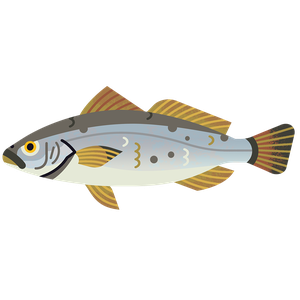
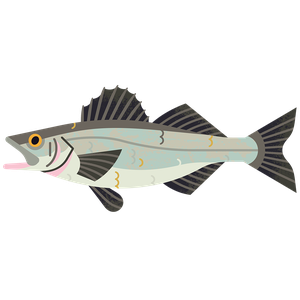
South African Cape hake stocks are above target levels, and fishing pressure seems to be within sustainable limits. There is no concern for biomass or fishing pressure. Management of this fishery appears to be effective and responsive, and has successfully recovered the stocks from a poor state. Most South African Cape hake is caught by otter trawls, which are likely to cause some damage to the seabed. Bycatch is moderate and may include vulnerable species. In this area there are particular concerns about the bycatch of silver kob.
Rating last updated December 2022
How we worked out this Rating
References
Andrews, J., Scarcella, G. and Pierre, J., 2021. Marine Stewardship Council (MSC) Public Certification Report: South Africa Hake trawl. Prepared by Lloyd’s Register on behalf of South African Deep-Sea Trawling Industry Association (SADSTIA). Published on 12.02.2021. Available at https://fisheries.msc.org/en/fisheries/south-africa-hake-trawl/@@assessments [Accessed on 06.12.2022].
DEFF, 2020. Status of the South African marine fishery resources 2020. Cape Town: Department of Environment, Forestry and Fisheries. ISBN: 978-0-621-48557-8. Available at https://www.sadstia.co.za/assets/uploads/statusofsouthafrican_marinefisheryresources2020.pdf [Accessed on 05.12.2022].
Eigaard, O. R., Bastardie, F., Breen, M., Dinesen, G. E., Hintzen, N. T., Laffargue, P., Mortensen, L. O., Nielsen, J. R., Nilsson, H. C., O- Neill, F. G., Polet, H., Reid, D. G., Sala, A., Skold, M., Smith, C., Sorensen, T. K., Tully, O., Zengin, M. and Rijnsdorp, A. D., 2016. Estimating seabed pressure from demersal trawls, seines, and dredges based on gear design and dimensions. ICES Journal of Marine Science, 73:1, pp. i27- i43. https://doi.org/10.1093/icesjms/fsv099.
Froese, R. and D. Pauly. Editors. 2022. FishBase: Merluccius capensis: Shallow-water Cape hake. Available at https://www.fishbase.se/summary/Merluccius-capensis.html [Accessed on 05.12.2022].
Froese, R. and D. Pauly. Editors. 2022. FishBase: Merluccius paradoxus: Deep-water Cape hake. Available at https://www.fishbase.se/summary/Merluccius-paradoxus.html [Accessed on 05.12.2022].
Hiddink, J., Jennings, S., Sciberras, M., Szostek, C.L., Hughes, K.M., Ellis, N., Rijnsdorp, A.D., McConnaughey, R.A., Mazor, T., Hilborn, R., Collie, J.S., Pitcher, C.R., Amoroso, R.O., Parma, A.M., Suuronen, P. and Kaiser, M.J. 2017. Global analysis of depletion and recovery of seabed biota after bottom trawling disturbance. PNAS. 114:31, pp. 8301-8306. https://doi.org/10.1073/pnas.1618858114.
Kennelly, S. J. & Broadhurst, M. K., 2021. A review of bycatch reduction in demersal fish trawls. Rev Fish Biol Fisheries 31, 289–318. https://doi.org/10.1007/s11160-021-09644-0.
Ross-Gillespie, A., 2022. Update to the hake Reference Case Operating Model with corrected longline data, and 2021 commercial and 2022 survey data. FISHERIES/2022/OCT/SWG-DEM/35rev. Available at https://zivahub.uct.ac.za/articles/report/Update_to_the_hake_Reference_Case_Operating_Model_with_corrected_longline_data_and_2021_commercial_and_2022_survey_data/21586710. [Accessed on 05.12.2022].
van Denderen, P. Bolam, S., Hiddink, J.G., Jennings, S., Kenny, A., Rijnsdorp, A., and van Kooten, T., 2015. Similar effects of bottom trawling and natural disturbance on composition and function of benthic communities across habitats. Mar Ecol Prog Ser. 2015;541:31–43. https://doi.org/10.3354/meps11550.