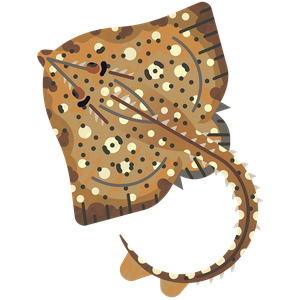
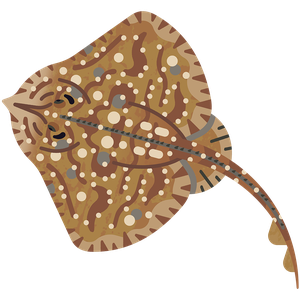
Sandy ray
What to check for
Celtic Sea and West of Scotland: All areas
Bottom trawl (otter)
Rating summary
Sandy ray in the Celtic Sea and West of Scotland is data limited, with low resilience to fishing pressure. There is a concern for both biomass and fishing pressure on this stock. Sandy ray is a vulnerable species, and management needs to be more precautionary. The joint TAC in place is not a suitable management method. Otter trawling is likely to cause some damage to the seabed. Bycatch is moderate and may include vulnerable species.
Rating last updated April 2026.
How we worked out this Rating
References
Eigaard, O.R., Bastardie, F., Breen, M., Dinesen, G.E., Hintzen, N.T., Laffargue, P., Mortensen, L.O., Nielsen, J.R., Nilsson, H.C., O'Neill, F.G., Polet, H., Reid, D.G., Sala, A., Sköld, M., Smith, C., Sorensen, T.K., Tully, O., Zengin, M., Rijnsdorp, A.D., 2016. Estimating seabed pressure from demersal trawls, seines, and dredges based on gear design and dimensions. ICES Journal of Marine Science, Volume 73, Issue suppl 1. Pages i27-i43. Available at https://academic.oup.com/icesjms/article/73/suppl_1/i27/2573989 [Accessed on 23.01.2026]
Froese, R. and D. Pauly, 2025. FishBase: Leucoraja circularis Sandy ray. Available at: Leucoraja circularis, Sandy ray : fisheries [Accessed on 16.04.2026]
Hiddink, J., Jennings, S., Sciberras, M., Szostek, C.L., Hughes, K.M., Ellis, N., Rijnsdorp, A.D., McConnaughey, R.A., Mazor, T., Hilborn, R., Collie, J.S., Pitcher, C.R., Amoroso, R.O., Parma, A.M., Suuronen, P. and Kaiser, M.J. 2017. Global analysis of depletion and recovery of seabed biota after bottom trawling disturbance. PNAS. 114:31, pp. 8301-8306. Available at https://doi.org/10.1073/pnas.1618858114 [Accessed on 23.01.2026]
ICES. 2025. Working Group on Elasmobranch Fishes (WGEF). ICES Scientific Reports. 7:92. 943 pp. https://doi.org/10.17895/ices.pub.30137623
ICES. 2025 Celtic Seas Ecosystem – fisheries Overview. In Report of the ICES Advisory Committee, 2025. ICES Advice 2025, section 7.2. https://doi.org/10.17895/ices.advice.30710879
ICES. 2024. Celtic Seas Ecoregion – Ecosystem overview. In Report of the ICES Advisory Committee, 2024. ICES Advice 2024, Section 7.1, https://doi.org/10.17895/ices.advice.25713033
ICES. 2024. Sandy ray (Leucoraja circularis) in subareas 6-7 (West of Scotland, southern Celtic Seas, English Channel). In Report of the ICES Advisory Committee, 2024. ICES Advice 2024, rji.27.67. https://doi.org/10.17895/ices.advice.25019552
Kennelly, S. J. & Broadhurst, M. K., 2021. A review of bycatch reduction in demersal fish trawls. Rev Fish Biol Fisheries 31, 289–318. Available at https://doi.org/10.1007/s11160-021-09644-0. [Accessed on 23.01.2026]
Kynoch, R., Fryer, R. & Neat, F., 2015. A simple technical measure to reduce bycatch and discard of skates and sharks in mixed-species bottom-trawl fisheries. ICES J Mar Sci,72(6):1861. Available at https://academic.oup.com/icesjms/article/72/6/1861/921176 [Accessed on 23.01.2026]
Shark Trust, 2025. Fisheries Advisories. Available at: Fisheries Advisories | The Shark Trust [Accessed on 23.01.2026]
Silva, J. F. and Ellis, J. R. 2019. Bycatch and discarding patterns of dogfish and sharks taken in English and Welsh commercial fisheries. Journal of Fish Biology. 94 (6). Available at https://doi.org/10.1111/jfb.13899 [Accessed on 23.01.2026]
van Denderen, P. Bolam, S., Hiddink, J.G., Jennings, S., Kenny, A., Rijnsdorp, A., and van Kooten, T., 2015. Similar effects of bottom trawling and natural disturbance on composition and function of benthic communities across habitats. Mar Ecol Prog Ser. 2015;541:31–43. Available at https://backend.orbit.dtu.dk/ws/portalfiles/portal/119579329/Post_print.pdf [Accessed on 23.01.2026]