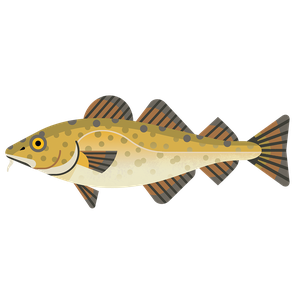
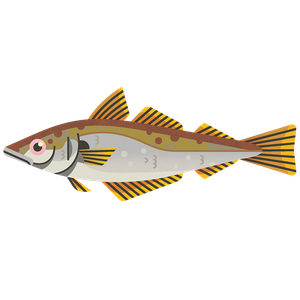
Tusk
What to check for
Northeast Atlantic: All areas
Hook & line (longline)
Rating summary
There is no concern for population size or fishing pressure for tusk in the Northeast. There are a number of management measures for tusk. However, it is a data limited species, so there is no way of assessing how well it is managed across the Northeast Atlantic as a whole. Tusk caught by longlines in the Northeast Atlantic are unlikely to cause habitat impacts. Although longlines are considered to pose low risk of bycatch there are concerns regarding the lack of information about bycatch of vulnerable species, more data on bycatch species and quantities is needed.
Rating last updated August 2024.
How we worked out this Rating
References
Agnesi, S., Annunziatellis, A., Chaniotis, P., Mo, G., Korpinen, S., Snoj, L., Tunesi, L., Reker, J., 2020, Spatial Analysis of Marine Protected Area Networks in Europe’s Seas III. ETC/ ICM Technical Report 3/2020: European Topic Centre on Inland, Coastal and Marine waters, 40 pp. Available at: https://www.eionet.europa.eu/etcs/etc-icm/products/etc-icm-report-3-2020-spatial-analysis-of-marine-protected-area-networks-in-europe2019s-seas-iii [Accessed on 06.06.2024]
ACAP, 2021. ACAP Review of mitigation measures and Best Practice Advice for Reducing the Impact of Pelagic Longline Fisheries on Seabirds. Reviewed at the Twelfth Meeting of the Advisory Committee Virtual meeting, 31 August – 2 September 2021. Available at https://www.acap.aq/resources/bycatch-mitigation/mitigation-advice/3956-acap-2021-pelagic-longlines-mitigation-review-bpa/file [Accessed on 06.06.2024].
Anderson, O.R.J., Small, C.J., Croxall, J.P., Dunn, E.K., Sullivan, B.J., Yates, O. and Black, A., 2011. Global seabird bycatch in longline fisheries, Endang Species Res 14. p 91-106. Available at https://doi.org/10.3354/esr00347. [Accessed on 06.06.2024].
Clark, M., Althaus, F., Schlacher, T., Williams, A., Bowden, D., Rowden, A., 2016. The impacts of deep-sea fisheries on benthic communities: a review. ICES Journal of Marine Science 73: suppl_1. P. i51–i69. Available at https://doi.org/10.1093/icesjms/fsv123. [Accessed on 06.06.2024].
Gilman, E., Chaloupka, M., Benaka, L.R., Bowlby, H., Fitchett, M., Kaiser, M. and Michael Musyl, M., 2022. Phylogeny explains capture mortality of sharks and rays in pelagic longline fisheries: a global meta-analytic synthesis. Sci Rep 12: 18164. Available at https://doi.org/10.1038/s41598-022-21976-w. [Accessed on 06.06.2024].
ICES. 2024. Greater North Sea ecoregion – Ecosystem overview. In Report of the ICES Advisory Committee, 2024. ICES Advice 2024, Section 7.1, Available at https://doi.org/10.17895/ices.advice.25714239. [Accessed on 06.06.2024]
ICES. 2024. Celtic Seas Ecoregion – Ecosystem overview. In Report of the ICES Advisory Committee, 2024. ICES Advice 2024, Section 7.1, Available at https://doi.org/10.17895/ices.advice.25713033 [Accessed on 06.06.2024].
Pham, C., Diogo, H., Menezes, G., Porteiro, F., Braga-Henriques, A., Vandeperre F. and Morato, T., 2014. Deep-water longline fishing has reduced impact on Vulnerable Marine Ecosystems. Sci Rep 4, 4837. Available at https://doi.org/10.1038/srep04837. [Accessed on 06.06.2024].