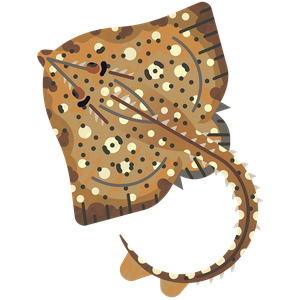
Undulate ray
Raja undulata
What to check for
Location
English Channel: All areas
Technical location
27 - Atlantic, Northeast, 7d: English Channel (East), 7e: English Channel (West)
Caught by
Net (gill or fixed)
Rating summary
Undulate ray in the English channel has recovered to a healthy state and is currently being harvested sustainably. The undulate ray fishery in the English Channel has only recently reopened. Multiple management measures are in place, however, it is too soon to know if these measures will be effective. Gillnets can be very size selective for the target fish but can be unselective at the species level for both non-target fish and for mammals, birds and turtles.Rating last updated October 2023.
How we worked out this Rating
Stock status
The size and health of a fish population, or 'stock', that is being targeted by fishermen is a crucial indicator of whether a fishery is sustainable. If the stock is too small to withstand fishing, it is at risk of crashing. We look at how big the stock is, and how much pressure there is from fishing, to assess this. The target level that many fisheries aim for is 'Maximum Sustainable Yield' - the most fish that can be caught year after year whilst keeping the population at a healthy size.
Undulate ray in the English channel has recovered to a healthy state and is currently being harvested sustainably.This stock was considered depleted since 1990 until a landing ban was implemented in 2009, which lasted until 2014. It has since recovered to a healthy state. Following a stock benchmark in 2022, relative biomass (B) is 1.77. This is above MSY Btrigger and Blim.Fishing pressure (F) on the stock in 2021 was 0.32. This is below FMSY.ICES advises that when the MSY approach is applied, landings in 2023 and 2024 should be no more than 4836 and 4675 tonnes respectively. This advice is substantially larger than the previous advice (2552 tonnes in 2021 and 2022), and it is not known how this will impact discard rates for undulate ray.Small fish (less than 50cm) were not included in the ICES assessment. Any catch of small undulate ray would continue to be discarded with a high survival rate.The stock of undulate ray in the English Channel is managed under a specific total allowable catch (TAC). This precautionary TAC has been increasing since 2016 as the biomass index has increased, however, it is constraining and results in high discard rates (e.g. 93% discarded in 2021). From 2019-2022, the TAC has been 234 tonnes for 7.d and 7.e combined. In 2023, the TAC increased substantially to 3,192 tonnes (with a 33% allocation to the UK).
Management
Good management is vital to be sure that fishing doesn't cause fish populations to decline. We look at whether regulations follow the best available scientific advice, how well compliance is monitored and enforced, and whether this is effective in maintaining healthy fish stocks.
The undulate ray fishery in the English Channel has only recently reopened. Multiple management measures are in place, however, it is too soon to know if these measures will be effective.The stock of undulate ray in the English Channel is managed under a specific TAC. This precautionary TAC has been increasing since 2016 following the biomass index but it is constraining, resulting in high discard rates.Each calendar year, a fishing vessel may retain on board and land any undulate ray caught in the English Channel, provided that the following conditions are met:No undulate ray may be caught between 1st May - 31st AugustNo more than 200kg of undulate ray (live weight) may be retained on board or landed per fishing tripNo undulate ray which measures less than 78 cm, or more than 97 cm, when measured from the tip of the snout to the tip of the tail shall be retained on board or landedNo undulate ray may be transshippedUndulate ray may only be retained on board or landed whole or guttedSkates and rays caught in the Northwest waters (ICES subareas 6 and 7) and North Sea waters (ICES subareas 2a, 3a and 4) with all fishing gears, are exempt from the landing obligation, based on their high survivability rates. Any skates and rays that are discarded are required to be released immediately and below the sea surface. Both the EU and UK have fishery management measures in place, which can include catch limits, targets for population sizes and fishing mortality, and controls on what fishing gear can be used and where. In the EU, compliance with regulations has been variable, and there are ongoing challenges with implementing some of them. There was a target for fishing to be at Maximum Sustainable Yield by 2020, but this was not achieved.In the UK, it is too early to tell how effective management is, as the Fisheries Act only came into force in January 2021. The Act requires the development of Fisheries Management Plans (FMPs) (replacing EU Multi-Annual Plans) but there are no details yet on how and when these will be developed. FMPs have the potential to be very important tools for managing UK fisheries, although data limitations may delay them for some stocks. MCS is keen to see FMPs for all commercially exploited stocks, especially where stocks are depleted, that include:Targets for fishing pressure and biomass, and additional management when those targets are not being metTimeframes for stock recoveryTechnologies such as Remote Electronic Monitoring (REM) to support data collection and improve transparency and accountabilityConsideration of wider environmental impacts of the fishery
Capture method
Environmental impacts of fishing vary hugely, depending on the method used and where it's happening. We look at whether the fishing gear being used could have an effect on seabed habitats, and if so, how severe might this be. We also review whether it catches any other species by accident (bycatch), and what effect this might have on those species - especially if they're Endangered, Threatened, or Protected.
Gillnets can be very size selective for the target fish but can be unselective at the species level for both non-target fish and for mammals, birds and turtles.Undulate ray prefer the slightly warmer water around the south of England and off the Welsh coast. Skates and rays are normally taken as bycatch and undulate ray in the English channel are mostly caught in bottom trawls (56%), nets (28%) and beam trawls (6%).Gillnets and fixed nets can be very size selective, but can bycatch species such as sharks, cetaceans and other marine mammals. Reports indicate that there is concern regarding the bycatch of cetaceans, particularly harbour porpoise, by gillnets. The IUCN lists harbour porpoise as being of least concern globally, but vulnerable in Europe. They are also classified as a priority species under the UK Post-2010 Biodiversity Framework and are protected under the European Union (EU) Habitats Directive and Habitats Regulations as transposed into UK law, under which there are explicit bycatch requirements. To comply with the Habitats Directive, the UK has recently designated five Special Areas for Conservation for harbour porpoises, however, there is currently no management in place for these.One of the areas of most concern is off the South West of England, where areas of higher gillnet fishing effort coincide with areas of larger harbour porpoise populations. While cetacean bycatch has been a long-term problem around Cornwall, the occurrence of stranded cetaceans has increased over the last two decades. In 2019, 24% of stranded cetaceans exhibited features consistent with bycatch or entanglement in fishing gear, a further 19% were assessed as being possible bycatch, and 52% had an unknown cause of death. However, this stock does not cover the Western English Channel, and harbour porpoise bycatch is not considered to be a problem in the Eastern English Channel.Because of gillnets' durability (they are made of nylon), if lost, they can continue to fish for several weeks before becoming tangled and bundled up, a phenomenon known as 'ghost fishing'. However, static nets, as with all gear, represent an investment by fishermen, and therefore there are incentives to avoid losing or damaging gear. Fish caught in trammel nets are often very good quality as they are not damaged by the capture process.
References
ASCOBANS, 2009. Conservation Plan for Harbour Porpoises in the North Sea as adopted at the 6th Meeting of the Parties to ASCOBANS, Bonn, Germany. 16 - 18 September 2009. Available at https://www.ascobans.org/sites/default/files/document/ASCOBANS_NorthSeaPlan_MOP6.pdf [Accessed on 05.10.2023].
British Sea Fishing. Undulate ray. Available at https://britishseafishing.co.uk/undulate-ray/ [Accessed on 04.10.2023].
Calderan, S. and Leaper, R., 2019. Review of harbour porpoise bycatch in UK waters and recommendations for management. January 2019, WWF. Available at https://www.wwf.org.uk/sites/default/files/2019-04/Review_of_harbour_porpoise_in_UK_waters_2019.pdf [Accessed on 05.10.2023].
Carlén, I., Nunny, L. and Simmonds, M. P. 2021. Out of Sight, Out of Mind: How Conservation Is Failing European Porpoises. Frontiers in Marine Science. Available at https://www.frontiersin.org/articles/10.3389/fmars.2021.617478/full [Accessed on 05.10.2023].
Chadwick, H., Clear, N., Crosby, A., Hawtrey-Collier, A. and Williams, R. 2019 Annual Report. Marine Strandings in Cornwall and the Isles of Scilly. Available at https://www.cornwallwildlifetrust.org.uk/sites/default/files/2020-12/2019%20Summary%20Report%20-%20Marine%20Strandings%20in%20Cornwall%20and%20the%20Isles%20of%20Scilly.pdf [Accessed on 05.10.2023].
Dedman, S., Officer, R. Brophy, D., Clarke, M. Reid, D. G. 2017. Towards a flexible Decision Support Tool for MSY-based Marine Protected Area design for skates and rays, ICES, 74 (2) pp. 576-587. Available at https://academic.oup.com/icesjms/article/74/2/576/2669563 [Accessed on 04.10.2023].
Clean Catch UK. Joint Action To Reduce Wildlife Bycatch. Available at https://www.cleancatchuk.com/ [Accessed on 05.10.2023].
Ellis, J. R., Burt, G.J., Grilli, G., McCully Phillips, S.R., Catchpole, T.L., Maxwell, D.L. 2018. At-vessel mortality of skates (Rajidae) taken in coastal fisheries and evidence of longer-term survival. Journal of Fish Biology. 92, 1702-1719. Available at https://pubmed.ncbi.nlm.nih.gov/29675895/ [Accessed on 04.10.2023].
Figueiredo, I., Maia, C. and Carvalho, L. 2020. Spatial distribution and abundance of the by-catch coastal elasmobranch Raja undulata: Managing a fishery after moratorium. Fisheries Management and Ecology, 27(5), pp 454-463. Available at https://onlinelibrary.wiley.com/doi/abs/10.1111/fme.12426 [Accessed on 04.10.2023].
ICES, 2018. ICES Advice: Bycatch of small cetaceans and other marine animals - review of national reports under Council Regulation (EC) No. 812/2004 and other information. Published 11 September 2018. Available at https://www.ices.dk/sites/pub/Publication%20Reports/Advice/2018/2018/byc.eu.pdf [Accessed on 05.10.2023].
ICES. 2022. Undulate ray (Raja undulata) in divisions 7.d and 7.e (English Channel). In Report of the ICES Advisory Committee, 2022. ICES Advice 2022, rju.27.7de. Available at https://doi.org/10.17895/ices.advice.19754482 [Accessed on 04.10.2023].
ICES. 2022. Working Group on Elasmobranch Fishes(WGEF).ICES Scientific Reports. 4:74. 848pp. Available at http://doi.org/10.17895/ices.pub.21089833 [Accessed on 04.10.2023].
Leeney, R. H., Amies, R., Broderick, A.C., Witt, M. J., Loveridge, J., Doyle, J. and Godley, B. J. 2008. Spatio-temporal analysis of cetacean strandings and bycatch in a UK fisheries hotspot. Biodiversity and Conservation. 17, 2323. Available at https://link.springer.com/article/10.1007/s10531-008-9377-5#citeas [Accessed on 05.10.2023].
Leeney, R. H., Witt, M. J., Broderick, A. C., Buchanan, J., Jarvis, D. S., Richardson, P. B. and Godley, B. J. 2011. Marine megavertebrates of Cornwall and the Isles of Scilly: relative abundance and distribution. Journal of the Marine Biological Association of the United Kingdom, 92(8), 1823-1833. Available at https://www.cambridge.org/core/journals/journal-of-the-marine-biological-association-of-the-united-kingdom/article/marine-megavertebrates-of-cornwall-and-the-isles-of-scilly-relative-abundance-and-distribution/7981AA197C2320B6A9E2C01BD7A1F7B7 [Accessed on 05.10.2023].
Moan, A., Skern-Mauritzen, M., Vølstad, J. H., Bjørge, A. 2020. Assessing the impact of fisheries-related mortality of harbour porpoise (Phocoena phocoena) caused by incidental bycatch in the dynamic Norwegian gillnet fisheries, ICES Journal of Marine Science, Volume 77, Issue 7-8, Pages 3039–3049. Available at https://doi.org/10.1093/icesjms/fsaa186 [Accessed on 05.10.2023].
North Atlantic Marine Mammal Commission and the Norwegian Institute of Marine Research. 2019. Report of Joint IMR/NAMMCO International Workshop on the Status of Harbour Porpoises in the North Atlantic. Tromsø, Norway. Available at https://www.ascobans.org/sites/default/files/document/ascobans_ac25_inf.4.3a_joint-imr-nammco-ws-harbour-porpoise.pdf [Accessed on 05.10.2023].
Omeyer, L. C. M., Doherty, P. D., Dolman, S., Enever, R., Reese, A., Tregenza, N., Williams, R. and Godley, B. J. 2020. Assessing the Effects of Banana Pingers as a Bycatch Mitigation Device for Harbour Porpoises (Phocoena phocoena). Frontiers in Marine Science. Available at https://www.frontiersin.org/articles/10.3389/fmars.2020.00285/full [Accessed on 05.10.2023].
OSPAR, 2017. Intermediate Assessment 2017: Harbour Porpoise Bycatch. Available at https://oap.ospar.org/en/ospar-assessments/intermediate-assessment-2017/biodiversity-status/marine-mammals/harbour-porpoise-bycatch/ [Accessed on 05.10.2023].
Shark Trust. 2023. Fisheries Advisories. Available at https://www.sharktrust.org/pages/category/fisheries-advisories [Accessed on 04.10.2023].
Silva, F., Ellis, J. & Catchpole, T., 2012. Species composition of skates (Rajidae) in commercial fisheries around the British Isles and their discarding patterns. J Fish Biol., 80:1678–1703. Available at https://www.nwwac.org/_fileupload/Papers%20and%20Presentations/2016/06%20FG%20Skates%20and%20Rays/Silva,%20Ellis%20&%20Catchpole_2012_Skate%20catches.pdf [Accessed on 04.10.2023].
UK Government. 2023. Category A (10 metre and under) Licence: Schedule (91) Non Sector. Available at https://assets.publishing.service.gov.uk/government/uploads/system/uploads/attachment_data/file/1181749/Cat_A_Licence_Schedule_91_V6_01_August_2023__1_.pdf [Accessed on 04.10.2023].
Sustainable swaps
Learn more about how we calculate our sustainability ratings.
How our ratings work
Add impact to your inbox
Join the movement: get updates on the issues you care about.
We'll email you inspiring stories about the work we're doing to save and recover our oceans, and news about our urgent campaigns for positive change.