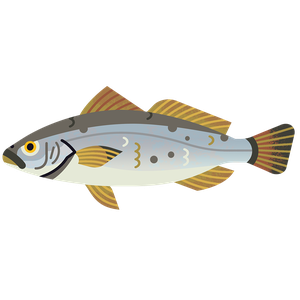
Whiting
What to check for
Irish Sea: All areas
Bottom trawl (otter)
Rating summary
Irish Sea whiting is below safe biological levels and there are no measures or plans in place to help it recover. Therefore, it receives a critical fail for stock status and is a default red rating.
Rating last updated August 2024.
How we worked out this Rating
References
DEFRA, 2022. List of fisheries management plans (FMPs). 6 December 2022. Available at: https://www.gov.uk/government/publications/joint-fisheries-statement-jfs/list-of-fisheries-management-plans [Accessed on 03.07.2024].
Eigaard, O. R., Bastardie, F., Breen, M., Dinesen, G. E., Hintzen, N. T., Laffargue, P., Mortensen, L. O., Nielsen, J. R., Nilsson, H. C., O- Neill, F. G., Polet, H., Reid, D. G., Sala, A., Skold, M., Smith, C., Sorensen, T. K., Tully, O., Zengin, M. and Rijnsdorp, A. D., 2016. Estimating seabed pressure from demersal trawls, seines, and dredges based on gear design and dimensions. ICES Journal of Marine Science, 73:1, pp. i27- i43. https://doi.org/10.1093/icesjms/fsv099.
Hiddink, J., Jennings, S., Sciberras, M., Szostek, C.L., Hughes, K.M., Ellis, N., Rijnsdorp, A.D., McConnaughey, R.A., Mazor, T., Hilborn, R., Collie, J.S., Pitcher, C.R., Amoroso, R.O., Parma, A.M., Suuronen, P. and Kaiser, M.J. 2017. Global analysis of depletion and recovery of seabed biota after bottom trawling disturbance. PNAS. 114:31, pp. 8301-8306. https://doi.org/10.1073/pnas.1618858114.
ICES, 2024a. Working group for the Celtic Seas ecoregion (WGCSE). ICES Scientific Reports. 5:32. 1370pp. Available at: https://doi.org/10.17895/ices.pub.22268980 [Accessed on 03.07.2024].
ICES, 2024b. Celtic Seas Ecoregion – Ecosystem overview. In Report of the ICES Advisory Committee, 2024. ICES Advice 2024, Section 7.1, Available at: https://doi.org/10.17895/ices.advice.25713033 [Accessed on 03.07.2024].
ICES, 2023. Whiting (Merlangius merlangus) in Division 7.a (Irish Sea). In Report of the ICES Advisory Committee, 2023. ICES Advice 2023, whg.27.7a. Available at: https://doi.org/10.17895/ices.advice.21864330 [Accessed on 04.07.2024].
ICES, 2022. Celtic Seas Ecoregion – Ecosystem overview. In Report of the ICES Advisory Committee, 2022. ICES Advice 2022, Section 7.1, Available at: https://doi.org/10.17895/ices.advice.21731615. [Accessed on 03.07.2024].
Kennelly, S. J. & Broadhurst, M. K., 2021. A review of bycatch reduction in demersal fish trawls. Rev Fish Biol Fisheries 31, 289–318. https://doi.org/10.1007/s11160-021-09644-0.
Kynoch, R., Fryer, R. & Neat, F., 2015. A simple technical measure to reduce bycatch and discard of skates and sharks in mixed-species bottom-trawl fisheries. ICES J Mar Sci,72(6):1861.
Marshall, C.T. Macdonald, P. Torgerson, E. Asare, J.L. Turner, R. 2021. Design, development and deployment of a software platform for real-time reporting in the west of Scotland demersal fleet. A study commissioned by Fisheries Innovation Scotland (FIS). Available at http://www.fiscot.org/ [Accessed on 03.07.2024].
Marty, L., Rochet, M.J., and Ernande, B., 2014. Temporal trends in age and size at maturation of four North Sea gadoid species: cod, haddock, whiting and Norway pout. Mar. Ecol. Prog. Ser. 496: pp 179-197. doi: 10.3354/meps10580
Silva, F., Ellis, J. & Catchpole, T., 2012. Species composition of skates (Rajidae) in commercial fisheries around the British Isles and their discarding patterns. J Fish Biol., 80:1678–1703.
UK Government, 2018. Minimum Conservation Reference Sizes (MCRS) in UK waters, Updated 12 November 2018. Available at: https://www.gov.uk/government/publications/minimum-conservation-reference-sizes-mcrs/minimum-conservation-reference-sizes-mcrs-in-uk-waters [Accessed 04.07.2024].
van Denderen, P. Bolam, S., Hiddink, J.G., Jennings, S., Kenny, A., Rijnsdorp, A., and van Kooten, T., 2015. Similar effects of bottom trawling and natural disturbance on composition and function of benthic communities across habitats. Mar Ecol Prog Ser. 2015;541:31–43.