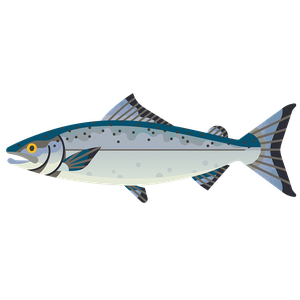
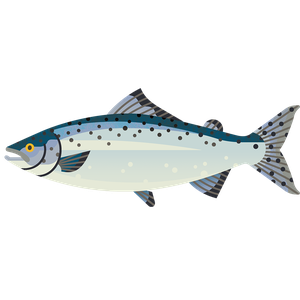
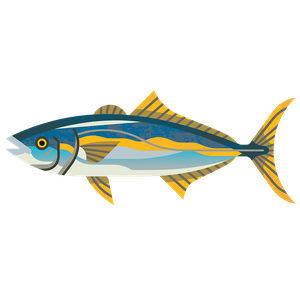
Atlantic salmon
Salmo salar
What to check for
Location
All areas, Scotland
Production method
Open net pen, marine
Certification
Global Seafood Alliance Best Aquaculture Practices (GAA BAP) 3*

Global Seafood Alliance Best Aquaculture Practices (GAA BAP) 4*

Rating summary
Atlantic salmon are farmed in open net pens in the sea. Producing fish in open systems can cause environmental impacts. The Global Seafood Alliance (GSA) Best Aquaculture Practices (BAP) standard addresses many areas of environmental concern including discharge of effluents, use of chemicals, escapes, disease and parasite interactions. However, lethal control of predators is permitted. There are also criteria in place covering welfare and humane slaughter. Criteria on responsible feed sourcing requires it to be traceable, however, sourcing of marine ingredients is not verified via audit and BAP certified salmon can use a high quantity of wild caught fish in their diet. Due to the lack of data in relation to some of the environmental impacts of salmon farming, MCS is advocating a halt in industry expansion using existing practices until more evidence is available. This rating is based on full compliance with certification requirements. Commercial buyers should therefore ensure that full compliance has been achieved in order for this rating to be applicable.Rating last updated February 2023.
Technical consultation summary
Atlantic salmon are farmed in open net pens in the sea. Producing fish in open systems can cause environmental impacts. The Global Seafood Alliance (GSA) Best Aquaculture Practices (BAP) standard addresses many areas of environmental concern including discharge of effluents, use of chemicals, escapes, disease and parasite interactions. However, lethal control of predators is permitted. There are also criteria in place covering welfare and humane slaughter. Criteria on responsible feed sourcing requires it to be traceable, however, sourcing of marine ingredients is not verified via audit and BAP certified salmon can use a high quantity of wild caught fish in their diet. Due to the lack of data in relation to some of the environmental impacts of salmon farming, MCS is advocating a halt in industry expansion using existing practices until more evidence is available.
How we worked out this Rating
Feed
What feed is given to farmed fish, where it comes from and how much is used is one of the most important aspects of fish farming. In this section we look at how sustainable the feed is and how much fish is included in the diet.
The BAP salmon standard requires feed used in salmon aquaculture to be traceable and requirements are in place for responsible ingredient sourcing. Salmon is a net consumer of protein.Atlantic salmon are a carnivorous species and have a requirement for a high protein diet, relying on commercial feeds within aquaculture production. Historically, the most important ingredients in salmon feed have been fishmeal and fish oil, now vegetable matter makes up the majority of the feed formula. GSA BAP certification requires feed ingredients to be responsibly sourced. For marine ingredients, at least 50% must be from certified sources, with the ultimate goal that all fishmeal and fish oil used in feed is certified. All palm oil used is certified by the Round Table on Sustainable Palm Oil (RSPO), and at least 50% of soy inputs come from certified sources such as ProTerra, Roundtable for Responsible Soy (RTRS) or Soybean Sustainability Assurance Protocol (SSAP) or equivalent.Under the BAP Salmon Farm standard, the dependency of wild caught fish used in fish meal and fish oil (known as the Feed Fish Dependency Ratio, FFDR) permits the use of more fish protein in the diets of farmed salmon, than the fish produce. Therefore, BAP certified salmon can be a net consumer rather than a net producer. Producers can improve their FFDR by using a greater percentage of fishmeal and fish oil from trimmings and offal, using other sources of meal and oil (e.g., vegetables) and improving their feeding efficiency.
Environment
The environmental impacts of aquaculture depend on what fish is farmed, how and where. It could be habitat damage, chemical use, pollution, freshwater use or parasites. In this section we look at the environmental impacts of greatest concern for that species and production method. Some species, such as shellfish, have very little impact, whilst others may give us cause for concern.
Salmon farming in open water net pens can have impacts on the environment. However, mitigation measures are in place within the BAP Salmon Farm standard to address many of those environmental impacts.Habitat alteration is minimal in the application of open water net pens and does not impact ecosystem functionality. Juveniles used in salmon aquaculture come from hatcheries, however, wild-caught cleaner fish species are used to biologically control sea lice. Lumpfish and wrasse are used as cleaner fish but the stock status for both species is unknown, and currently fishery management measures are primarily voluntary. Therefore, the impact on the stocks of these species is unknown.BAP-certified salmon farms apply good farming practices reducing the need for chemical and medicinal inputs. Although, farms do use medicines and products containing chemicals such as disinfectants are used to ensure the health and welfare of the fish, and to maintain farm infrastructure, and equipment (e.g., pens and boats). Chemicals and medical treatments are not promoted over best management practices, which minimizes risk to the environment, but when application is necessary, they will be used. Chemicals and medical treatments are monitored and/or limited and must meet the mandatory regulatory framework of the production country.Biosecurity measures set out in the BAP Salmon Farm Standard limit disease outbreaks and escapes. Nonetheless, parasitic and pathogenic burdens in farmed BAP salmon can occur, but management practices are in place to lesson these burdens. Salmon farms are known to increase the number of salmon sea lice parasites in the surrounding environment which can impact on wild populations. Pathogenic disease outbreaks also occur but they are not thought to threaten regional level operations. Due to the nature of open net pens there is a risk of farmed salmon escaping with evidence of negative ecological effects on local wild populations, such as genetic introgression.The grey and common seal are the main documented predators of farmed salmon. Under the BAP program humane, non-lethal predator control is encouraged, although permitted in some countries. Lethal control of seals on aquaculture farms has been documented in some countries, although lethal measures have not significantly affected either one of the predatory species population status.
Fish health and welfare
Fish health and welfare is a concern for many consumers. High welfare standards are an indication of good farm management, we look to see if there are industry wide welfare standards in place, and if these include humane slaughter.
The BAP Standard ensures that practices and guidelines are in place to address the welfare needs of farmed salmon, and ensures that humane slaughter takes place.BAP-certificated salmon farms ensures that practices and guidelines are in place to address the welfare needs of animals within aquaculture. Health and welfare standards are referenced throughout the standard. Specific requirements address health and welfare of aquaculture animals, and humane slaughter, where techniques must render fish immediately unconscious thus insensible to pain.
Management
How aquaculture is regulated and how effective those regulations are is an important aspect of farmed fish production. We also look to see if aquaculture is included in broader environmental management plans. In this management section we also award scores for globally recognised certification standards, as certified seafood requires verification of environmental performance and traceability.
BAP farmed salmon are well managed and management is thought to be fully effective.The independent BAP Salmon Farm Standard addresses many issues of environmental concern and ensures compliance. There is no requirement for certified farms to be subject to any strategic environmental planning. However, production countries supplying the UK marketplace with BAP-certified salmon incorporate strategic environmental planning at a country level. These countries include Scotland and Norway.Aquaculture policy in the UK is a devolved matter, with the separate administrations of Wales, England, Northern Ireland and Scotland responsible for its collective oversight. Aquaculture production in Scotland is covered in the 2015 National Marine Plan. This plan covers the management of both Scottish inshore waters (out to 12 nautical miles) and offshore waters (12 to 200 nautical miles). Scotland s River Basin Management Plan (RBMP) also sets out a range of actions to address water quality, physical condition, water flows and levels, the migration of wild fish and invasive nonnative species. The RBMP is produced every six years by SEPA on behalf of the Scottish Government.In Norway, management of marine areas is broken down into three areas: the Barents Sea, the Norwegian Sea, and the North Sea, that combined cover the entire Norwegian Exclusive Economic Zone (EEZ). Marine spatial plans have been developed for these three regions and these include the impact of aquaculture on the marine ecosystem. They also identify valuable and vulnerable areas that require special management measures.The BAP Salmon Farm standard addresses environmental impacts of salmon aquaculture, which is further supported by country level regulations.The Best Aquaculture Practices (BAP) certification programme comprises a suite of standards for farms, hatcheries, feed mills and processing plants addressing environmental and social issues, food safety and animal welfare. Benchmarked to GSSI and GFSI and with star ratings (1- 4), it uses independent audits to provide assurance along the supply chain.
References
Best Aquaculture Practices. 2016. BAP Salmon Farm Standards – Issue 2 Revision 3 – October 2016. Available at https://www.bapcertification.org/Downloadables/pdf/PI%20-%20Standard%20-%20Salmon%20Farm%20-%20Issue%202.3%20-%2013-October-2016-GSA.pdf [Accessed on 13.02.2023].
Best Aquaculture Practices. 2019. BAP Program Update – Stricker Stance on Antibiotics Use in Farms, Effective January 1, 2021. Available at https://www.bapcertification.org/Downloadables/pdf/standards/PI%20-%20Notice%20-%20BAP%20bans%20use%20of%20Critically%20Important%20Antibiotics%20-%207August2019.pdf [Accessed on 13.02.2023].
Best Aquaculture Practices. 2022. BAP Feed Mill Standard – Issue 3.1, 31st May 2022. Available at https://www.bapcertification.org/Downloadables/pdf/standards/GSA%20-%20Feed%20Mill%20Standard%20-%20Issue%203.1%20-%2031-May-2022.pdf [Accessed on 13.02.2023].
Best Aquaculture Practices. 2023. Find BAP-Certified Producers. Available at https://bapcertification.org/Producers [Accessed on 13.02.2023].
DEFRA. 2015. United Kingdom Multiannual National Plan for The Development of Sustainable Aquaculture. Available at: https://assets.publishing.service.gov.uk/government/uploads/system/uploads/attachment_data/file/480928/sustainable-aquaculture-manp-uk-2015.pdf [Accessed on 18.01.2023].
Elevancini, J. 2017. How do third-party certifications control the use of antibiotics in global salmon aquaculture? College of Sustainability. Dalhousie University. Halifax, Nova Scotia. Available at https://dalspace.library.dal.ca/bitstream/handle/10222/73361/ESS-Thesis-Regulation%20of%20Antibiotics%20in%20Salmon%20Aquaculture-Elevancini.pdf?sequence=1 [Accessed on 13.02.2023].
FAO. 2011. FAO Regional Training on the Principles of Cage Culture in Reservoirs. Available at: http://www.fao.org/fileadmin/templates/SEC/docs/Fishery/Fisheries_Events_2012/Principles_of_cage_culture_in_reservoirs/Mooring_Systems.pdf [Accessed on 11.01.2023].
FAO. 2023. Salmo salar. Cultured Aquatic Species Information Programme. Text by Jones, M. Fisheries and Aquaculture Division [online]. Rome. Updated 2004-11-25. Available at https://www.fao.org/fishery/en/culturedspecies/salmo_salar/en [Accessed on 25.01.2023].
Hoel, A. and Olsen, E. 2010. Marine Spatial Planning: Norway’s management plans. Available at https://imr.brage.unit.no/imr-xmlui/bitstream/handle/11250/102586/O0510.pdf?sequence=1&isAllowed=y [Accessed on 02.02.2023].
Marine Harvest. 2022. Salmon Farming Industry Handbook 2022. Available at https://mowi.com/wp-content/uploads/2022/07/2022-Salmon-Industry-Handbook-1.pdf [Accessed on 11.01.2023].
Martsikalis, P., Gkafas, G., Palaiokostas, C. and Exadactylos, A. 2019. Chapter 4: Genomics Era on Breeding Aquaculture Stocks, pp.65-77. In: Lembo, G and Mente, E. (eds) Organic Aquaculture - Impacts and Future Developments. Available at https://doi.org/10.1007/978-3-030-05603-2_4 [Accessed on 16.01.2023].
Monterey Bay Aquarium Seafood Watch. 2021a. Atlantic Salmon (salmo salar), Norway Marine Net Pens. Available at: https://www.seafoodwatch.org/recommendation/salmon/atlantic-salmon-38266?species=302 [Accessed on 11.03.2023].
Monterey Bay Aquarium Seafood Watch. 2021b. Atlantic Salmon (salmo salar), Scotland Marine Net Pens. Available at: https://www.seafoodwatch.org/recommendation/salmon/atlantic-salmon-31565?species=302 [Accessed on 11.01.2023].
Natural Scotland. 2022. Scotland's Aquaculture – Fish Escapes. Available at http://aquaculture.scotland.gov.uk/data/fish_escapes.aspx [Accessed on 01.02.2023].
Powell, A., Tresurer, J., Pooley, C., Keay, A., Lloyyd, R., Imsland, A. and Garcia de Leaniz, C. 2018. Use of lumpfish for sea lice control in salmon farming: challenges and opportunities. Reviews in Aquaculture, Volume 10, pp.683-702. Available at https://doi.org/10.1111/raq.12194 [Accessed on 16.01.2023].
Scottish Government. 2015. Scotland’s National Marine Plan. Available at: https://www.gov.scot/publications/scotlands-national-marine-plan/ [Accessed on 18.01.2023].
Scottish Government. 2021a. National Marine Plan Review 2021: Three Year Report on the effectiveness of Scotland’s National Marine Plan. Available at https://marine.gov.scot/sites/default/files/national_marine_plan_review_2021.pdf [Accessed on 20.01.2023].
Scottish Government. 2021b. Scottish Fish Farm Production Survey 2021. Available at: https://www.gov.scot/publications/scottish-fish-farm-production-survey-2021/ [Accessed on 16.01.2023].
Seafish. 2020. Atlantic Salmon – salmo salar: profile last updated 16 November 2020. Available at: https://www.seafish.org/responsible-sourcing/aquaculture-farming-seafood/species-farmed-in-aquaculture/aquaculture-profiles/atlantic-salmon/ [Accessed on 09.01.2023].
Seafish. 2023. Seafood retail data and insight. Available at https://www.seafish.org/insight-and-research/seafood-retail-data-and-insight/ [Accessed on 16.01.2023].
SEPA. 2023. River Basin Management Planning. Available at https://www.sepa.org.uk/environment/water/river-basin-management-planning/ [Accessed 18.01.2023]
Skaala, O., Besnier, F., Borgstrom, R., Barlaup, B., Sorvik, A., Normann, E., Ostebo, B., Hansen, M. and Glover, K. 2019. An extensive common-garden study with domesticated and wild Atlantic salmon in the wild reveals impact on smolt production and shifts in fitness traits. Evolutionary Applications, Volume 12, Issue 5, pp.1001-1016. Available at: https://doi.org/10.1111/eva.12777 [Accessed on 16.01.2023].
Sustainable swaps
Learn more about how we calculate our sustainability ratings.
How our ratings work
Add impact to your inbox
Join the movement: get updates on the issues you care about.
We'll email you inspiring stories about the work we're doing to save and recover our oceans, and news about our urgent campaigns for positive change.