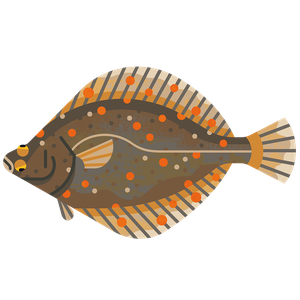
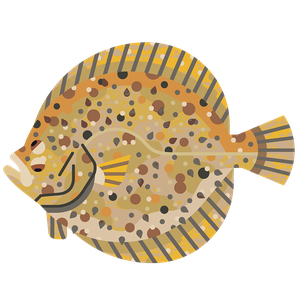
Dover sole
What to check for
English Channel (West): All areas
Bottom trawl (beam)
Rating summary
Western English Channel sole is in a good state, and fishing mortality is at sustainable levels. There is no management plan in place for this fishery but some measures are in place, and total allowable catch (TAC) is generally set in line with scientific advice. This fishery has a low level of discarding of unwanted fish. In terms of bycatch, plaice is also caught in this fishery and the minimum mesh size is not matched to the lower size limit for plaice, leading to a large number of plaice being discarded. Beam trawls have significant impacts on the seabed, including damage to benthic communities and vulnerable marine habitats. They can also have high bycatch, potentially of vulnerable species.
Rating last updated July 2024.
How we worked out this Rating
References
Burt, G. J., Readdy, L., Benedet, R., and Forster, R. 2021. Programme 40; Western Channel sole and plaice. Fisheries Science Partnership 2020/2021. Final Report. Centre for Environment, Fisheries and Aquaculture Science (Cefas), Lowestoft, UK, 47 pp.
Cook, R., Gaudian, G., des Clers, S. and Seip- Markensteijn, C.M., 2022. Marine Stewardship Council (MSC) Public Certification Report: Scottish Fisheries Sustainable Accreditation Group (SFSAG) Northern Demersal Stocks. Prepared by Control Union (UK) Limited on behalf of Scottish Fisheries Sustainable Accreditation Group (SFSAG). May 2022. Available at https://cert.msc.org/FileLoader/FileLinkDownload.asmx/GetFile?encryptedKey=BdxOJoY7Sf4DmNJEB/m47M6xx0rRfgP/niGx3vj5Ud8hadYI3XCNrnlSFL/jlTgK [Accessed on 12.07.2024].
Department of Agriculture, Environment and Rural Affairs. Cod Conservation measures in the Irish Sea. Available at https://www.daera-ni.gov.uk/articles/cod-conservation-measures [Accessed on 12.07.2024].
Eigaard, O.R., Bastardie, F., Breen, M., Dinesen, G.E., Hintzen, N.T., Laffargue, P., Mortensen, L.O., Nielsen, J.R., Nilsson, H.C., O'Neill, F.G., Polet, H., Reid, D.G., Sala, A., SkOld, M., Smith, C., Sorensen, T.K., Tully, O., Zengin, M., Rijnsdorp, A.D., 2016. Estimating seabed pressure from demersal trawls, seines, and dredges based on gear design and dimensions. ICES Journal of Marine Science, Volume 73, Issue suppl 1. Pages i27-i43. Available at https://academic.oup.com/icesjms/article/73/suppl_1/i27/2573989 [Accessed on 12.07.2024].
Hiddink, J., Jennings, S., Sciberras, M., Szostek, C.L., Hughes, K.M., Ellis, N., Rijnsdorp, A.D., McConnaughey, R.A., Mazor, T., Hilborn, R., Collie, J.S., Pitcher, C.R., Amoroso, R.O., Parma, A.M., Suuronen, P. and Kaiser, M.J. 2017. Global analysis of depletion and recovery of seabed biota after bottom trawling disturbance. PNAS. 114:31, pp. 8301-8306. https://doi.org/10.1073/pnas.1618858114.
ICES. 2024. Sole (Solea solea) in Division 7.e (western English Channel). In Report of the ICES Advisory Committee, 2024. ICES Advice 2024, sol.27.7e. Available at https://doi.org/10.17895/ices.advice.25019678. [Accessed on 12.07.2024].
Kennelly, S. J. & Broadhurst, M. K., 2021. A review of bycatch reduction in demersal fish trawls. Rev Fish Biol Fisheries 31, 289–318. https://doi.org/10.1007/s11160-021-09644-0.
Kynoch, R., Fryer, R. & Neat, F., 2015. A simple technical measure to reduce bycatch and discard of skates and sharks in mixed-species bottom-trawl fisheries. ICES J Mar Sci,72(6):1861.
Silva, F., Ellis, J. & Catchpole, T., 2012. Species composition of skates (Rajidae) in commercial fisheries around the British Isles and their discarding patterns. J Fish Biol., 80:1678–1703.
van Denderen, P. Bolam, S., Hiddink, J.G., Jennings, S., Kenny, A., Rijnsdorp, A., and van Kooten, T., 2015. Similar effects of bottom trawling and natural disturbance on composition and function of benthic communities across habitats. Mar Ecol Prog Ser. 2015;541:31–43.