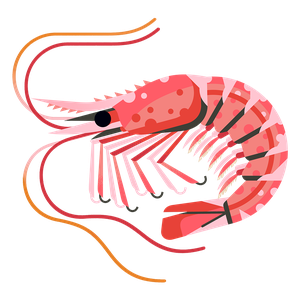
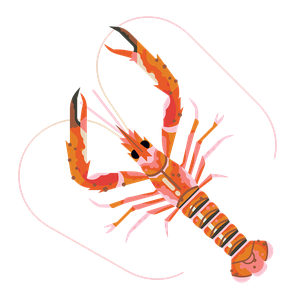
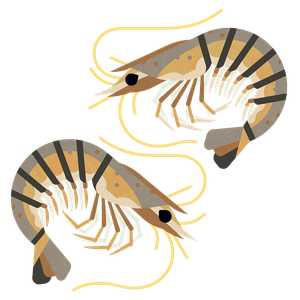
King prawn
Litopenaeus vannamei
What to check for
Location
All areas, Scotland
Production method
Closed system, RAS
Rating summary
King prawns farmed in UK recirculating aquaculture systems are a good choice. They have relatively low requirements for fishmeal and fish oil. Being that RAS is a closed-loop system, there is minimal environmental impact, or risk of escapes, disease, and predator interactions. Although currently at low production volumes, this method is well regulated and managed, but remains uncertified.Rating last updated November 2025.
Technical consultation summary
King prawns farmed in UK recirculating aquaculture systems are a good choice. They have relatively low requirements for fishmeal and fish oil, with an FFDR value estimated below 0.5, and are fed a diet inclusive of alternative and novel protein sources. Being that RAS is a closed-loop system, there is minimal environmental impact, or risk of escapes, disease, and predator interactions. Juveniles for this production system are sourced from hatcheries, so wild populations are unaffected. Although currently at low production volumes, this method is well regulated and managed, but remains uncertified.
How we worked out this Rating
Feed
What feed is given to farmed fish, where it comes from and how much is used is one of the most important aspects of fish farming. In this section we look at how sustainable the feed is and how much fish is included in the diet.
Production of King prawns (Litopenaeus vannamei) in UK RAS systems relies on commercial feeds produced by established global feed companies, consisting of both marine and terrestrial ingredients.King prawns in RAS systems in the UK are fed a standard pelleted diet containing fishmeal, fish oil, and plant-based proteins and oils.Over time, cheaper plant-based proteins and oils, such as soy and palm, have been increasingly substituted into feed formulations. Feed suppliers may have internal policies to ensure that plant-based and marine ingredients are traceable and responsibly sourced. Many companies have already achieved, or are actively working towards, the goal of sourcing 100% of their ingredients responsibly.King prawns have a relatively low requirement for fish oil and a slightly higher demand for fishmeal. These requirements have both declined over time. Currently, the Feed Fish Dependency Ratio – the quantity of wild fish (excluding by-products) needed to produce one unit of farmed seafood – is estimated to be below 0.5 for king prawns farmed in UK RAS systems.
Environment
The environmental impacts of aquaculture depend on what fish is farmed, how and where. It could be habitat damage, chemical use, pollution, freshwater use or parasites. In this section we look at the environmental impacts of greatest concern for that species and production method. Some species, such as shellfish, have very little impact, whilst others may give us cause for concern.
Species farmed in recirculating aquaculture systems have little direct environmental impact due to the closed nature of the system.King prawns farmed in recirculating aquaculture systems (RAS) in the UK have minimal environmental impact. These systems can be established almost anywhere with access to water and often make use of existing buildings, therefore avoiding sensitive habitats. When purpose-built, they are typically located on converted land or brownfield sites, ensuring no loss of habitat or ecosystem functionality. As RAS is a closed-loop system, ongoing freshwater use is minimal, and only small amounts are required to replace water lost through evaporation.Although pathogens can spread quickly in RAS systems, the closed design does provide physical isolation from the surrounding environment. This prevents the transmission of pathogens or parasites to wild species and eliminates risks associated with chemical use. Chemical use in UK RAS prawn farming is very limited, and any wastewater generated can be treated and sterilised before potential discharge, ensuring that the risk of chemical release into the environment is very low.Wastewater management is highly efficient. Drum filters separate solid waste, which can then be repurposed as fertiliser or directed into biodigesters, while biofilters remove toxic ammonia from the liquid portion.Juveniles for UK RAS prawn systems are hatchery-produced, and therefore wild populations are unaffected. Also, as king prawns are raised in fully enclosed systems, there is no risk of escapes, and predator control measures are unnecessary.
Fish health and welfare
Fish health and welfare is a concern for many consumers. High welfare standards are an indication of good farm management, we look to see if there are industry wide welfare standards in place, and if these include humane slaughter.
Regulations on animal welfare do not apply to crustaceans. Slaughter is carried out humanely.Animal welfare is not applicable for crustaceans as it is not covered by EU regulations on welfare.
Management
How aquaculture is regulated and how effective those regulations are is an important aspect of farmed fish production. We also look to see if aquaculture is included in broader environmental management plans. In this management section we also award scores for globally recognised certification standards, as certified seafood requires verification of environmental performance and traceability.
Recirculating aquaculture systems perform well regarding management and regulation due to their terrestrial location and planning.Land based recirculation systems score well for regulation and management. Marine spatial planning is not applicable to land-based systems that are subject to terrestrial planning. There is regulatory framework that covers the protection of valuable habitats and species. As the system is fully closed, regulations regarding environmental impact assessments, land and water resource use, chemicals, discharges, biosecurity and species introduction are not applicable, and none of the environmental assessment questions scored negatively due to poor regulation.
References
BioMar, 2024. Sustainability Report. Available at: Sustainability Report | BioMar [Accessed on 10.11.2025]
Cargill, 2025. Impact Report 2025. Available at: Cargill Impact Report 2025 [Accessed on 10.11.2025]
Cargill, 2024. Product highlights from 2024. Available at: Product | Cargill [Accessed on 10.11.2025]
Cargill, 2019. Cargill Policy on Sustainable Palm Oil. Available at: palm-oil-policy-statement-pdf.pdf [Accessed on 10.11.2025]
FAO. 2009. Penaeus vannamei. In Cultured aquatic species fact sheets. Available at: FAO - Penaeus vannamei [Accessed on 10.11.2025]
RASTECH, 2025. RASTECH. Available at: Rastech – Recirculating Aquaculture SCIENCE [Accessed on 10.11.2025]
Skretting, 2024. Impact Report 2024. Available at: skretting-impact-report-2024.pdf [Accessed on 10.11.2025]
The UK Sustainable King Prawn Project, 2025. Outputs. Available at: Outputs > The UK Sustainable King Prawn Project [Accessed on 10.11.2025]
Weineck, K., Ray, A.J., Fleckenstein, L.J., Medley, M., Dzubuk, N., Piana, E. and Cooper, R.L., 2018. Physiological changes as a measure of crustacean welfare under different standardized stunning techniques: Cooling and electroshock. Animals, 8(9), p.158.
Pers Comm. RASTECH. Email 23.10.2025 and 17.11.2025
Sustainable swaps
Learn more about how we calculate our sustainability ratings.
How our ratings work
Add impact to your inbox
Join the movement: get updates on the issues you care about.
We'll email you inspiring stories about the work we're doing to save and recover our oceans, and news about our urgent campaigns for positive change.