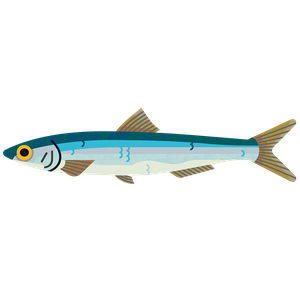
Peruvian anchovy
What to check for
Central-Southern Chile Stock (3-4): All areas
Net (purse seine or ring)
Rating summary
The stock of Peruvian anchovy is abundant, and there is no concern for fishing pressure. There are management measures in place for the fishery, which are partly effective in managing the stock, however catches are above advice. Peruvian anchovy is caught by purse seiners in central Chile. They are caught by purse seiners in central Chile. There has little to no impact on ecosystems however there are some bycatch concerns.
Rating last updated in November 2024.
How we worked out this Rating
References
Bucarey, D., M. Zúñiga Basualto, F. Espíndola Rebolledo, and J. C. Quiroz. 2022. Status and possibilities for the biologically sustainable exploitation of Anchoveta and Spanish sardine, from the Atacama Region to the Coquimbo Region, 2022. SECOND REPORT Performance Agreement 2021. UNDERSECRETARIAT OF ECONOMY AND EMT / May 2022. 125 pp. IFOP. Available at: https://www.ifop.cl/wp-content/contenidos/uploads/RepositorioIfop/InformeFinal/2022/P-483259_anchoveta_sardina_esp_Atacama_Coquimbo.pdf [Accessed on 27.11.2024]
Canales, T. and Leal, E. 2009. Life history parameters of anchoveta Engraulis ringens Jenyns, 1842, in central north Chile. Revista de Biología Marina y Oceanografía, 44(1), pp.173-179. Available at: http://www.scielo.cl/pdf/revbiolmar/v44n1/art17.pdf [Accessed on 27.11.2024]
Canales, C. M., N. A. Adasme, L. A. Cubillos, M. J. Cuevas, and N. Sánchez. 2018. Long-time spatio-temporal variations in anchovy (Engraulis ringens) biological traits off northern Chile: an adaptive response to long-term environmental change? ICES Journal of Marine Science 75(6):1908-1923. https://academic.oup.com/icesjms/article/75/6/1908/5052273 [Accessed on 27.11.2024]
CCT-PP. 2022. Minutes of the third session of the Scientific Technical Committee of Small Pelagic Fisheries, 2022. 9 pp. Available at: https://www.subpesca.cl/portal/616/articles-114925_documento.pdf [Accessed on 27.11.2024]
Fishsource. 2024. Anchoveta Chile Atacama (III) -Coquimbo (IV) – Profile updated on 31 October 2023. Available at: https://www.fishsource.org/fishery_page/3315 [Accessed on 19.11.2024]
Gonzalez-Pestana, A., Alfaro-Shigueto, J., Mangel, J.C., 2022. A review of high trophic predator-prey relationships in the pelagic Northern Humboldt system, with a focus on anchovetas, Fisheries Research, Volume 253, https://doi.org/10.1016/j.fishres.2022.106386 [Accessed on 27.11.2024]
MMA, 2020. Ministry of the Environment approves and formalizes the classification of species by conservation status, sixteenth process. Official Gazette of the Republic of Chile. Ministry of the Interior and Public Security. 6 pages. Available at: https://clasificacionespecies.mma.gob.cl/wp-content/uploads/2020/12/DS16-2020_oficializa_16toProc_RCE_DiarioOficial.pdf [Accessed on 27.11.2024]
MEFR, 2013. Law No. 20,657, dated January 31, 2013, from the Ministry of Economy, Development, and Tourism; Undersecretariat of Fisheries and Aquaculture. Amends the General Fisheries and Aquaculture Law (Law No. 18,892 and its modifications) in areas related to the sustainability of hydrobiological resources, access to industrial and artisanal fishing activities, and regulations for research and enforcement. Available at: http://www.leychile.cl/Navegar?idNorma=1048776. [Accessed on 27.11.2024]
MEFT. 2019. Law 21132. Modernizes and strengthens the public service function of the National Fisheries Service. Ministry of Economy, Development, and Tourism https://www.bcn.cl/leychile/navegar?idNorma=1128370 [Accessed on 27.11.2024]
MEFT, 2012. Law No. 20,625 defines the discard of hydrobiological species and establishes control measures and sanctions for those engaging in this practice during fishing operations. Available at: http://www.subpesca.cl/portal/615/w3-article-80306.html. [Accessed on 27.11.2024]
Petit, I. J., A. N. Campoy, M.-J. Hevia, C. F. Gaymer, and F. A. Squeo. 2018. Protected areas in Chile: are we managing them? Revista Chilena de Historia Natural 91(1):1. https://doi.org/10.1186/s40693-018-0071-z [Accessed on 27.11.2024]
Pikitch, E., Boersma, P.D., Boyd, I.L., Conover, D.O., Cury, P., Essington, T., Heppell, S.S., Houde, E.D., Mangel, M., Pauly, D., Plagányi, É., Sainsbury, K., and Steneck, R.S. 2012. Little Fish, Big Impact: Managing a Crucial Link in Ocean Food Webs. Lenfest Ocean Program. Washington, DC. 108 pp. [Accessed on 27.11.2024]
Porobic, J., E. A. Fulton, S. Frusher, C. Parada, M. Haward, B. Ernst, and D. Stram. 2018. Implementing Ecosystem-based Fisheries Management: Lessons from Chile’s experience. Marine Policy 97:82-90. http://www.sciencedirect.com/science/article/pii/S0308597X17307510 [Accessed on 27.11.2024]
Silva, C., I. Andrade, E. Yáñez, S. Hormazabal, M. Á. Barbieri, A. Aranis, and G. Böhm. 2016. Predicting habitat suitability and geographic distribution of anchovy (Engraulis ringens) due to climate change in the coastal areas off Chile. Progress in Oceanography 146:159-174. [Accessed on 27.11.2024]
SERNAPESCA, 2023. Annual Report on Quotas for the Artisanal and Industrial Sectors for the Year 2022. 227 pp. Available at: http://www.sernapesca.cl/sites/default/files/informe_final_cuotas_ano_2022_v20230331.pdf
Vega, R., L. Ossa, B. Suárez, M. Jiménez, S. Henríquez, A. González, R. Ojeda, and et al. 2020. Scientific observers program: Research and monitoring program for discards and incidental catch in pelagic fisheries, 2019-2020. FINAL REPORT. Performance Agreement 2019. 442 pp. https://www.ifop.cl/wp-content/contenidos/uploads/RepositorioIfop/InformeFinal/2020/P-581156.pdf [Accessed on 27.11.2024]