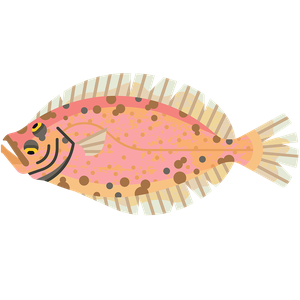
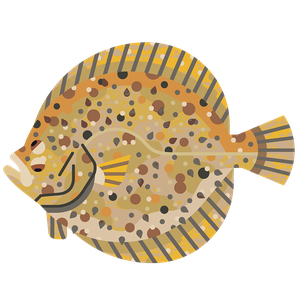
Plaice
What to check for
English Channel (West): All areas
Net (gill or fixed)
Rating summary
Plaice in the Western English Channel is currently fished at sustainable levels, but a new advice method highlights that stock biomass is below sustainable levels. There is no management plan in place for this fishery, but there are some measures in place. Gillnets in this area can encounter bycatch of non-target fish, mammals and birds. This includes the harbour porpoise which is vulnerable in Europe.
Last updated: July 2025
How we worked out this Rating
References
Calderan, S. and Leaper, R., 2019. Review of harbour porpoise bycatch in UK waters and recommendations for management. January 2019, WWF. Available at https://www.wwf.org.uk/sites/default/files/2019-04/Review_of_harbour_porpoise_in_UK_waters_2019.pdf [Accessed on 12.07.2024].
Chadwick, H., Clear, N., Crosby, A., Hawtrey-Collier, A. and Williams, R. Marine Strandings in Cornwall and the Isles of Scilly: 2019 Annual Report. Report by Cornwall Wildlife Trust and Marine Strandings Network. Available at https://www.cornwallwildlifetrust.org.uk/sites/default/files/2020-12/2019%20Summary%20Report%20-%20Marine%20Strandings%20in%20Cornwall%20and%20the%20Isles%20of%20Scilly.pdf [Accessed on 12.07.2024].
Burt, G., Readdy, L., Benedet, R., Forster, R. 2021. Programme 40: Western Channel Sole and
Plaice. Available at: https://data.cefas.co.uk/view/21387 [Accessed on 03.07.2025]
Eigaard, O.R., Bastardie, F., Breen, M., Dinesen, G.E., Hintzen, N.T., Laffargue, P., Mortensen, L.O., Nielsen, J.R., Nilsson, H.C., O'Neill, F.G., Polet, H., Reid, D.G., Sala, A., SkOld, M., Smith, C., Sorensen, T.K., Tully, O., Zengin, M., Rijnsdorp, A.D., 2016. Estimating seabed pressure from demersal trawls, seines, and dredges based on gear design and dimensions. ICES Journal of Marine Science, Volume 73, Issue suppl 1. Pages i27-i43. Available at https://academic.oup.com/icesjms/article/73/suppl_1/i27/2573989 [Accessed on 03.07.2025].
Ellis, J. R., Bendall, V. A., Hetherington, S. J., Silva, J. F. and McCully Phillips, S. R. 2016. National Evaluation of Populations of Threatened and Uncertain Elasmobranchs (NEPTUNE). Project Report (Cefas) V1.4. Available at http://randd.defra.gov.uk/Document.aspx?Document=13513_MB5201NEPTUNEFinalReportv1.4.pdf [Accessed on 12.07.2024].
EU. 2024. Council Regulation (EU) 2024/257 of 11 January 2024 fixing for 2024, 2025 and 2026 the
fishing opportunities for certain fish stocks, applicable in Union waters and, for Union
fishing vessels, in certain non-Union waters, and amending Regulation (EU) 2023/194.
ST/16570/2023/ADD/3/REV/1. Official Journal of the European Union, L 2024/257,
11.1.2024, p. 1–219. http://data.europa.eu/eli/reg/2024/257/oj
EU. 2019. Regulation (EU) 2019/1241 of the European Parliament and of the Council of 20 June
2019 on the conservation of fisheries resources and the protection of marine ecosystems
through technical measures, amending Council Regulations (EC) No 1967/2006, (EC) No
1224/2009 and Regulations (EU) No 1380/2013, (EU) 2016/1139, (EU) 2018/973, (EU)
2019/472 and (EU) 2019/1022 of the European Parliament and of the Council, and repealing
Council Regulations (EC) No 894/97, (EC) No 850/98, (EC) No 2549/2000, (EC) No 254/2002,
(EC) No 812/2004 and (EC) No 2187/2005. Official Journal of the European Union, L 198,
25.7.2019, p. 105. http://data.europa.eu/eli/reg/2019/1241/2024-04-09
Glemarec, G., Kindt-Larse, L., Scherffenberg Lundgaard, L. and Larsen, F. 2020. Assessing seabird bycatch in gillnet fisheries using electronic monitoring. Biological Conservation. 243. 108461. Available at https://doi.org/10.1016/j.biocon.2020.108461 [Accessed on 12.07.2024].
GOV.UK. 2025. Technical Conservation and Landing Obligation rules and regulations 2025. Available at: https://www.gov.uk/guidance/technical-conservation-and-landing-obligation-rules-and-regulations-2025 [Accessed on 03.07.2025]
Hiddink, J., Jennings, S., Sciberras, M., Szostek, C.L., Hughes, K.M., Ellis, N., Rijnsdorp, A.D., McConnaughey, R.A., Mazor, T., Hilborn, R., Collie, J.S., Pitcher, C.R., Amoroso, R.O., Parma, A.M., Suuronen, P. and Kaiser, M.J. 2017. Global analysis of depletion and recovery of seabed biota after bottom trawling disturbance. PNAS. 114:31, pp. 8301-8306. https://doi.org/10.1073/pnas.1618858114.
ICES. 2025. Plaice (Pleuronectes platessa) in Division 7.e (western English Channel). Replacing advice provided in June 2025. In Report of the ICES Advisory Committee, 2025. ICES Advice 2025, ple.27.7e. https://doi.org/10.17895/ices.advice.29468948
ICES. 2025. Plaice (Pleuronectes platessa) in Division 7.e (western English Channel). Replacing advice provided in June 2024. In Report of the ICES Advisory Committee, 2025. ICES Advice 2025, ple.27.7e. https://doi.org/10.17895/ices.advice.29412776
ICES. 2025. Plaice (Pleuronectes platessa) in Division 7.e (western English Channel). ICES Stock Annexes. 26 pp. https://doi.org/10.17895/ices.pub.29149577
ICES. 2025. Benchmark Workshop for Selected Plaice Stocks (WKBPLAICE). ICES Scientific Reports. 7:41. 70 pp. https://doi.org/10.17895/ices.pub.28400255
ICES. 2024. Celtic Seas Ecoregion – Ecosystem overview. In Report of the ICES Advisory Committee, 2024. ICES Advice 2024, Section 7.1, https://doi.org/10.17895/ices.advice.25713033
ICES. 2024 Celtic Seas Ecosystem – fisheries Overview. In Report of the ICES Advisory Committee, 2024. ICES Advice 2024, section 7.2. https://doi.org/10.17895/ices.advice.27879936
JNCC. 2019. Harbour porpoise (Phocoena phocoena) Special Area of Conservation: Bristol Channel Approaches / Dynesfeydd Môr Hafren. Conservation Objectives and Advice on Operations. Available at https://data.jncc.gov.uk/data/505b3bab-a974-41e5-991c-c29ef3e01c0a/BCA-ConsAdvice.pdf [Accessed on 12.07.2024].
Kennelly, S. J. & Broadhurst, M. K., 2021. A review of bycatch reduction in demersal fish trawls. Rev Fish Biol Fisheries 31, 289–318. https://doi.org/10.1007/s11160-021-09644-0.
Kynoch, R., Fryer, R. & Neat, F., 2015. A simple technical measure to reduce bycatch and discard of skates and sharks in mixed-species bottom-trawl fisheries. ICES J Mar Sci,72(6):1861.
Palomares, M.L.D. and D. Pauly. Editors. 2025. SeaLifeBase. Available at: https://www.fishbase.org/summary/Pleuronectes_platessa.html [Accessed on: 03.07.2025].
Omeyer, L.C.M., Doherty, P.D., Dolman, S., Enever, R., Reese, A., Tregenza, N., Williams, R. and Godley, B.J. 2020. Assessing the Effects of Banana Pingers as a Bycatch Mitigation Device for Harbour Porpoises (Phocoena phocoena). Frontiers in Marine Science. Front. Mar. Sci. https://doi.org/10.3389/fmars.2020.00285.
OSPAR, 2017. Intermediate Assessment 2017: Harbour Porpoise Bycatch. Available at https://oap.ospar.org/en/ospar-assessments/intermediate-assessment-2017/biodiversity-status/marine-mammals/harbour-porpoise-bycatch/ [Accessed on 12.07.2024].
Scottish Government, 2021. UK Dolphin and Porpoise Conservation Strategy: Technical Report. Published 22 March 2021. ISBN: 9781800048522. Available at https://www.gov.scot/publications/uk-dolphin-porpoise-conservation-strategy-technical-report/documents/ [Accessed on 12.07.2024].
Silva, F., Ellis, J. & Catchpole, T., 2012. Species composition of skates (Rajidae) in commercial fisheries around the British Isles and their discarding patterns. J Fish Biol., 80:1678–1703.
Species account by IUCN SSC Cetacean Specialist Group; regional assessment by European Mammal Assessment team. 2007. Phocoena phocoena. The IUCN Red List of Threatened Species 2007: e.T17027A6734714. Available at https://www.iucnredlist.org/species/17027/6734714 [Accessed on 12.07.2024].
van Denderen, P. Bolam, S., Hiddink, J.G., Jennings, S., Kenny, A., Rijnsdorp, A., and van Kooten, T., 2015. Similar effects of bottom trawling and natural disturbance on composition and function of benthic communities across habitats. Mar Ecol Prog Ser. 2015;541:31–43.