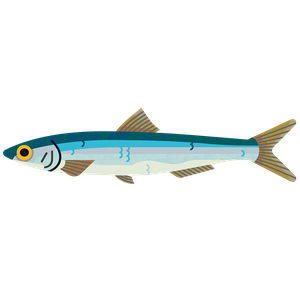
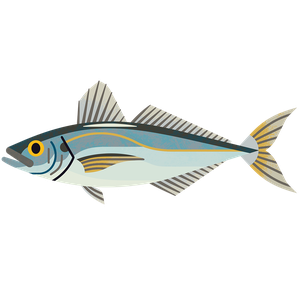
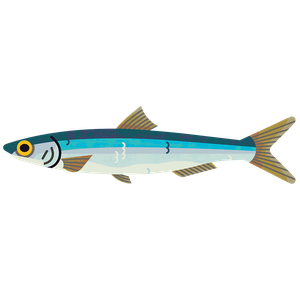
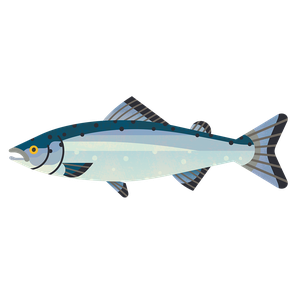
Sardine in the southern Celtic Seas and English Channel is abundant and there is no concern for fishing pressure.
This stock is assessed by the International Council for the Exploration of the Sea (ICES). The most recent assessment was published in 2025 using data up to 2025. The next assessment is expected in 2026.
Route 2 (data limited) scoring has been applied to this rating owing to the lack of a reference point for fishing pressure. Sardines are considered to have medium resilience to fishing.
Sardine in area 7 has been surveyed and assessed as a separate stock since 2017. It was very data limited until 2021, when a benchmark was carried out to improve the quality of the assessment. No MSY-based reference points have been defined for this stock to indicate what would be a sustainable level of fishing or biomass. However, there is an estimated trigger point, to safeguard the biomass, which has been set at 120,751 tonnes.
Sardine is a short-lived species, and biomass can fluctuate considerably. While there have been some fluctuations since 2017, there has been an overall increasing trend. Biomass in 2025 was 502,312t, the highest since the time series began in 2017, and well above the trigger point. Therefore, there is no concern for the biomass of this stock.
There is no indicator for fishing pressure. Stock-specific catch advice was provided for the first time in 2022. In 2024, ICES advised catches of no more than 13,459t. Total landings were 16,808t - above the advice and the 2020-2024 average (13,656t). This suggests that there could be concern for the fishing pressure. However, a number of caveats have been mentioned in relation to ICES advice for this stock, indicating that it may not be appropriate (further details below). Cefas have also provided separate catch advice for the MSC-certified component of the sardine fishery, indicating that higher catches would not be a threat to the biomass. Based on these caveats, and noting that the biomass has been able to increase under current levels of fishing, we do not consider there to be concern for fishing pressure.
Following the 2021 benchmark and in the absence of MSY-based reference points, ICES’ approach to developing catch advice involved using average catches for the preceding two years. However, ICES noted some caveats, including that the stock is only moderately exploited and could withstand higher levels of fishing pressure; that catches from the past decade had been low; and that harvest rates from the most recent two years were the lowest in the time series. Catches fluctuate based on changes in fleet activity and which species are being targeted. Therefore, these low catches were not indicative of stock size.
As a result of this, ICES noted that the 2021 benchmark would produce a low catch advice, and that the stock was likely to be able to support higher exploitation rates. The ICES approach in 2021 led to a harvest rate of 2.6%, whereas in 2017 and 2018 it had been 7%. It has been suggested that the approach may not be appropriate for moderately exploited stocks such as the Celtic Sea sardine.
In Cornwall, the Cornish Sardine Management Association (CSMA) have sought additional catch advice for their MSC-certified fishery, which accounts for over 50% of the total catches of this stock. Each year, the CSMA proposes an annual catch limit for its fleet, based on capacity. This is reviewed by Cefas based on the likelihood of keeping the stock below FMSY and the risk of reducing biomass to Blim. In 2022, CSMA raised concerns about the new ICES approach and continued to liaise with Cefas for catch advice. In 2023, CSMA proposed an increased catch of 11,150t and Cefas advised that this rate of harvest would be precautionary and would not lead to overexploitation of the stock.
Based on the above, ICES catch advice may not be appropriate for assessing fishing pressure until a new approach can be developed.