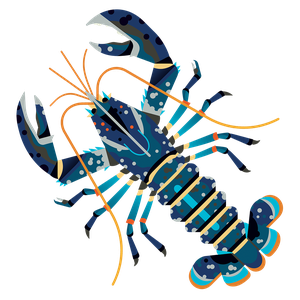
Scampi or langoustine
What to check for
Botney Cut to Silver Pit (FU 5): All areas
Bottom trawl (otter)
Fishery Improvement Project (FIP)
Rating summary
In Botney Cut to Silver Pit, scampi, often referred to as Nephrops or Norway lobster, is data limited. There is concern for the biomass, as the most recent stock information is no longer considered to be representative of the current abundance. There does not appear to be concern for fishing pressure. Catch limits don't match the stock area, meaning that there is a risk of overfishing. Catches and discards have historically have been too high, although they have declined in recent years. Management is not following scientific advice and is insufficient to prevent overexploitation. Almost all Norway lobster in this area are caught by otter trawling. Trawling for Norway lobster can have an impact on seabed habitats, particularly on mud which is subjected to high disturbance by fishing. Bycatch may also be of concern.
Rating last updated: December 2023.
How we worked out this Rating
References
BENTHIS. 2015. Deliverable 2.3: Benthic impact of fisheries in European waters: the distribution and intensity of bottom trawling. Available at: http://archimer.ifremer.fr/doc/00310/42138/54476.pdf [Accessed on 27.11.2023].
CruCSChange, 2015. The crustacean chemosensory system: Consequences of climate and environmental change. EU Grant agreement ID: 331296. Available at https://cordis.europa.eu/article/id/182940-impact-of-environmental-change-on-norway-lobster [Accessed on 27.11.2023].
Drewery, J., Edridge, A., Kinghorn, M., Kynoch, R.J., Mair, J., O’Neill, F.G. and Summerbell. K., 2015. Effects of Codend Mesh Size and Twine Number on Nephrops Selectivity. Report on FISA project 03/13. Scottish Marine and Freshwater Science Vol 6 No 3. Edinburgh: Scottish Government, 23pp. Available at https://www.gov.scot/publications/scottish-marine-freshwater-science-volume-6-number-3-effects-codend/ [Accessed on 27.11.2023].
Enever R., Catchpole T.L., Ellis. J.R., and Grant A., 2009. The survival of skates (Rajidae) caught by demersal trawlers fishing in UK waters. Fisheries Research, 97: 1–2, pp. 72-76. https://doi.org/10.1016/j.fishres.2009.01.001.
Gullestad, P., Abotnes, A.M., Bakke, G., Skern-Mauritzen, M., Nedreaas, K., Savik, G., 2017. Towards ecosystem-based fisheries management in Norway - Practical tools for keeping track of relevant issues and prioritising management efforts. Marine Policy. 77. pp104-110. https://doi.org/10.1016/j.marpol.2016.11.032
Hinz, H., Prieto, V., and Kaiser, M. J., 2009. Trawl disturbance on benthic communities: chronic effects and experimental predictions. Ecological Applications: A Publication of the Ecological Society of America, 19(3), 761-73. https://doi.org/10.1890/08-0351.1
ICES. 2022. Norway lobster (Nephrops norvegicus) in divisions 4.b and 4.c, Functional Unit 5 (central and southern North Sea, Botney Cut-Silver Pit). In Report of the ICES Advisory Committee, 2022. ICES Advice 2022, nep.fu.5. Available at https://doi.org/10.17895/ices.advice.19453547 [Accessed on 27.11.2023].
ICES, 2022. Working Group on the Assessment of Demersal Stocks in the North Sea and Skagerrak (WGNSSK). ICES Scientific Reports. 3:66. 1281 pp. Available at http://doi.org/10.17895/ices.pub.19786285 [Accessed on 27.11.2023].
Kingma, I. and Walker, P. Rays of Hope - Discard survival in North Sea Skates and Rays. ICES CM 2014/O:09. Available at: http://www.ices.dk/sites/pub/CM%20Doccuments/CM-2014/Theme%20Session%20O%20contributions/O0914.pdf [Accessed on 27.11.2023].
Mandelman, J.W., Cicia, A.M., Ingram Jr, G.W., Driggers III, W.B., Coutre, K.M. and Sulikowski, J.A., 2013. Short-term post-release mortality of skates (family Rajidae) discarded in a western North Atlantic commercial otter trawl fishery. Fisheries Research 139, pp. 76-84. https://doi.org/10.1016/j.fishres.2012.09.020.
Matear, L., Vina-Herbon, C., Woodcock, K.A., Duncombe-Smith, S.W., Smith, A.P., Schmitt, P., Kreutle, A., Marra, S., Curtis, E.J., and Baigent, H.N. 2023. Extent of Physical Disturbance to Benthic Habitats: Fisheries. In: OSPAR, 2023: The 2023 Quality Status Report for the Northeast Atlantic. OSPAR Commission, London. Available at https://oap.ospar.org/en/ospar-assessments/quality-status-reports/qsr-2023/indicator-assessments/phys-dist-habs-fisheries/ [Accessed on 27.11.2023].
Murray and Cowie, 2011. Plastic contamination in the decapod crustacean Nephrops norvegicus (Linnaeus, 1758). Marine Pollution Bulletin, 62: 6, pp.1207-1217. https://doi.org/10.1016/j.marpolbul.2011.03.032.
Norwegian Directorate of Fisheries. 2015. Marine protected areas. Available at: https://www.fiskeridir.no/English/Coastal-management/Marine-protected-areas [Accessed on 27.11.2023].
OSPAR. 2023. Sea Pen & Burrowing Megafauna. Available at https://www.ospar.org/work-areas/bdc/species-habitats/list-of-threatened-declining-species-habitats/habitats/sea-pen-burrowing-megafauna [Accessed on 27.11.2023].
Palomares, M.L.D. and Pauly, D. (Editors), 2022. SeaLifeBase. Nephrops norvegicus: Norway lobster. Available at https://www.sealifebase.ca/summary/Nephrops-norvegicus.html [Accessed on 27.11.2023].
Project UK. Nephrops. Available at https://www.projectukfisheries.co.uk/nephrops [Accessed on 27.11.2023].
Williams, C. and Carpenter, G., 2016. NEF working paper: The Scottish Nephrops fishery: Applying social, economic, and environmental criteria. Available at https://griffincarpenter.org/briefings/the-scottish-nephrops-fishery-applying-social-economic-and-environmental-criteria/ [Accessed on 27.11.2023].
Wood, H., Eriksson, S., Nordborg, M., and Styf, H., 2015. The effect of environmental stressors on the early development of the Norway lobster Nephrops norvegicus (L.). Journal of Experimental Marine Biology and Ecology. 473. pp. 35-42. http://dx.doi.org/10.1016%2Fj.jembe.2015.08.009.