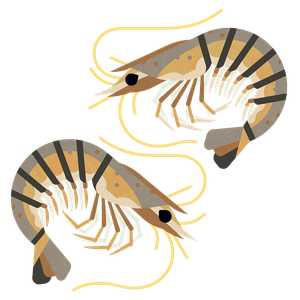
Tiger prawn
What to check for
Asia: India, All Areas; Indonesia, All Areas; Vietnam, All areas
Pond, improved extensive, Pond, semi-intensive
Rating summary
There are many areas of environmental concern in tiger prawn aquaculture in India, Vietnam and Indonesia. This includes the use of illegal chemicals, including antibiotics, salinisation of soil and freshwater, direct discharges into the environment, and the use of wild caught juveniles. Supplementary feed is used in semi-intensive and improved extensive systems, however, there is little transparency of the ingredients used and no requirements for responsible feed sourcing. It’s also not known if there are any welfare regulations in place and management for the aquaculture sector in India, Vietnam and Indonesia is thought to be only partially effective in mitigating negative environmental impacts.
Rating last updated January 2025.
How we worked out this Rating
References
Abdul-Aziz, M.A., Schöfl, G., Mrotzek, G., Haryanti, H., Sugama, K. and Saluz, H.P. 2015. Population structure of the Indonesian giant tiger shrimp Penaeus monodon: a window into evolutionary similarities between paralogous mitochondrial DNA sequences and their genomes. Ecol Evol. 2015;5(17):3570-84. Available at https://www.ncbi.nlm.nih.gov/pmc/articles/PMC4567862/ [Accessed on 01.16.2025].
Briggs, M. 2005. Introductions and movement of two penaeid shrimp species in Asia and the Pacific (No. 476). Food & Agriculture Org. Available at http://www.fao.org/docrep/009/a0086e/A0086E00.htm#TOC [Accessed on 01.16.2025].
CAA. 2018. Coastal Aquaculture Authority (India). Available at http://www.caa.gov.in [Accessed on 01.16.2025].
Chakraborti, J. and Bandyapadhyay, P.K. 2011. Seasonal incidence of protozoan parasites of the black tiger shrimp (Penaeus monodon) of Sundarbans, West Bengal, India. J Parasit Dis. 2011;35(1):61-5. Available at https://www.ncbi.nlm.nih.gov/pmc/articles/PMC3114977/ [Accessed on 01.16.2025].
Deltares. 2016. Mangrove restoration: to plant or not to plant? Available at https://www.deltares.nl/app/uploads/2016/07/Mangrove-restoration_to-plant-or-not-to-plant.pdf [Accessed on 01.16.2025].
EJF. 2004. Farming the Sea, Costing the Earth: Why we Must Green the Blue Revolution. Environmental Justice Foundation, London, UK. Available at https://ejfoundation.org/resources/downloads/Farming-Sea-Costing-Earth-ok.pdf [Accessed on 01.16.2025].
FAO. 2013. Culprit behind mass shrimp die-offs in Asia unmasked. News article 3 May 2013, Rome. Available at http://www.fao.org/news/story/en/item/175416/icode/ [Accessed on 01.16.2025].
FAO. 2004. National Aquaculture Sector Overview: India. Available at https://www.fao.org/fishery/legalframework/nalo_india/en [Accessed on 01.16.2025].
FAO. 2014. National Aquaculture Sector Overview: Vietnam. Available at https://www.fao.org/fishery/legalframework/nalo_vietnam/en [Accessed on 01.16.2025].
FAO. 2005. National Aquaculture Sector Overview: Indonesia. Available at https://www.fao.org/fishery/legalframework/nalo_indonesia/en [Accessed on 01.16.2025].
Hens, L., Vromant, N., Tho, N., Hung, N.T. 2009. Salination of surface water, groundwater, and soils in the shrimp farming areas of the coastal Cai Nuoc district, South Vietnam, International Journal of Environmental Studies, 66:1, 69-81. Available at https://www.researchgate.net/publication/248923902_Salination_of_Surface_water_groundwater_and_soils_in_the_shrimp_farming_areas_of_the_coastal_Cai_Nuoc_district_South_Vietnam [Accessed on 01.16.2025].
Lightner, D.V., Redman, R.M., Pantoja, C.R., Tang, K.F.J., Noble, B.L., Schofield, P., Mohney, L.L., Navarro, S.A. 2012. Historic emergence, impact and current status of shrimp pathogens in the Americas. Journal of Invertebrate Pathology, 110(2), pp. 174-183. Available at https://arizona.pure.elsevier.com/en/publications/historic-emergence-impact-and-current-status-of-shrimp-pathogens- [Accessed on 01.16.2025].
MBA. 2015. Monterey Bay Aquarium Seafood Watch assessment of Farmed Shrimp grown in ponds in Indonesia. Available at https://www.seafoodwatch.org/recommendation/shrimp/red-shrimp-whiteleg-shrimp-indonesia-ponds?species=156 [Accessed on 01.16.2025].
MBA. 2017. Monterey Bay Aquarium Seafood Watch assessment of Farmed Shrimp grown in ponds in Vietnam. Available at https://www.seafoodwatch.org/recommendation/shrimp/red-shrimp-whiteleg-shrimp-vietnam-intensive-pond?species=156 [Accessed on 01.16.2025].
MBA. 2021. Monterey Bay Aquarium Seafood Watch assessment of Farmed Shrimp grown in ponds in India. Available at https://www.seafoodwatch.org/recommendation/shrimp/red-shrimp-whiteleg-shrimp-india-ponds2?species=156 [Accessed on 01.16.2025].
Osbourne, Z. 2018. Pushing Vietnam’s shrimp industry toward sustainability. Mongabay. Available at https://news.mongabay.com/2018/07/pushing-vietnams-shrimp-industry-toward-sustainability/ [Accessed on 01.16.2025].
Seafish. 2013. Responsible Sourcing Guide: Marine Warm Water Prawns. Available at https://www.seafish.org/document/?id=d443878e-d50b-4d78-9d68-8b5c393ed0c0 [Accessed on 01.16.2025].
STIP. 2018b. Seafood Trade Intelligence Portal: Shrimp in Vietnam. Available at https://seafood-tip.com/sourcing-intelligence/countries/vietnam/shrimp/ [Accessed on 01.16.2025].
Suratin, A. 2011. Restoring neglected coastal land in Indonesia. New Agriculturist. Oxfam Indonesia. Available at http://www.new-ag.info/en/focus/focusItem.php?a=2088 [Accessed on 01.16.2025].
Tacon, A.G.J., Jory D., and Nunes, A. 2013. Shrimp feed management: issues and perspectives. In M.R. Hasan and M.B. New, eds. On-farm feeding and feed management in aquaculture. FAO Fisheries and Aquaculture Technical Paper No. 583. Rome, FAO. pp. 481–488. Available at http://www.fao.org/tempref/FI/CDrom/T583/root/18.pdf [Accessed on 01.16.2025].
The Asean Post. 2018. Vietnam’s shrimp exports at risk – Stephen Chin, 8 October 2018. Available at https://theaseanpost.com/article/vietnams-shrimp-exports-risk [Accessed on 01.16.2025].
The Fish Site. 2018. How to improve welfare at slaughter – by Rob Fletcher, March 16, 2018. Available at https://thefishsite.com/articles/seafood-welfare-at-slaughter-explained [Accessed on 01.16.2025].
Undercurrent News. 2018. EU official: India shrimp farm compliance on antibiotics ‘insufficient’ – By Louis Harkell Jan 29, 2018. Available at https://www.undercurrentnews.com/2018/01/29/eu-official-says-india-shrimp-farm-compliance-on-antibiotics-is-insufficient-as-trade-challenges-dominate-goa-show/ [Accessed on 01.16.2025].
Walker, P.J. and Winton, J.R. 2010. Emerging viral diseases of fish and shrimp. Veterinary Research Volume 41(6); Nov-Dec 2010. Available at http://www.ncbi.nlm.nih.gov/pmc/articles/PMC2878170/ [Accessed on 01.16.2025].