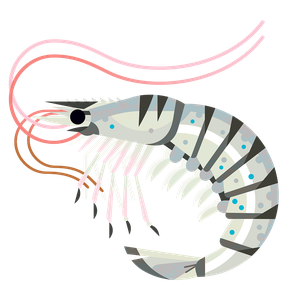
Tiger prawn
Penaeus monodon
What to check for
Location
All areas
Production method
Pond, extensive
Rating summary
There are negative environmental impacts of prawn farming including the destruction of mangrove habitats and the salinisation of soil and freshwater. There are also a lack of welfare and humane slaughter measures in place. However, tiger prawns produced in extensive ponds require few inputs, such as feed or chemicals, use hatchery reared juveniles and may actively remove nutrients from the environment. Management and regulation for the aquaculture sector in Bangladesh is thought to be only partially effective in mitigating negative environmental impacts.Rating last updated January 2025.
Technical consultation summary
There are negative environmental impacts of prawn farming including the destruction of mangrove habitats and the salinisation of soil and freshwater. There are also a lack of welfare and humane slaughter measures in place. However, tiger prawns produced in extensive ponds require few inputs, such as feed or chemicals, use hatchery reared juveniles and may actively remove nutrients from the environment. Management and regulation for the aquaculture sector in Bangladesh is thought to be only partially effective in mitigating negative environmental impacts.
How we worked out this Rating
Feed
What feed is given to farmed fish, where it comes from and how much is used is one of the most important aspects of fish farming. In this section we look at how sustainable the feed is and how much fish is included in the diet.
Giant tiger prawns grown in extensive pond systems in Bangladesh require very little feed input.Because tiger prawn produced in Bangladesh is mainly cultured in extensive systems, there is usually zero feed inputs. Feed for the prawn comes from naturally occurring plankton in the water.
Environment
The environmental impacts of aquaculture depend on what fish is farmed, how and where. It could be habitat damage, chemical use, pollution, freshwater use or parasites. In this section we look at the environmental impacts of greatest concern for that species and production method. Some species, such as shellfish, have very little impact, whilst others may give us cause for concern.
There are some areas of environmental concern in tiger prawn aquaculture in Bangladesh, but extensive systems require few inputs.One of the main issues of environmental concern in prawn farming is the use of illegal chemicals. However, in extensive systems in Bangladesh, chemical usage is minimal. Another benefit of extensive pond production systems is that discharged effluents have little environmental impact and when stocking densities are very low, prawn ponds are typically net removers of nutrients from the environment.While prawns are susceptible to an array of diseases, particularly viral pathogens, it is notable that direct environmental impacts of prawn viruses have not been commonly observed in wild populations. While escape inevitably occur, this species is native throughout the region and escapees are also not thought to pose a genetic or competitive threat to wild populations.However, there are still some negative environmental impacts of tiger prawn farming in extensive pond systems. Prawn producers contribute to soil salinization, which can impact livelihoods and food security. In addition, while hatchery produced juveniles are used, there may also be wild caught juveniles used in extensive pond systems. While non-lethal predatory controls appear to be the norm in the sector, it cannot be assured that lethal control of predators does not take place.Prawn farming has also historically been responsible for large-scale mangrove removal and tiger prawn farming has contributed towards the ongoing loss of functionality of mangrove habitats in Bangladesh.
Fish health and welfare
Fish health and welfare is a concern for many consumers. High welfare standards are an indication of good farm management, we look to see if there are industry wide welfare standards in place, and if these include humane slaughter.
Due to data deficiency on this topic, a precautionary score has been given.It is unknown if there are welfare regulations in place for farmed prawns in Bangladesh. It is common practice to use immersion in an ice slurry to kill prawns, but it is unknown if this is the method that is always used in Bangladesh.
Management
How aquaculture is regulated and how effective those regulations are is an important aspect of farmed fish production. We also look to see if aquaculture is included in broader environmental management plans. In this management section we also award scores for globally recognised certification standards, as certified seafood requires verification of environmental performance and traceability.
For uncertified giant tiger prawns produced in Bangladesh, regulations are in place, but some are only partially effective in mitigating the negative environmental impacts of aquaculture.This assessment covers uncertified extensive giant tiger prawn production in Bangladesh.Management and regulation in Bangladesh cover habitat protection, chemical usage, biosecurity and disease management, and species introductions, Environmental Impact Assessment (EIA) are also required. However, despite the existence of a regulatory framework for the sector, it is evident that confusion exists between the various agencies involved and, due to a lack of capacity, enforcement of these management measures is weak.
References
Afroz, T. and Alam, S. 2012. Sustainable shrimp farming in Bangladesh: A quest for an Integrated Coastal Zone Management. Ocean & Coastal Management 71 (2013) 275-283. Available at: http://www.sciencedirect.com/science/article/pii/S0964569112002785 [Accessed on 01.16.2025].
Ahmed, N. and Diana, J.S. 2015a. Coastal to inland: Expansion of prawn farming for adaptation to climate change in Bangladesh. Aquaculture Reports 2 (2015) 67–76. Available at: http://ac.els-cdn.com/S235251341530003X/1-s2.0-S235251341530003X-main.pdf?_tid=652492b6-23db-11e6-916e-00000aacb35e&acdnat=1464333768_1197b4f10069fdfed26ebceb9166f136 [Accessed on 01.16.2025].
Ahmed, N. and Diana, J.S. 2015b. Threatening “white gold”: Impacts of climate change on shrimp farming in coastal Bangladesh. Ocean & Coastal Management 114 (2015) 42e52. Available at: https://www.researchgate.net/publication/297480681_Threatening_white_gold_Impacts_of_climate_change_on_shrimp_farming_in_coastal_Bangladesh [Accessed on 01.16.2025].
Briggs, M. 2005. Introductions and movement of two penaeid shrimp species in Asia and the Pacific (No. 476). Food & Agriculture Org. Available at: http://www.fao.org/docrep/009/a0086e/A0086E00.htm#TOC [Accessed on 01.16.2025].
Deltares. 2016. Mangrove restoration: to plant or not to plant? Available at: https://www.deltares.nl/app/uploads/2016/07/Mangrove-restoration_to-plant-or-not-to-plant.pdf [Accessed on 01.16.2025].
DOF & Bangladesh Shrimp and Fish Foundation. 2015. CODE OF CONDUCT For Selected 10 Segments of the Shrimp Aquaculture Industry in Bangladesh. Available at: http://mofl.portal.gov.bd/sites/default/files/files/mofl.portal.gov.bd/legislative_information/ef408fe7_b347_4e56_9251_10bb70459bfd/Code%20of%20Conduct%20_FinalVersion_25_07_2015%20%281%29.pdf [Accessed on 01.16.2025].
EJF. 2004. Farming the Sea, Costing the Earth: Why we Must Green the Blue Revolution. Environmental Justice Foundation, London, UK. Available at: https://ejfoundation.org/resources/downloads/Farming-Sea-Costing-Earth-ok.pdf [Accessed on 01.16.2025].
Jahan, K.M., Belton, B., Ali, H., Dhar, G.C. and Ara, I. 2015. Aquaculture technologies in Bangladesh: An assessment of technical and economic performance and producer behavior. Penang, Malaysia: WorldFish. Program Report: 2015-52. Available at: http://aquaticcommons.org/20459/1/2015-52.pdf [Accessed on 01.16.2025].
Jannat, M., Ahmed, M.K., Islam, M., Goutam, K. and Kamruzzaman, M. 2017. Shrimp Post-Larvae Nursing in Earthen Ponds, Bangladesh. Journal of Scientific Research 9, 97. 10.3329/jsr.v1i1.28482. Available at: https://www.researchgate.net/publication/312296541_Shrimp_Post-Larvae_Nursing_in_Earthen_Ponds_Bangladesh [Accessed on 01.16.2025].
MBA. 2017. Monterey Bay Aquarium Seafood Watch assessment of Giant Tiger Prawn and Giant Freshwater Prawn grown in ponds in Bangladesh. Available at: https://www.seafoodwatch.org/-/m/sfw/pdf/reports/s/mba_seafoodwatch_farmedshrimp_bangladesh%20report.pdf [Accessed on 01.16.2025].
Seafish. 2013. Responsible Sourcing Guide: Marine Warm Water Prawns. Available at: https://www.seafish.org/document/?id=d443878e-d50b-4d78-9d68-8b5c393ed0c0 [Accessed on 01.16.2025].
Seafood TIP. 2021. Semi-intensive P. monodon farming. Available at: https://seafood-tip.com/sourcing-intelligence/countries/bangladesh/shrimp/semi-intensive-p-monodon/ [Accessed on 01.16.2025].
Tacon, A.G.J., Jory, D. and Nunes, A. 2013. Shrimp feed management: issues and perspectives. In: M.R. Hasan and M.B. New, eds. On-farm feeding and feed management in aquaculture. FAO Fisheries and Aquaculture Technical Paper No. 583. Rome, FAO. pp. 481–488. Available at: http://www.fao.org/tempref/FI/CDrom/T583/root/18.pdf [Accessed on 01.16.2025].
The Fish Site. 2018. How to improve welfare at slaughter – by Rob Fletcher, March 16, 2018. Available at: https://thefishsite.com/articles/seafood-welfare-at-slaughter-explained [Accessed on 01.16.2025].
Walker, P.J. and Winton, J.R. 2010. Emerging viral diseases of fish and shrimp. Veterinary Research Volume 41(6); Nov-Dec 2010. Available at: http://www.ncbi.nlm.nih.gov/pmc/articles/PMC2878170/ [Accessed on 01.16.2025].
Sustainable swaps
Learn more about how we calculate our sustainability ratings.
How our ratings work
Add impact to your inbox
Join the movement: get updates on the issues you care about.
We'll email you inspiring stories about the work we're doing to save and recover our oceans, and news about our urgent campaigns for positive change.