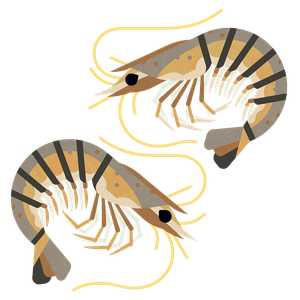
Tiger prawn
Penaeus monodon
What to check for
Location
All areas, All areas
Production method
Pond, extensive
Certification
EU Organic
Soil Association
Rating summary
Organic Tiger prawns (P. monodon) from Madagascar and Vietnam farmed in extensive systems do not rely on feed inputs. Organic certification ensures best practices and guidelines are in place for animal welfare and humane slaughter and also mitigates many areas of environmental concern. The production of Organic Tiger prawn does not allow the destruction of mangroves for pond construction, pond discharges are low and only minimal chemical treatments are used, if at all. Surrounding wild shrimp populations are also not impacted by disease or escapes from farms but can be used to supply juveniles, the status of which is uncertain. There are still some improvements to be made. Currently, lethal control of predators may still be used and strategic level environmental planning is not in place. Management and regulation of the aquaculture sector, while comprehensive, still needs to be better resourced to ensure effectiveness.This rating is based on full compliance with certification requirements. Commercial buyers should therefore ensure that full compliance has been achieved in order for this rating to be applicable.Rating last updated: October 2021
How we worked out this Rating
Feed
What feed is given to farmed fish, where it comes from and how much is used is one of the most important aspects of fish farming. In this section we look at how sustainable the feed is and how much fish is included in the diet.
Tiger prawns farmed in extensive systems do not require commercial feed inputs.In extensive farm systems, all food is naturally derived from the surrounding pond. Therefore, there is no dependence on terrestrial or marine feed ingredients.
Environment
The environmental impacts of aquaculture depend on what fish is farmed, how and where. It could be habitat damage, chemical use, pollution, freshwater use or parasites. In this section we look at the environmental impacts of greatest concern for that species and production method. Some species, such as shellfish, have very little impact, whilst others may give us cause for concern.
Organic production of tiger prawn does not allow the destruction of mangroves for pond construction. Only minimal essential chemical treatments are used, if at all, and pond discharges are low. Surrounding wild shrimp populations are not impacted by diseases or escapes from farms, but are used to supply juveniles, the status of which is uncertain. Methods of predator control are unknown, but may include lethal control. Historically, the destruction and loss of mangrove habitat due to shrimp farming activities has been one of the main environmental concerns with this production system around the world.Organic prawn farms avoid chemical usage and low stocking densities employed in tiger prawn production, results in minimal chemical and antibiotic use. Likewise, as there are no additional feed inputs effluent discharge is considered minimal. Organic production systems are required to minimise the impact on the surrounding aquatic and terrestrial environment.Biosecurity measures set out in organic certification standards limit disease outbreaks and escapes. Shrimp are susceptible to an array of diseases, particularly viral pathogens. Although farmed shrimp diseases can be transferred to wild populations, these wild stocks are not generally impacted in a significant way. Escapes of farmed tiger prawns, from extensive pond farms, is also a risk but it is unlikely that any population level impacts would occur as a result of competitive or genetic interactions with wild prawns, if escapes occurred as juveniles are sourced from wild population via natural influx. The stock status of wild tiger prawns is uncertain.Shrimp farming often requires the control of local predators. Organic standards permit lethal control in certain circumstances (i.e. when non-lethal methods have proved ineffective), in line with EU regulations. However, lethal control is not the norm, more usually the use of noise deterrents (such as firecrackers) and dogs are adequate to scare predators away from shrimp ponds. Lethal control of predators has been documented in some countries but unlikely to affect the population size of the affected species.
Fish health and welfare
Fish health and welfare is a concern for many consumers. High welfare standards are an indication of good farm management, we look to see if there are industry wide welfare standards in place, and if these include humane slaughter.
Organic certification standards ensure that best practices and guidelines are in place to address the welfare needs of animals within organic aquaculture.Health and welfare standards are referenced throughout the organic standards. Specific requirements address health and welfare of aquaculture animals, and humane slaughter, where techniques must render fish immediately unconscious and insensible to pain.
Management
How aquaculture is regulated and how effective those regulations are is an important aspect of farmed fish production. We also look to see if aquaculture is included in broader environmental management plans. In this management section we also award scores for globally recognised certification standards, as certified seafood requires verification of environmental performance and traceability.
Independent organic certification standards address many of the issues of environmental concern, however, compliance cannot be assured for all. Vietnam and Madagascar require impact assessments but not strategic level planning. Management and regulation of the aquaculture sector needs to be better resourced to ensure effectiveness. A review of the sector indicates that effectiveness of the organic standards may not be able effectively manage the potential environmental impacts of the industry, particularly as the sector expands and production increases. Although organic standards address many of the production practice specific issues the issues of overarching regulation and management of the sector remain unchanged.The Soil Association defines organic farming as a system of farming and food production. Organic farmers aim to produce high quality food, using methods that benefit our whole food system, from people and planet, plant health to animal welfare. The score for this section reflects EU Organic, Naturland and Soil Association certified producers that are in full compliance with the standard.
References
CBI. 2021. What requirements must fish and seafood comply with to be allowed on the European market? Available at https://www.cbi.eu/market-information/fish-seafood/what-requirements-should-your-product-comply [Accessed on 03.11.2021].
COMMISSION E. Ref. Ares(2015)4242403 - 12/10/2015, FINAL REPORT OF AN AUDIT CARRIED OUT IN CONTROL BODIES FROM 17 NOVEMBER 2014 TO 28 NOVEMBER 2014 IN ORDER TO EVALUATE THE APPLICATION OF THE ORGANIC PRODUCTION STANDARDS AND CONTROL MEASURES APPLIED BY A RECOGNISED CON [Internet]. 2015. Available at https://ec.europa.eu/food/audits-analysis/act_getPDF.cfm?PDF_ID=12052 [Accessed on 03.11.2021].
Escal. 2021.Organic Black Tiger Prawns – Escal Seafood. Available at https://www.escal-seafood.com/product/organic-black-tiger-prawns/ [Accessed on 03.11.2021].
European Union. Council Regulation (EC) No 834/2007 of 28 June 2007 on organic production and labelling of organic products and repealing Regulation (EEC) No 2092/91. Official Journal of the European Union. 2007. Available at https://eur-lex.europa.eu/legal-content/EN/TXT/PDF/?uri=CELEX:32007R0834&rid=6 [Accessed on 03.11.2021].
European Union. REGULATION (EU) 2018/848 OF THE EUROPEAN PARLIAMENT AND OF THE COUNCIL of 30 May 2018 on organic production and labelling of organic products and repealing Council Regulation (EC) No 834/200. Official Journal of the European Union . 2018. Available at https://eur-lex.europa.eu/legal-content/EN/TXT/PDF/?uri=CELEX:32018R0848&from=EN [Accessed on 03.11.2021].
European Union. 2021. European Union - Audit Reports. 2021. Available at https://ec.europa.eu/food/audits-analysis/audit_reports/index.cfm [Accessed on 03.11.2021].
European Union. 2012. European Union - Audit Reports. Available at https://ec.europa.eu/food/audits-analysis/audit_reports/index.cfm [Accessed on 03.11.2021].
FAO. 2009. FAO - Penaeus monodon Fabricius, Cultured species fact sheets. Available at https://www.fao.org/fishery/docs/CDrom/aquaculture/I1129m/file/en/en_gianttigerprawn.htm [Accessed on 03.11.2021].
FAO. 2021. FAO Fisheries & Aquaculture - Vue générale de la législation nationale sur l’aquaculture - Madagascar. Available at https://www.fao.org/fishery/legalframework/nalo_madagascar/fr#tcN900BA [Accessed on 03.11.2021].
FAO. 2021. FAO Fisheries & Aquaculture - National Aquaculture Sector Overview - Viet Nam. Available at https://www.fao.org/fishery/countrysector/naso_vietnam/en [Accessed on 03.11.2021].
Issuu. 2021. Feed production for organic tiger shrimp farming in Madagascar. Available at https://issuu.com/aquacultureasiapacific/docs/aq21153_aap_janfeb21_fa_sml/s/11624993 [Accessed on 03.11.2021].
Mongabay. Top Madagascar shrimp co. moved millions among tax-haven shell companies. Available at https://news.mongabay.com/2018/10/top-madagascar-shrimp-co-moved-millions-among-tax-haven-shell-companies/ [Accessed on 03.11.2021].
Organic Without Boundaries. 2020. How Madagascar Passed its First Law on Organic Agriculture! Available at https://www.organicwithoutboundaries.bio/2020/07/01/how-madagascar-passed-its-first-law-on-organic-agriculture/ [Accessed on 03.11.2021].
Soil Association. 2021. Soil Association Standards Aquaculture. Version 18.6, pp.3-78. Available at https://www.soilassociation.org/media/18614/aquaculture-standards.pdf [Accessed on 25.02.2021].
Soil Association. 2021. Summary of standard changes: Organic standards documents updated Friday 12th February 2021 – Version 18.6. Available at https://www.soilassociation.org/media/19109/sa-standards-summary-of-changes.pdf [Accessed on 25.02.2021].
TasteFrance. Shellfish. Available at https://tastefrance-food.com/en/shop?product_search%5Bsort%5D=&product_search%5Bcategories%5D%5B%5D=277&product_search%5Bcategories%5D%5B%5D=292&product_search%5Bproperties%5D%5B69%5D%5B%5D=419 [Accessed on 03.11.2021].
UNIMA. 2021. UNIMA Shrimp, Madagascar - YouTube. Available at https://www.youtube.com/watch?v=ILr7l9MT1T0 [Accessed on 03.11.2021].
WWF. 2016. Malagasy Shrimp - WWF Seafood Sustainability. Available from: https://seafoodsustainability.org/portfolio/malagasy-shrimp/ [Accessed on 03.11.2021].
Sustainable swaps
Learn more about how we calculate our sustainability ratings.
How our ratings work
Add impact to your inbox
Join the movement: get updates on the issues you care about.
We'll email you inspiring stories about the work we're doing to save and recover our oceans, and news about our urgent campaigns for positive change.