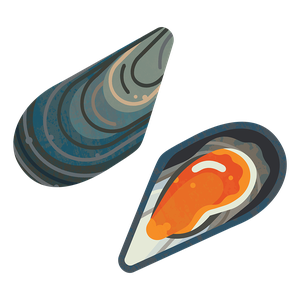
Chilean mussel
Mytilus chilensis
What to check for
Location
All areas
Production method
Culture, bottom, Culture, suspension
Certification
All
Rating summary
Farmed mussels do not require any commercial feed sources as they get all of their nutrient requirements from the surrounding water. They feed by filtering mainly microscopic algae from the surrounding sea water. Overall, Chilean mussel aquaculture performs well on environmental impacts, as they require no chemical inputs, disease risk is low and naturally settling spat are used for on-growing. There are no welfare requirements for shellfish species. Regulation of mussel farming in Chile is comprehensive, and appears to be fully effective in minimising negative impacts.Rating last updated March 2023.
Technical consultation summary
Farmed mussels do not require any commercial feed sources as they get all of their nutrient requirements from the surrounding water. They feed by filtering mainly microscopic algae from the surrounding sea water. Overall, Chilean mussel aquaculture performs well on environmental impacts, as they require no chemical inputs, disease risk is low and naturally settling spat are used for on-growing. There are no welfare requirements for shellfish species. Regulation of mussel farming in Chile is comprehensive, and appears to be fully effective in minimising negative impacts.
How we worked out this Rating
Feed
What feed is given to farmed fish, where it comes from and how much is used is one of the most important aspects of fish farming. In this section we look at how sustainable the feed is and how much fish is included in the diet.
Farmed mussels do not require any commercial feed sources as they get all of their nutrient requirements from the surrounding water.They feed by filtering mainly microscopic algae from the surrounding sea water.
Environment
The environmental impacts of aquaculture depend on what fish is farmed, how and where. It could be habitat damage, chemical use, pollution, freshwater use or parasites. In this section we look at the environmental impacts of greatest concern for that species and production method. Some species, such as shellfish, have very little impact, whilst others may give us cause for concern.
Overall, Chilean mussel aquaculture performs well on environmental impacts, as they require no chemical inputs, disease risk is low and naturally settling spat are used for ongrowing.Mussels used in aquaculture can be found naturally in marine and brackish areas and therefore culture is entirely sea-based. Habitat concerns resulting from the physical infrastructure associated with suspended mussel culture are minimal and include the alteration of hydrodynamics, current velocities, and reduced flow rates.A variety of shellfish predators exist among mussel farms, including oyster drills, sea stars, crabs, benthic fishes, seabirds, and mammals. Methods used to harvest mussels in suspended rope culture generally do not result in direct impacts to predators. Passive and benign barrier netting can be used to prohibit any type of predator and is usually species specific. Duck deterrents are also used, with varying results.Recent mussel culture generally does not involve the application of chemicals (e.g. antibiotics, pesticides, herbicides, fertilizers) to control fouling and predators or to prevent disease.As farmed mussels are not provided external feed and there is no nutrient fertilisation, there is no concern about the impact of effluents. However, there can be a concern over changes in the sedimentary environment around mussel farms due to bio deposition and sediment trapping. These changes are limited to the farm site and are not considered to extend beyond the immediate vicinity of the farm. Furthermore, mussel farming has been shown to increase water quality at the farm site through removal of excess nutrients and phytoplankton.Mussel juveniles or ‘spat’ used for farming are either collected from the wild or settle naturally on purpose-made collectors. Research into and the development of a mussel hatchery is currently ongoing in Chile and three companies have built hatcheries and produced Chilean mussel seed at an experimental level. However, none of them yet producing seed commercially and at present, the cultivation of mussels does not rely on hatchery production of seed as wild spat falls are usually of sufficient quality and reliability and are not overexploited.Aquaculture systems that are open to the environment tend to pose a risk for disease and parasite interaction with wild populations. However, there have been few mass mortality events described for adult blue mussels and good management practices ensure that the risk is low and does not threaten regional level populations
Fish health and welfare
Fish health and welfare is a concern for many consumers. High welfare standards are an indication of good farm management, we look to see if there are industry wide welfare standards in place, and if these include humane slaughter.
Animal welfare is not applicable for shellfish as it is not covered by welfare regulations.
Management
How aquaculture is regulated and how effective those regulations are is an important aspect of farmed fish production. We also look to see if aquaculture is included in broader environmental management plans. In this management section we also award scores for globally recognised certification standards, as certified seafood requires verification of environmental performance and traceability.
Regulation of mussel farming in Chile is comprehensive, and appears to be fully effective in minimising negative impacts. As this assessment covers both mussels independently certified to ASC standards, and uncertified mussels, two different scores have been awarded for this section. A score of 5 is awarded for certified mussels and a score of 2 is awarded for uncertified mussels.In Chile, the administration of marine conservation is complex, with multiple state agencies having the power to establish, veto, and administer the governance and management of ocean and coastal resources. At present, there is no strategic environmental planning in place, however, this could be subject to change in the future as Chile has been active over the past 5 years in designating MPAs in its marine waters and this is often a precursor to the development of a plan to cover all national marine waters.In Chile, there is regulatory framework in place to address farm level environmental impact assessment, protection of valuable habitats and species, use of land and water resources, discharges, biosecurity and disease management. These all appear to be fully effective in minimising negative impacts of mussel farming.
References
ASC. 2023. Find a product “Chilean mussel”. Available at: https://www.asc-aqua.org/what-you-can-do/take-action/find-a-product/ [Accessed on 01.03.2023].
CEFAS. 2014. CEFAS Report: Background information for sustainable aquaculture development, addressing environmental protection in particular. Available at: https://ec.europa.eu/environment/enveco/water/pdf/SUSAQ%20Final%20Report%20Part%201.pdf [Accessed on 01.03.2023].
David & Lucile Packard Foundation. 2022. Chile Marine Strategy (2022 Update) 2022-2023. Available at: https://www.packard.org/wp-content/uploads/2022/03/Chile-Marine-Updated-Strategy-2022.pdf [Accessed on 03.03.2023].
FAO. 2023. National Aquaculture Legislation Overview Chile. Text by D'Andrea, A.. Fisheries and Aquaculture Division [online]. Rome. Available at: https://www.fao.org/fishery/en/legalframework/cl/en?lang=en [Accessed on 03.03.2023].
FAO. 2023. Mytilus edulis. Cultured Aquatic Species Information Programme. Text by Goulletquer, P.. Fisheries and Aquaculture Division [online]. Rome. Available at https://www.fao.org/fishery/en/culturedspecies/mytilus_edulis/en [Accessed on 28.02.2023].
Gonzalez-Poblete, E, Hurtado F. C., Rojo S. C., Norambuena C. R., 2018. Blue mussel aquaculture in Chile: Small or large scale industry?, Aquaculture, Volume 493, Pages 113-122. Available at https://doi.org/10.1016/j.aquaculture.2018.04.026 [Accessed on 28.02.2023].
MSC. 2018. CHILEAN MUSSEL FISHERY AND SUSPENDED CULTURE TORALLA S.A. AND CULTIVOS TORALLA, S.A., REGION X, CHILE. Available at: https://fisheries.msc.org/en/fisheries/chilean-mussel-fishery-and-suspended-culture-toralla-s.a-and-cultivos-toralla-s.a/@@assessment-documentsets?assessment_step=Surveillance+Audit&documentset_name=Surveillance+report&assessment_id=FA-01817&phase_name=Ongoing+surveillance&start_date=2018-01-30 [Accessed on 03.03.2023].
MSC. 2019. Announcement of Certificate Withdrawl. Available at: https://cert.msc.org/FileLoader/FileLinkDownload.asmx/GetFile?encryptedKey=Q20gNthGEA6g9U+cUy8OG0WRa/xO9BhQrN26EWQumHlKThj2po8pLU6xpcl38Ut2 [Accessed on 03.03.2023].
OECD. 2011. “Chile going green”, in Maintaining Momentum: OECD Perspectives on Policy Challenges in Chile, OECD Publishing, Paris. Available at: https://www.oecd.org/chile/maintainingmomentumoecdperspectivesonpolicychallengesinchile.htm [Accessed on 03.03.2023].
Price, C.S., Keane, E., Morin, D., Vaccaro, C., Bean, D., & Morris, Jr., J.A. (2017). Protected Species & Longline Mussel Aquaculture Interactions. NOAA Technical Memorandum NOS NCCOS 211. 85 pp. Available at: https://repository.library.noaa.gov/view/noaa/16942 [Accessed on 02.03.2023].
Seafish. 2008. Aquaculture Hyperbooks Suspended Mussel Technical Pages. Available at: https://www.seafish.org/document/?id=b2f67171-a2d7-4e27-b081-dd55db2df709 [Accessed on 01.03.2023].
Seafish. 2020. Mussels, Various species. Available at: https://www.seafish.org/responsible-sourcing/aquaculture-farming-seafood/species-farmed-in-aquaculture/aquaculture-profiles/mussels/ [Accessed on 01.03.2023].
Seafood Watch. Monterey Bay Aquarium. 2021. Atlantic & Coho Salmon in Chile. Available at: https://www.seafoodwatch.org/recommendation/salmon/atlantic-salmon-38205?species=302 [Accessed on 01.03.2023].
Seafood Watch. 2020. Marine Mussels Mytilus spp, Perna sp. Worldwide On and Off Bottom Culture. Available at: https://www.seafoodwatch.org/recommendation/mussels/mussels-29905?species=3454 [Accessed on 01.03.2023].
SUBPESCA. 2023. Regulated Activities. Aquaculture. Available at: https://www.subpesca.cl/portal/616/w3-article-86161.html [Accessed on 07.03.2023].
Sustainable swaps
Learn more about how we calculate our sustainability ratings.
How our ratings work
Add impact to your inbox
Join the movement: get updates on the issues you care about.
We'll email you inspiring stories about the work we're doing to save and recover our oceans, and news about our urgent campaigns for positive change.