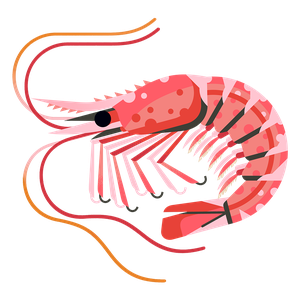
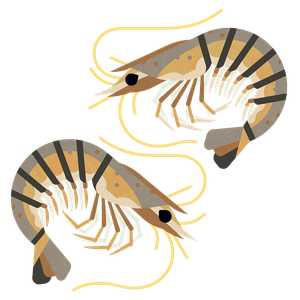
King prawn
Litopenaeus vannamei
What to check for
Location
All Areas, All Areas, All areas
Production method
Pond, intensive, Pond, semi-intensive
Rating summary
There are many areas of environmental concern in King prawn aquaculture in India, Vietnam and Indonesia. This includes the use of illegal chemicals, including antibiotics, salinisation of soil and freshwater, and discharges into the environment. Supplementary feed is used in intensive and semi-intensive systems, however, there is little transparency of the ingredients used and no requirements for responsible feed sourcing. It’s also not known if there are any welfare regulations in place and management for the aquaculture sector in India, Vietnam and Indonesia is thought to be only partially effective in mitigating negative environmental impacts.Rating last updated January 2025.
Technical consultation summary
There are many areas of environmental concern in King prawn aquaculture in India, Vietnam and Indonesia. This includes the use of illegal chemicals, including antibiotics, salinisation of soil and freshwater, and discharges into the environment. Supplementary feed is used in intensive and semi-intensive systems, however, there is little transparency of the ingredients used and no requirements for responsible feed sourcing. It’s also not known if there are any welfare regulations in place and management for the aquaculture sector in India, Vietnam and Indonesia is thought to be only partially effective in mitigating negative environmental impact
How we worked out this Rating
Feed
What feed is given to farmed fish, where it comes from and how much is used is one of the most important aspects of fish farming. In this section we look at how sustainable the feed is and how much fish is included in the diet.
Supplementary feed is used in intensive and semi-intensive systems in India, Vietnam and Indonesia, however there is little transparency on the ingredients used and no requirements for responsible feed sourcing.King prawns farmed in intensive and semi-intensive systems in Asia are provided with supplementary feed, as is typical of production systems that use stocking densities higher than those occurring in nature.The sector provides little transparency with regard to the marine and terrestrial ingredients used in feed and there are no requirements for responsible sourcing. Feeds are often traceable to a feed manufacturer, however there are no policies in place to ensure its responsible sourcing.The Feed Fish Dependency Ratio, which determines the quantity of wild fish needed to produce the same quantity of farmed fish differs slightly for each country but on average, it is below 1. This means that less fish protein is required in the diet they produce, making them a fish producer rather than a fish consumer.No novel or alternative feed ingredients are widely used in these feeds currently.
Environment
The environmental impacts of aquaculture depend on what fish is farmed, how and where. It could be habitat damage, chemical use, pollution, freshwater use or parasites. In this section we look at the environmental impacts of greatest concern for that species and production method. Some species, such as shellfish, have very little impact, whilst others may give us cause for concern.
Semi-intensive and intensive farming of King prawns in India, Vietnam and Indonesia has a negative impact on the environment.One of the main issues of environmental concern is the use of illegal chemicals, including antibiotics. Many shipments have been rejected by importers due to the detection of illegal chemical residues. In addition, prawn farming contributes to soil salinity, which has a damaging effect on soil composition and negatively impacts livelihoods and food security. Discharges of waste into the environment also occur but the environmental impacts are thought to generally be moderate.While prawn farming has historically been responsible for large-scale mangrove removal, this destructive practice has greatly diminished as awareness of its detrimental impacts has grown. Evidence suggests that the impacts of prawn aquaculture on mangrove ecosystems are on the decline. Prawns are also susceptible to an array of diseases, particularly viral pathogens but it is notable that direct environmental impacts have not been commonly observed.Although King prawns are not native to Asia, and escapes inevitably occur, there is no documented evidence of this species becoming established in the wild in this region. Hatchery production of this species is also technically advanced, and the industry rely entirely on domesticated stocks.While non-lethal predatory controls would appear to be the norm within the sector, a precautionary approach has been applied in assessing this aspect of production due to data deficiency.
Fish health and welfare
Fish health and welfare is a concern for many consumers. High welfare standards are an indication of good farm management, we look to see if there are industry wide welfare standards in place, and if these include humane slaughter.
Due to data deficiency on this topic, a precautionary score has been given.It is unknown if there are welfare regulations in place for farmed prawns in India, Vietnam and Indonesia. It is common practice to use immersion in an ice slurry to kill prawns, but it is unknown if this is the method that is always used in these countries.
Management
How aquaculture is regulated and how effective those regulations are is an important aspect of farmed fish production. We also look to see if aquaculture is included in broader environmental management plans. In this management section we also award scores for globally recognised certification standards, as certified seafood requires verification of environmental performance and traceability.
For uncertified King prawns produced in India, Vietnam and Indonesia regulations are in place but are only partially effective in mitigating the negative environmental impacts from aquaculture.This assessment covers uncertified intensive and semi-intensive king prawn production in India, Vietnam, and Indonesia.Management and regulation in India, Vietnam and Indonesia cover the use of land and water resources, discharges including effluents and their impacts and species introduction. However, it only partially addresses the identification and protection of vulnerable habitats and species and biosecurity and disease management. Environmental Impact Assessment (EIA) is only partially addressed as the smaller farms, which make up the bulk of the farms, are exempt. Current legislation on the use of chemicals (including licensing) is ambiguous and does not adequately address the aquaculture sector.Overall, although there are a multitude of legislative instruments in place to govern the aquaculture sectors in India, Vietnam and Indonesia, these can only be said to be partially effective in minimizing negative environmental impacts – and in some instances there is evidence that these regulations are ineffective.
References
Briggs, M. 2005. Introductions and movement of two penaeid shrimp species in Asia and the Pacific (No. 476). Food & Agriculture Org. Available at http://www.fao.org/docrep/009/a0086e/A0086E00.htm#TOC [Accessed on 01.16.2025].
CAA. 2018. Coastal Aquaculture Authority (India). Available at http://www.caa.gov.in [Accessed on 01.16.2025].
Deltares. 2016. Mangrove restoration: to plant or not to plant? Available at https://www.deltares.nl/app/uploads/2016/07/Mangrove-restoration_to-plant-or-not-to-plant.pdf [Accessed on 01.16.2025].
EJF. 2004. Farming the Sea, Costing the Earth: Why we Must Green the Blue Revolution. Environmental Justice Foundation, London, UK. Available at https://ejfoundation.org/resources/downloads/Farming-Sea-Costing-Earth-ok.pdf [Accessed on 01.16.2025].
FAO. 2013. Culprit behind mass shrimp die-offs in Asia unmasked. News article 3 May 2013, Rome. Available at http://www.fao.org/news/story/en/item/175416/icode/ [Accessed on 01.16.2025].
FAO. 2004. National Aquaculture Sector Overview: India. Available at https://www.fao.org/fishery/legalframework/nalo_india/en [Accessed on 01.16.2025].
FAO. 2014. National Aquaculture Sector Overview: Vietnam. Available at https://www.fao.org/fishery/legalframework/nalo_vietnam/en [Accessed on 01.16.2025].
FAO. 2005. National Aquaculture Sector Overview: Indonesia. Available at https://www.fao.org/fishery/legalframework/nalo_indonesia/en [Accessed on 01.16.2025].
Hens, L., Vromant, N., Tho, N., Hung, N.T. 2009. Salination of surface water, groundwater, and soils in the shrimp farming areas of the coastal Cai Nuoc district, South Vietnam, International Journal of Environmental Studies, 66:1, 69-81. Available at https://www.researchgate.net/publication/248923902_Salination_of_Surface_water_groundwater_and_soils_in_the_shrimp_farming_areas_of_the_coastal_Cai_Nuoc_district_South_Vietnam [Accessed on 01.16.2025].
Lightner, D. V., Redman, R.M., Pantoja, C.R., Tang, K.F.J., Noble, B.L., Schofield, P., Mohney, L.L., Navarro, S.A. 2012. Historic emergence, impact and current status of shrimp pathogens in the Americas - Journal of Invertebrate Pathology, 110 (2), pp. 174-183. Available at https://arizona.pure.elsevier.com/en/publications/historic-emergence-impact-and-current-status-of-shrimp-pathogens- [Accessed on 01.16.2025].
MBA. 2015. Monterey Bay Aquarium Seafood Watch assessment of Farmed Whiteleg Shrimp grown in ponds in Indonesia. Available at https://www.seafoodwatch.org/recommendation/shrimp/red-shrimp-whiteleg-shrimp-indonesia-ponds?species=156 [Accessed on 01.16.2025].
MBA. 2017. Monterey Bay Aquarium Seafood Watch assessment of Farmed Whiteleg Shrimp grown in ponds in Vietnam. Available at https://www.seafoodwatch.org/recommendation/shrimp/red-shrimp-whiteleg-shrimp-vietnam-intensive-pond?species=156 [Accessed on 01.16.2025].
MBA. 2021. Monterey Bay Aquarium Seafood Watch assessment of Farmed Whiteleg Shrimp grown in ponds in India. Available at https://www.seafoodwatch.org/recommendation/shrimp/red-shrimp-whiteleg-shrimp-india-ponds2?species=156 [Accessed on 01.16.2025].
Osbourne, Z. 2018. Pushing Vietnam’s shrimp industry toward sustainability. Mongabay. Available at https://news.mongabay.com/2018/07/pushing-vietnams-shrimp-industry-toward-sustainability/ [Accessed on 01.16.2025].
Palomares, M.L.D. and D. Pauly. Editors. 2021. SeaLifeBase. Litopenaeus vannamei, Whiteleg shrimp. Available at https://www.sealifebase.ca/summary/Litopenaeus-vannamei.html [Accessed on 01.16.2025].
Seafish. 2013. Responsible Sourcing Guide: Marine Warm Water Prawns. Available at https://www.seafish.org/document/?id=d443878e-d50b-4d78-9d68-8b5c393ed0c0 [Accessed on 01.16.2025].
STIP. 2018b. Seafood Trade Intelligence Portal: Shrimp in Vietnam. Available at https://seafood-tip.com/sourcing-intelligence/countries/vietnam/shrimp/ [Accessed on 01.16.2025].
Suratin, A. 2011. Restoring neglected coastal land in Indonesia, New Agriculturist. Oxfam Indonesia. Available http://www.new-ag.info/en/focus/focusItem.php?a=2088 [Accessed on 01.16.2025].
Tacon, A.G.J., Jory D. and Nunes, A. 2013. Shrimp feed management: issues and perspectives. In M.R. Hasan and M.B. New, eds. On-farm feeding and feed management in aquaculture. FAO Fisheries and Aquaculture Technical Paper No. 583. Rome, FAO. pp. 481–488. Available at http://www.fao.org/tempref/FI/CDrom/T583/root/18.pdf [Accessed on 01.16.2025].
The Asean Post. 2018. Vietnam’s shrimp exports at risk – Stephen Chin, 8 October 2018. Available at https://theaseanpost.com/article/vietnams-shrimp-exports-risk [Accessed on 01.16.2025].
The Fish Site. 2018. How to improve welfare at slaughter – by Rob Fletcher, March 16 2018. Available at https://thefishsite.com/articles/seafood-welfare-at-slaughter-explained [Accessed on 01.16.2025].
Undercurrent News. 2018. EU official: India shrimp farm compliance on antibiotics ‘insufficient’ – By Louis Harkell Jan 29, 2018. Available at https://www.undercurrentnews.com/2018/01/29/eu-official-says-india-shrimp-farm-compliance-on-antibiotics-is-insufficient-as-trade-challenges-dominate-goa-show/ [Accessed on 01.16.2025].
Walker, P.J. and Winton, J.R. 2010. Emerging viral diseases of fish and shrimp. Veterinary Research Volume 41(6); Nov-Dec 2010. Available at http://www.ncbi.nlm.nih.gov/pmc/articles/PMC2878170/ [Accessed on 01.16.2025].
Sustainable swaps
Learn more about how we calculate our sustainability ratings.
How our ratings work
Add impact to your inbox
Join the movement: get updates on the issues you care about.
We'll email you inspiring stories about the work we're doing to save and recover our oceans, and news about our urgent campaigns for positive change.