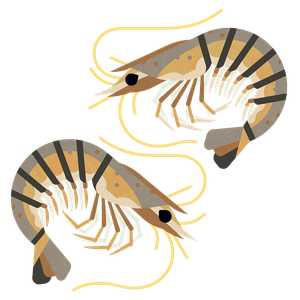
King prawn
Litopenaeus vannamei
What to check for
Location
All areas
Production method
Pond, freshwater
Certification
Global Seafood Alliance Best Aquaculture Practices (GAA BAP) 4*

Rating summary
King prawns certified by the Global Seafood Alliance (GSA), formerly Global Aquaculture Alliance (GAA), Best Aquaculture Practices (BAP) are managed well and the Farm Standard mitigates many areas of environmental concern in prawn farming, including freshwater depletion, habitat alteration, discharge of effluents, chemical usage, escapes and disease and parasite interactions. The Farm Standard also has criteria in place to ensure animal welfare and humane slaughter. A 4* rating ensures compliance with the BAP Feed Mill Standard. However, there are still improvements that could be made, including the addition of a mandatory Environmental Impact Assessment, and increasing the percentage inclusion of responsible feed ingredients. This rating is based on full compliance with certification requirements. Commercial buyers should therefore ensure that full compliance has been achieved in order for this rating to be applicable.Rating last updated December 2024.
How we worked out this Rating
Environment
The environmental impacts of aquaculture depend on what fish is farmed, how and where. It could be habitat damage, chemical use, pollution, freshwater use or parasites. In this section we look at the environmental impacts of greatest concern for that species and production method. Some species, such as shellfish, have very little impact, whilst others may give us cause for concern.
The GSA BAP Farm Standard mitigates many areas of environmental concern in prawn farming, but there are still improvements that could be made. The GSA BAP Farm Standard has criteria in place for production practices that address many environmental impacts. This includes ensuring that depletion or degradation of freshwater supplies is mitigated, water quality criteria provide a regulatory limit for discharges of effluent, and any habitat alteration that has taken place, such as the destruction of mangroves, is historic with verifiable restoration taking place. Juveniles used are also hatchery based, with the exception of extensive pond systems where incidental introductions are allowed. Prawn farms rely on chemical usage and antibiotics are widely used. The GSA BAP Farm Standard has a ban on the use of chemicals that are designated as ‘Critically Important for Human Medicine’. It also has criteria in place that restrict when chemicals can be used, however, there are no limits on the amount of times they can be used per production cycle. There are other potential environmental issues with prawn farming that the GSA BAP Farm Standard addresses that are on a lower scale of ecological concern in prawn farming. This includes disease outbreak and parasite interactions, which may occur but are thought to be at a farm level and do not threaten regional level operations. It also includes the risk of escapes, which have not been found to have established in the wild. However, problems do still exist with prawn farming. Although GAA BAP addresses many areas of concern, there are still improvements we would like to see made. This includes the use of lethal control of predators, which, although discouraged, is still allowed to take place when necessary.
Fish health and welfare
Fish health and welfare is a concern for many consumers. High welfare standards are an indication of good farm management, we look to see if there are industry wide welfare standards in place, and if these include humane slaughter.
The GSA BAP Farm Standard has criteria in place to ensure animal welfare and humane slaughter. The GSA BAP Farm Standard outlines practices that are in place to ensure animal welfare including an Animal Health Management Plan. It also details approved humane methods of slaughter.
Management
How aquaculture is regulated and how effective those regulations are is an important aspect of farmed fish production. We also look to see if aquaculture is included in broader environmental management plans. In this management section we also award scores for globally recognised certification standards, as certified seafood requires verification of environmental performance and traceability.
GSA BAP certified farmed prawns are well managed and management is thought to be fully effective. Management could be improved by the addition of a mandatory Environmental Impact Assessment (EIA). This assessment covers all prawns farmed by GSA BAP certification globally. Although the Standard does cover some aspects of strategic environmental planning, auditors must necessarily defer to an array of national and regional regulations, depending on the varying locations of certification-seeking producers. The GSA BAP certification criteria covers the identification and protection of valuable habitats and species, use of land and water resources, use of chemicals, discharges, biosecurity, disease management and species introduction. It does not require that certified farms undertake a formal Environmental Impact Assessment (EIA). The Best Aquaculture Practices (BAP) certification programme comprises a suite of standards for farms, hatcheries, feed mills and processing plants addressing environmental and social issues, food safety and animal welfare. Benchmarked to GSSI and GFSI and with star ratings (1-4), it uses independent audits to provide assurance along the supply chain.
References
Aninakwah, R. 2019. 22 years of promoting best practice in shrimp aquaculture. The Fish Site. Available at: https://thefishsite.com/articles/22-years-of-promoting-best-practice-in-shrimp-aquaculture [Accessed on 09.12.2024].
Best Aquaculture Practices, 2024. Aquaculture Facility Certification: Feed Mills Standard, Issue 3.2, 9 December 2024. Available at: https://www.bapcertification.org/Downloadables/pdf/standards/BAP%20-%20Feed%20Mills%20-%20Issue%203.2%20-%2009-December-2024.pdf [Accessed on 16.12.2024].
Best Aquaculture Practices, 2023. Aquaculture Facility Certification: BAP Farm Standard, Issue 3.1, 3 February 2023. Available at: https://www.bapcertification.org/Downloadables/pdf/BAP%20-%20BAP%20Farm%20Standard%20-%20Issue%203.1%20-%2007-February-2023.pdf [Accessed on 16.12.2024].
Best Aquaculture Practices, 2023. Hatchery Standard. Available at: https://www.bapcertification.org/Downloadables/pdf/BAP%20-%20Hatchery%20Standard%20-%20Issue%202.1%20-%2030-January-2023.pdf [Accessed on 09.12.2024].
Best Aquaculture Practices, 2017. Finfish and Crustacean Farm Standard (FCFS). Issue 2.4 – 23 May 2017. Available at: https://www.bapcertification.org/Downloadables/pdf/standards/PI%20-%20Standard%20-%20Finfish%20and%20Crustacean%20Farms%20%E2%80%93%20Issue%202.4%20%E2%80%93%2023-May-2017.pdf [Accessed on 09.12.2024].
Flegel, T.W. 2019. A future vision for disease control in shrimp aquaculture. Journal of the World Aquaculture Society 2019; 50:249–266. Available at: https://onlinelibrary.wiley.com/doi/pdf/10.1111/jwas.12589 [Accessed on 09.12.2024].
Monterey Bay Aquarium Seafood Watch. 2015. Whiteleg shrimp. China. Ponds. Available at: https://www.seafoodwatch.org/recommendation/shrimp/red-shrimp-whiteleg-shrimp-china-ponds?species=156 [Accessed on 09.12.2024].
Monterey Bay Aquarium Seafood Watch. 2021. Whiteleg shrimp. Ecuador. Semi-intensive ponds. Available at: https://www.seafoodwatch.org/recommendations/search?query=%3Aspecies%3BWhiteleg%20shrimp%3Acountry%3BEcuador [Accessed on 09.12.2024].
Naylor, R.L., Hardy, R.W., Buschmann, A.H. et al. 2021. A 20-year retrospective review of global aquaculture. Nature 591, 551–563. Available at: https://doi.org/10.1038/s41586-021-03308-6 [Accessed on 09.12.2024].
Shinn, A.P., Pratoomyot, J., Griffiths, D., Trong, T.Q., Vu, N.T., Jiravanichpaisal, P. and Briggs, M. 2018. Asian Shrimp Production and the Economic Costs of Disease. Asian Fisheries Science 31S(2018): 29-58. Available at: http://www.asianfisheriessociety.org/publication/downloadfile.php?id=1217&file=Y0dSbUx6QXhOVFF5TWpNd01ERTFORGMzTXpJM05UZ3VjR1Jt#page=35 [Accessed on 09.12.2024].
Tacon, A.G.J., Jory, D., Nunes, A. 2013. Shrimp feed management: issues and perspectives. In: Hasan, M.R., New, M.B. (eds) On-farm feeding and feed management in aquaculture. FAO Fisheries and Aquaculture Technical Paper No. 583. Rome, FAO. pp. 481-488. Available at: http://www.fao.org/tempref/FI/CDrom/T583/root/18.pdf [Accessed on 09.12.2024].
Sustainable swaps
Learn more about how we calculate our sustainability ratings.
How our ratings work
Add impact to your inbox
Join the movement: get updates on the issues you care about.
We'll email you inspiring stories about the work we're doing to save and recover our oceans, and news about our urgent campaigns for positive change.