King scallop
What to check for
Scotland (Shetland): Certified fleets only (0-6 nm)
Dredge
Marine Stewardship Council (MSC)
Rating summary
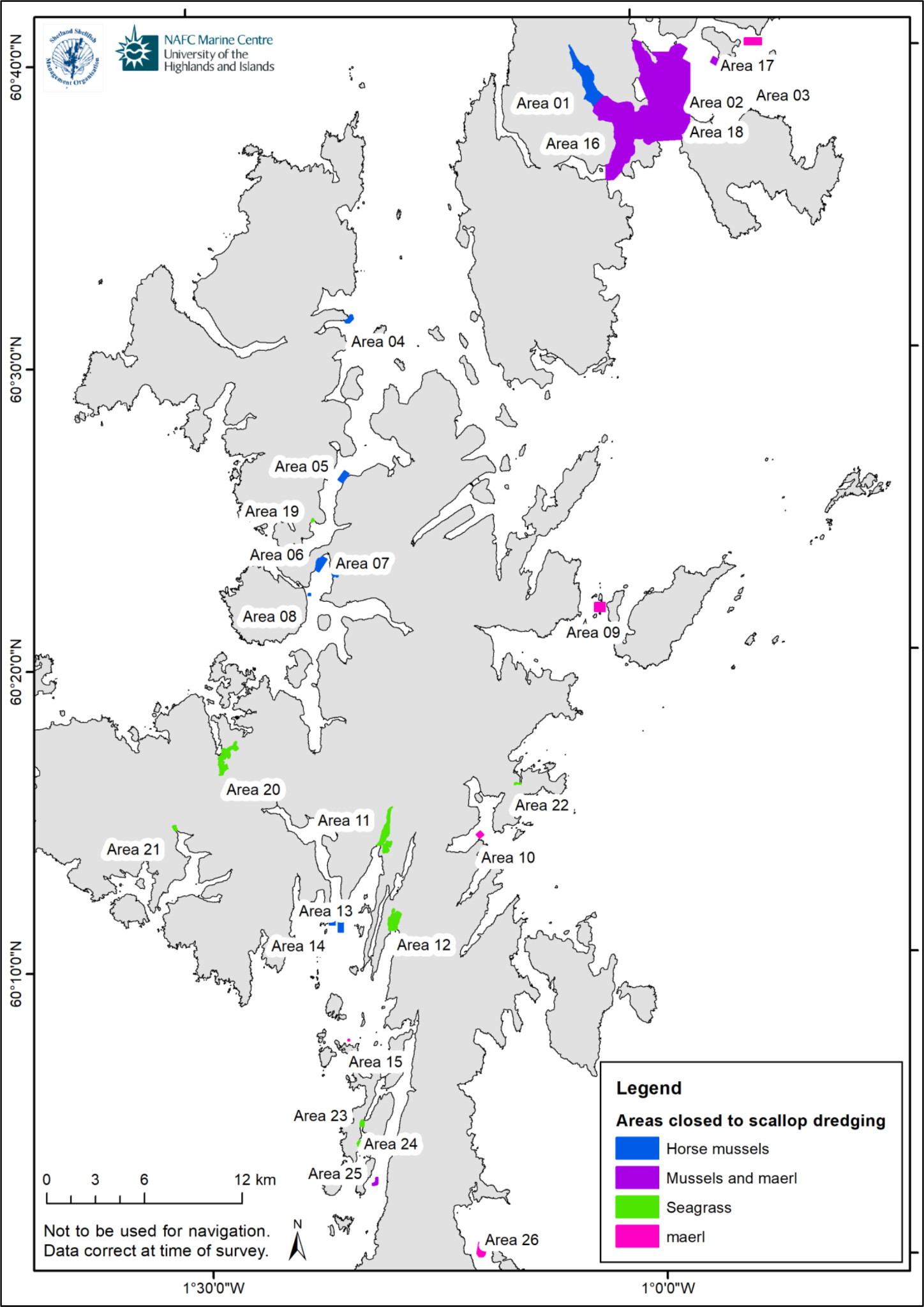
Information about Shetland king scallops indicates that the stock is growing, and there is no concern for the biomass or fishing pressure. All of the inshore (0-6nm) scallop dredge fishery is independently certified to Marine Stewardship Council (MSC) standards. Some appropriate management measures are in place, but improvements are needed to better control the impacts of dredging. Scallop dredging can be very damaging to seabed habitats and species. In Shetland, some areas are closed to scallop dredging, and the certified fishery is monitored to ensure impacts are reduced.
Rating last updated November 2023
How we worked out this Rating
References
Cappell, R., Huntington, T., Nimmo, F., and MacNab, S. 2018. UK scallop fishery: current trends, future management options and recommendations. Report produced by Poseidon Aquatic Resource Management Ltd. Available at http://www.nwwac.org/_fileupload/Papers%20and%20Presentations/2019/Madrid_2019/1417%20Poseidon%20UK%20Scallop%20final%20report%2011_10_18.pdf [Accessed on 14.06.2022].
Cappell, R., Keus, B. and Addison, J., 2018. Marine Stewardship Council Public Certification Report: SSMO Shetland inshore brown & velvet crab and scallop fishery. Prepared for The Shetland Shellfish Management Organisation by Acoura Marine Ltd. Published 12 July 2018. Available at https://fisheries.msc.org/en/fisheries/ssmo-shetland-inshore-brown-crab-and-scallop/@@assessments [Accessed on 07.07.2022].
Cappell, R., and Addison, J., 2022. Marine Stewardship Council 3rd Surveillance Audit: SSMO Shetland inshore brown crab and scallop. Prepared for The Shetland Shellfish Management Organisation by LRQA. Published 13 May 2022. Available at https://fisheries.msc.org/en/fisheries/ssmo-shetland-inshore-brown-crab-and-scallop/@@assessments [Accessed on 07.07.2022].
Cappell, R. & Addison. J., 2023. Marine Stewardship Council 4th Surveillance Audit: SSMO Shetland Inshore Brown Crab and Scallop. Prepared for The Shetland Shellfish Management Organisation by LRQA. Published 13 July 2023. Available at https://fisheries.msc.org/en/fisheries/ssmo-shetland-inshore-brown-crab-and-scallop/@@assessments [Accessed on 28.11.2023].
Dobby, H., Fryer, R., Gibson, T., Kinnear, S., Turriff, J. and McLay, A. (2017) Scottish Scallop Stocks: Results of 2016 Stock Assessments. Scottish Marine and Freshwater Science Vol 8 No 21, 178pp. DOI: 10.7489/2005-1. Available at https://data.marine.gov.scot/dataset/scottish-scallop-stocks-results-2016-stock-assessments [Accessed on 01.06.2022].
Hiddink, J., Jennings, S., Sciberras, M., Szostek, C.L., Hughes, K.M., Ellis, N., Rijnsdorp, A.D., McConnaughey, R.A., Mazor, T., Hilborn, R., Collie, J.S., Pitcher, C.R., Amoroso, R.O., Parma, A.M., Suuronen, P. and Kaiser, M.J. 2017. Global analysis of depletion and recovery of seabed biota after bottom trawling disturbance. PNAS. 114:31, pp. 8301-8306. https://doi.org/10.1073/pnas.1618858114.
Howarth, L. M. & Stewart, B. D. 2014. The dredge fishery for scallops in the United Kingdom (UK): effects on marine ecosystems and proposals for future management. Report to the Sustainable Inshore Fisheries Trust. Marine Ecosystem Management Report no. 5, University of York, 54 pp. Available at http://eprints.whiterose.ac.uk/79233/1/Howarth_and_Stewart_2014_Ecosystem_effects_management_of_UK_scallop_fisheries.pdf [Accessed on 14.06.2022].
Lambert, G.I., Jennings, S., Kaiser, M.J., Davies, T.W. and Hiddink, J.G., 2014. Quantifying recovery rates and resilience of seabed habitats impacted by bottom fishing. Journal of Applied Ecology. 51:5, pp. 1326-1336. https://doi.org/10.1111/1365-2664.12277.
Lawler, A., Nawri, N., Harvey, J., Clarke, D., Vanstaen, K., and Benedet, R., 2023. Assessment of king scallop stock status for selected waters around the English coast 2021/2022. Cefas: A Defra and Industry Funded Project. March 2023. 78pp. Available at https://assets.publishing.service.gov.uk/government/uploads/system/uploads/attachment_data/file/1149470/SCE_assessment_report_2022_main_v2.pdf [Accessed on 05.06.2023].
MMO, 2023. UK sea fisheries annual statistics report 2022. Marine Management Organisation. Published 28 September 2023. Available at https://www.gov.uk/government/statistics/uk-sea-fisheries-annual-statistics-report-2022 [Accessed on 13.11.2023].
Palomares, M.L.D. and Pauly, D. Editors. 2023. SeaLifeBase: Pecten maximus, Great Atlantic scallop. Available at https://www.sealifebase.ca/summary/Pecten-maximus.html [Accessed on 28.11.2023].
Pitcher, C.R., Hiddink, J.G., Jennings, S., Collie, J., Parma, A.M., Amoroso, R., Mazor, T., Sciberras, M., McConnaughey, R.A., Rijnsdorp, A.D., Kaiser, M.J., Suuronen, P. and Hilborn, R., 2022. Trawl impacts on the relative status of biotic communities of seabed sedimentary habitats in 24 regions worldwide. PNAS 119:2. https://doi.org/10.1073/pnas.2109449119.
RIFG, 2023. Regions: Shetland. https://rifg.scot/region/shetland [Accessed on 28.11.2023].
Sciberras, M., Hiddink, J.G., Jennings, S., Szostek, C.L., Hughes, K.M., Kneafsey, B., Clarke, L.J., Ellis, N., Rijnsdorp, A.D., McConnaughey, R.A., Hilborn, R., Collie J.S., Pitcher, C.R., Amoroso, R.O., Parma, A.M., Suuronen, P. and Kaiser, M.J. 2018. Response of benthic fauna to experimental bottom fishing: A global meta- analysis. Fish and Fisheries, 19:4, pp 698-715. https://doi.org/10.1111/faf.12283. [Accessed on 15.06.2022].
Scotland’s Marine Assessment, 2020. Predicted extent of physical disturbance to seafloor. Available at https://marine.gov.scot/sma/assessment/predicted-extent-physical-disturbance-seafloor [Accessed on 10.06.2022].
Scottish Government, 2023. News: New fisheries measures announced. Published: 14 August 2023. Available at https://www.gov.scot/news/new-fisheries-measures-announced/ [Accessed on 30.11.2023].
Scottish Government, 2023. Publication - FOI/EIR release: Shetland Shellfish Management Organisation (SSMO) and MSC surveillance audit: EIR release. Published: 14 August 2023. Available at https://www.gov.scot/publications/foi-202300367414/ [Accessed on 29.11.2023].
Shetland Islands Marine Planning Partnership, 2021. Shetland Islands Regional Marine Plan. NAFC Marine Centre UHI pp 158. Available at https://www.shetland.uhi.ac.uk/t4-media/one-web/shetland/research/document/marine-spatial-planning/sirmp/SIRMP_2021_Amended_Version.pdf [Accessed on 07.07.2022].
Shetland UHI, 2023. Shetland Shellfish Stock Assessment 2022 - Summary Report: King Scallop Fishery. Prepared by University of the Highlands and Islands Shetland for the Shetland Shellfish Management Organisation (SSMO). Available at https://www.ssmo.co.uk/site/assets/files/1553/king_scallop.pdf [Accessed on 28.11.2023].
Shucksmith, RJ, 2017. Shetland Islands Marine Region State of the Marine Environment Assessment. NAFC Marine Centre UHI. Report for the Shetland Islands Marine Planning Partnership. pp 172. Available at https://www.shetland.uhi.ac.uk/t4-media/one-web/shetland/research/document/marine-spatial-planning/state-of-environment-assessment/shetland-state-of-the-marine-environment-assessment-april-17.pdf
SSMO, 2023. Shetland Shellfish Management Organisation Maps: Overview of Closed Areas. Available at https://www.ssmo.co.uk/site/assets/files/1480/21-9-2020-smp.jpg [Accessed on 28.11.2023].
SSMO, 2023. Shetland Shellfish Management Organisation Regulations. Updated August 2023. Available at https://www.ssmo.co.uk/site/assets/files/1/ssmo_regulations.pdf [Accessed on 28.11.2023].
WWF, RSPB and MCS, 2022. TransparentSea: Protecting our ocean using Remote Electronic Monitoring with cameras. Available at https://www.mcsuk.org/ocean-emergency/sustainable-seafood/our-sustainable-seafood-work/transparentsea/ [Accessed on 30.11.2023].