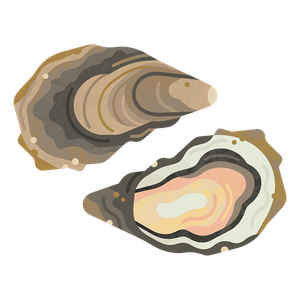
Native oyster
What to check for
Europe: UK, All areas
Culture, suspension
Rating summary
Overall, native oyster suspended aquaculture performs well on environmental impacts. They do not require any commercial feed sources as they get all their nutrient requirements from the surrounding water. There are some impacts from farms including sediment changes and shading, which can alter the local environment. Oyster farms may, however, provide some local benefits as they extract excess nutrients and particulates from coastal waters. Juvenile oysters are sourced from appropriate hatcheries and escapes from farms are not considered a concern for this native species. Disease outbreaks can and do occur, although they do not threaten regional level operations. Aquaculture policy in the UK is a devolved matter. Regulations are in place to limit environmental impacts including land and water use, discharges, disease management and biosecurity, however, there is no independent certification available.
Rating last updated June 2022.
How we worked out this Rating
References
Adamson, E., Syvret, M., Woolmer, A. 2018. Shellfish Seed Supply for Aquaculture in the UK: Report on Views Collected from the Industry in 2017. 20p. Available: http://www.shellfish.org.uk/files/Literature/Projects-Reports/Report-on-UK-shellfish-seed-Fishmongers-Company-June-2018.pdf [Accessed on 06.08.2019]
Buschbaum, C., Cornelius, A. and Goedknegt, M. A. 2016. Deeply hidden inside introduced biogenic structures – Pacific oyster reefs reduce detrimental barnacle overgrowth on native blue mussels. Journal of Sea Research. 117 (20-26).
CEFAS. 2012. Aquaculture statistics for the UK, with a focus on England and Wales. Available: https://assets.publishing.service.gov.uk/government/uploads/system/uploads/attachment_data/file/405469/Aquaculture_Statistics_UK_2012.pdf [Accessed on 08.08.2019]
Cook, E.J., Beveridge, C.M., Lamont, P., O’Higgins, T., Wilding, T. 2014. Survey of Wild Pacific Oyster Crassostrea gigas in Scotland. Scottish Aquaculture Research Forum Report SARF099. Available at: http://www.sarf.org.uk/cms-assets/documents/207056-140687.sarf099.pdf [Accessed on 07.08.2019]
CIFCA. 2021. Sturgeon, S., Street, K., Trundle, C., and Jenkin, A. Fal Native Oyster Fishery. Season 2020-2021 Permit Statistics Report. Cornwall Inshore Fisheries and Conservation Authority (Cornwall IFCA), Hayle. Available at: https://secure.toolkitfiles.co.uk/clients/17099/sitedata/Research_Reports/20-21Fal-Oyster-Stats-.pdf [Accessed on 09.03.2022]
DEFRA. 2015. United Kingdom multiannual national plan for the development of sustainable aquaculture. Available at: https://assets.publishing.service.gov.uk/government/uploads/system/uploads/attachment_data/file/480928/sustainable-aquaculture-manp-uk-2015.pdf [Accessed on 09.08.2019]
Echweiler, N. and Christensen, H. T. 2011. Trade-off between increased survival and reduced growth for blue mussels living on Pacific oyster reefs. Journal of Experimental Marine Biology and Ecology. 403(90-95)
European Commission. 2012. Guidance on Aquaculture and Natura 2000. Available at: https://ec.europa.eu/fisheries/sites/fisheries/files/docs/body/guidance-aquaculture-natura2000.pdf [Accessed on 08.08.2019]
FAO. 2019. National Aquaculture Legislation Overview: United Kingdom. Available at: http://www.fao.org/fishery/legalframework/nalo_uk/en [Accessed on 08.08.2019]
FAO. Crassostrea gigas (Thunberg, 1793). Available at: http://www.fao.org/fishery/culturedspecies/Crassostrea_gigas/en#tcNA009D [Accessed on 07.08.2019]
Forrest BM, Elmetri I, Clark K. 2007. Review of the Ecological Effects of Intertidal Oyster Aquaculture. Prepared for Northland Regional Council. Cawthron Report No. 1275, 25p. Available: http://envirolink.govt.nz/assets/Envirolink/216-NLRC25.pdf [Accessed on 06.08.2019]
Gov.UK, nd. Bonamiosis. Available at: https://assets.publishing.service.gov.uk/government/uploads/system/uploads/attachment_data/file/292127/Guide_to_bonamiosis.pdf [Accessed on 16.3.2022]
Gov.UK, 2022. Disease status of fish, shellfish and crustacean. Available at: https://www.gov.uk/guidance/report-serious-fish-or-shellfish-diseases#disease-status-for-england-and-wales [Accessed on 16.3.2022]
Huntington, T., & R. Cappell. 2020. English Aquaculture Strategy. Final Report. Produced by Poseidon Aquatic Resources Management Ltd for the Seafish Industry Authority. 80 pp + appendices. Available at: https://consult-poseidon.com/fishery-reports/English%20Aquaculture%20Strategy%20-%20full%20report%20%20Nov%202020.pdf [Accessed on 04.03.2022]
Markert, A. and Wehrmann, A. 2009. Recently established Crassostrea-reefs verus native Mytilus-beds: differences in ecosystem engineering affects the macrofaunal communities (Wadden Sea of Lower Saxony, southern German Bight). Biological Invasions. 12(15-32).
Mercaldo-Allen, R. & Goldberg, R. 2011. Review of the Ecological Effects of Dredging in the Cultivation and Harvest of Molluscan Shellfish. NOAA Technical Memorandum NMFS-NE-220. Available at: http://shellfish.ifas.ufl.edu/wp-content/uploads/Review-Ecological-Effects-of-Dredging-to-Harvest-Molluscs.pdf [Accessed on 17.5.2022]
Miossec, L., Le Deuff, R‐M., and Goulletquer, P. 2009. Alien species alert: Crassostrea gigas (Pacific oyster). ICES Cooperative Research Report No. 299. 42 pp. Available: https://archimer.ifremer.fr/doc/2009/rapport-6945.pdf [Accessed on 07.08.2019]
Monterey Bay Aquarium Seafood Watch. Oysters. Available at: https://www.seafoodwatch.org/seafood-recommendations/groups/oysters?q=pacific%20oyster&t=pacific%20oyster&type=pacific&method=farmed#tab=seafood-watch [Accessed on 02.08.2019]
Native Oyster Network, 2022. Available at: https://nativeoysternetwork.org/ [Accessed on 04.03.2022]
Newell,.R.I.E., 2004. Ecosystem influences of natural and cultivated populations of suspension-feeding bivalve molluscs: a review. Journal of Shellfish Research (Vol. 23, Issue 1)
OSH. 2022. Orkney Shellfish Hatchery, Available at: https://orkneyshellfishhatchery.co.uk/news/2021/orkney-shellfish-hatcherys-first-stock-of-native-flat-oyster-spat-released-into-scottish-seas/ [Accessed on 04.03.2022]
Roberts, C.A., Walmsley, S. F., Hull, S.C. 2015. A Spatial Assessment of the Potential for Aquaculture in Welsh Waters. Project Ref: R/4297/01, Report No: R.2384. Available at: https://llyw.cymru/sites/default/files/publications/2018-05/asesur-posibiliadau-ar-gyfer-dyframaethu.pdf [Accessed on 15.03.2022]
Scottish Government. 2017. Envrionmental Impacts. Available at: https://www2.gov.scot/Topics/marine/Fish-Shellfish/18716/environmentalimpact [Accessed on 08.08.2019]
Seafish. 2008. Development of a Pacific Oyster Aquaculture Protocol for the UK – Technical Report. Available at: https://www.seafish.org/media/Publications/POP_-_Technical_Report_Ver._2.pdf [Accessed on 09.08.2019]
Seafish. Oysters. Available at: https://seafish.org/aquaculture/profile/23/oysters [Accessed on 02.08.2019]
SimplyOysters, 2022. Mersea Native Oysters (S-L). Available at: https://simplyoysters.com/buy-native-oysters/mersea-native-oysters & Helford Native Oysters (S-L) https://simplyoysters.com/buy-native-oysters/helford-oysters [Accessed on 18.5.2022]
Spruceeats, 2022. Guide to oysters. Available at: https://www.thespruceeats.com/guide-to-oysters-2217274 [Accessed on 03.03.2022]
The Glenmorangie Company. Dornoch Environmental Enhancement Project (DEEP). Available at: http://www.theglenmorangiecompany.com/about-us/deep/ [Accessed on 08/08/2019]
Wood, et al. 2017. UK macroalgae aquaculture: What are the key environmental and licensing considerations?, Marine Policy, Volume 83, Pages 29-39, https://doi.org/10.1016/j.marpol.2017.05.021.
Zero Waste Scotland. Case study: Integrated Multi-Trophic Aquaculture. Available at: https://www.zerowastescotland.org.uk/sites/default/files/2870%20ZWS%20Bio%20Economy%20Loch%20Fyne%20Case%20Study%20AW%20FINAL%20HI%20RES.pdf [Accessed: 06/08/2019]
Zwerschke, N., Emmerson, M. C., Roberts, D. and O’Connor, N. E. 2016. Benthic assemblages associated with native and non-native oysters are similar. Marine Pollution Bulletin. 111(305-310).