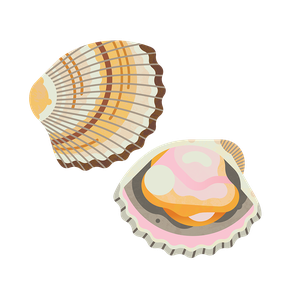
Queen scallop
What to check for
Wales: Welsh waters
Dredge
Rating summary
There is very little information about queen scallops in Wales. Trends in the wider area suggest there could be concern for biomass and fishing pressure. There are few appropriate management measures in place. There is no harvest plan, catch limit, or significant effort control. Queen scallops in Wales are caught by dredging. This can have an impact on habitats, and has a bycatch of other species.
How we worked out this Rating
References
ABPmer, 2016. Assessing Welsh Fishing Activities - Phase 1, Principles and prioritisation report. ABPmer Report No R.2607. A report produced by ABPmer for Welsh Government, October 2016. Available at https://cdn.cyfoethnaturiol.cymru/media/684380/awfa-ppdoc-final-oct16.pdf.
Delargy, A., Hold, N., Lambert, G.I., Murray L.G., Hinz H., Kaiser M.J., McCarthy, I., Hiddink J.G., 2019. Welsh waters scallop surveys and stock assessment. Bangor University, Fisheries and Conservation Report No. 75. pp 48. Available at http://sustainable-fisheries-wales.bangor.ac.uk/documents/Welsh%20waters%20scallop%20surveys%20and%20stock%20assessment.pdf [Accessed on 25.07.2022].
Howarth, L. M. & Stewart, B. D. 2014. The dredge fishery for scallops in the United Kingdom (UK): effects on marine ecosystems and proposals for future management. Report to the Sustainable Inshore Fisheries Trust. Marine Ecosystem Management Report no. 5, University of York, 54 pp. Available at http://eprints.whiterose.ac.uk/79233/1/Howarth_and_Stewart_2014_Ecosystem_effects_management_of_UK_scallop_fisheries.pdf [Accessed on 14.06.2022].
JNCC, 2022. MPA Mapper. https://jncc.gov.uk/mpa-mapper/ [Accessed on 26.07.2022].
Lambert, G.I., Murray L.G., Kaiser M.J., Salomonsen H. and Cambie, G., 2013. Welsh waters scallop survey – Cardigan Bay to Liverpool Bay July-August 2013. Bangor University, Fisheries and Conservation Report No. 30. pp 44. Available at http://fisheries-conservation.bangor.ac.uk/wales/documents/30v2corr.pdf.
Lambert, G.I., Murray L.G., Hinz H., and Kaiser M.J., 2014. Status of scallop populations in Welsh waters. Bangor University, Fisheries and Conservation Report No. 41. pp 61. Available at http://sustainable-fisheries-wales.bangor.ac.uk/documents/41corr.pdf [Accessed on 26.07.2022].
MacNab, S. and Nimmo, F., 2022. Awel y Môr Offshore Wind Farm Commercial Fisheries Baseline Report. Report produced by Poseidon Aquatic Resources Management Ltd. Available at https://infrastructure.planninginspectorate.gov.uk/wp-content/ipc/uploads/projects/EN010112/EN010112-000249-6.4.8.1_AyM_ES_Volume4_Annex8.1_CommercialFisheriesBaseline_Final.pdf [Accessed on 26.07.2022].
Ondes, F., Kaiser, M. and Murray, L. 2016. Quantification of the indirect effects of scallop dredge fisheries on a brown crab fishery. Marine Environmental Research, 119, pp.136-143. https://doi.org/10.1016/j.marenvres.2016.05.020.
Palomares, M.L.D. and Pauly, D. Editors. 2022. SeaLifeBase: Pecten maximus, Great Atlantic scallop. Available at https://www.sealifebase.ca/summary/Aequipecten-opercularis.html [Accessed on 25.07.2022].
Scottish Government, 2016. Consultation on New Controls in the Queen Scallop Fishery in ICES Divisions VIa and VIIa. Available at https://www.gov.scot/publications/consultation-new-controls-queen-scallop-fishery-ices-divisions-via-viia/ [Accessed on 25.07.2022].
Szostek, C., Kaiser, M., Bell, E., Murray, L., & Lambert, G., 2017. Regional variation in bycatches associated with king scallop (Pecten maximus L.) dredge fisheries. Marine Environmental Research, 123, 1-13. https://doi.org/10.1016/j.marenvres.2016.11.006.
UK Govt, 2022. Guidance: Manage your fishing effort: Western Waters crabs and scallops. Available at https://www.gov.uk/guidance/manage-your-fishing-effort-western-waters-crabs [Accessed on 08.07.2022].