Scampi or langoustine
What to check for
Porcupine Bank (FU 16): All areas
Bottom trawl (otter)
Rating summary
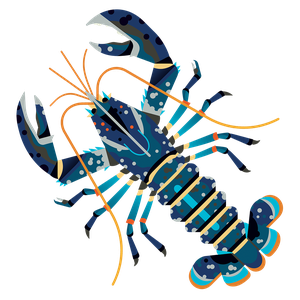
On Porcupine Bank, scampi, often referred to as Nephrops or Norway lobster, is data limited due to a lack of reference points for biomass. There is no concern for biomass but there is concern for fishing pressure. Some management measures are in place and landings are within recommended limits. However, there is no information about discarding, so total catches are unknown. In this area, trawling for Norway lobster affects vulnerable deep-sea habitats such as sea pens.
Rating last updated November 2025.
How we worked out this Rating
References
Aristegui, M., Ryan, G., Bentley, K., Sullivan, M., Murphy, N., Mascorda-Cabre, L., Gifford, A. and McCorriston, P., 2024. Porcupine Bank Nephrops Grounds (FU16) 2024 UWTV Survey Report and catch scenarios for 2025. Marine Institute UWTV Survey report. Available at: https://oar.marine.ie/bitstream/handle/10793/1992/Survey%20Report%20FU16%20UWTV%202024.pdf?sequence=5&isAllowed=y [Accessed on 28.11.2025].
CruCSChange, 2015. The crustacean chemosensory system: Consequences of climate and environmental change. EU Grant agreement ID: 331296. Available at https://cordis.europa.eu/article/id/182940-impact-of-environmental-change-on-norway-lobster [Accessed on 28.11.2025].
Ellis, J.R., McCully Phillips, S.R., and Poisson, F., 2017. A review of capture and post-release mortality of elasmobranchs. Journal of Fish Biology. 90: 3, pp.653–722. https://doi.org/10.1111/jfb.13197
EU, 2019. Regulation (EU) 2019/472 of the European Parliament and of the Council of 19 March 2019 establishing a multiannual plan for stocks fished in the Western Waters and adjacent waters, and for fisheries exploiting those stocks, amending Regulations (EU) 2016/1139 and (EU) 2018/973, and repealing Council Regulations (EC) No 811/2004, (EC) No 2166/2005, (EC) No 388/2006, (EC) No 509/2007 and (EC) No 1300/2008. Available at https://eur-lex.europa.eu/legal-content/en/TXT/?uri=CELEX:32019R0472 [Accessed on 28.11.2025].
ICES, 2022. Working Group for the Celtic Seas Ecoregion(WGCSE).ICES Scientific Reports. 4:45. 1413pp. Available at http://doi.org/10.17895/ices.pub.19863796 [Accessed on 25.01.2023].
ICES, 2024. Celtic Seas Ecoregion – Ecosystem overview. In Report of the ICES Advisory Committee, 2024. ICES Advice 2024, Section 7.1, Available at: https://doi.org/10.17895/ices.advice.25713033 [Accessed on 28.11.2025].
ICES, 2024. EU standing request on catch scenarios for zero TAC stocks 2024: cod (Gadus morhua) in divisions 7.e–k (eastern English Channel and southern Celtic Seas). In Report of the ICES Advisory Committee, 2024. ICES Advice 2024, sr.2024.18b, Available at: https://doi.org/10.17895/ices.advice.26763922 [Accessed on 28.11.2025].
ICES, 2025. Celtic Sea mixed fisheries considerations. In Report of the ICES Advisory Committee, 2025. ICES Advice 2025. Available at: https://doi.org/10.17895/ices.advice.30374749 [Accessed on 28.11.2025].
ICES, 2025. Norway lobster (Nephrops norvegicus) in divisions 7.b-c and 7.j-k, Functional Unit 16 (west and southwest of Ireland, Porcupine Bank). In Report of the ICES Advisory Committee, 2025. ICES Advice 2025, nep.fu.16. Available at: https://doi.org/10.17895/ices.advice.27202722 [Accessed on 28.11.2025].
JNCC, 2021. West of Walney MPA. Published 19.08.2021. Available at https://jncc.gov.uk/our-work/west-of-walney-mpa/ [Accessed on 28.11.2025].
Matear, L., Vina-Herbon, C., Woodcock, K.A., Duncombe-Smith, S.W., Smith, A.P., Schmitt, P., Kreutle, A., Marra, S., Curtis, E.J., and Baigent, H.N. 2023. Extent of Physical Disturbance to Benthic Habitats: Fisheries. In: OSPAR, 2023: The 2023 Quality Status Report for the Northeast Atlantic. OSPAR Commission, London. Available at https://oap.ospar.org/en/ospar-assessments/quality-status-reports/qsr-2023/indicator-assessments/phys-dist-habs-fisheries/ [Accessed on 26.11.2025].
Murray and Cowie, 2011. Plastic contamination in the decapod crustacean Nephrops norvegicus (Linnaeus, 1758). Marine Pollution Bulletin, 62: 6, pp.1207-1217. https://doi.org/10.1016/j.marpolbul.2011.03.032.
OSPAR. 2023. Sea Pen & Burrowing Megafauna. Available at https://www.ospar.org/work-areas/bdc/species-habitats/list-of-threatened-declining-species-habitats/habitats/sea-pen-burrowing-megafauna [Accessed on 26.11.2025].
Palomares, M.L.D. and Pauly, D. (Editors), 2025. SeaLifeBase. Nephrops norvegicus: Norway lobster. Available at https://www.sealifebase.ca/summary/Nephrops-norvegicus.html [Accessed on 26.11.2025].
Seafish, 2025. UK Nephrops Fisheries Improvement Action Plan. Available at: https://www.seafish.org/document/?id=36083 [Accessed on 26.11.2025].
Wood, H., Eriksson, S., Nordborg, M., and Styf, H., 2015. The effect of environmental stressors on the early development of the Norway lobster Nephrops norvegicus (L.). Journal of Experimental Marine Biology and Ecology. 473. pp. 35-42. http://dx.doi.org/10.1016%2Fj.jembe.2015.08.009.